A prominent example is the Joint Institute’s collaboration with the European Organization for Nuclear Research (CERN), which contributes to solving numerous theoretical and experimental challenges in high-energy physics. JINR participates in the Large Hadron Collider (LHC) project—developing and constructing individual systems for the ATLAS, CMS, and ALICE detectors as well as for the LHC machine itself. Based at its supercomputing center, the Institute is also involved in establishing the Russian Regional Data Processing Center for LHC experimental data, which is expected to become an integral part of the European Union’s “HEP EU-GRID” project. JINR maintains mutually beneficial contacts with the IAEA, UNESCO, the European Physical Society, the International Centre for Theoretical Physics in Trieste, and CLAF (Latin-American Centre for Physics).
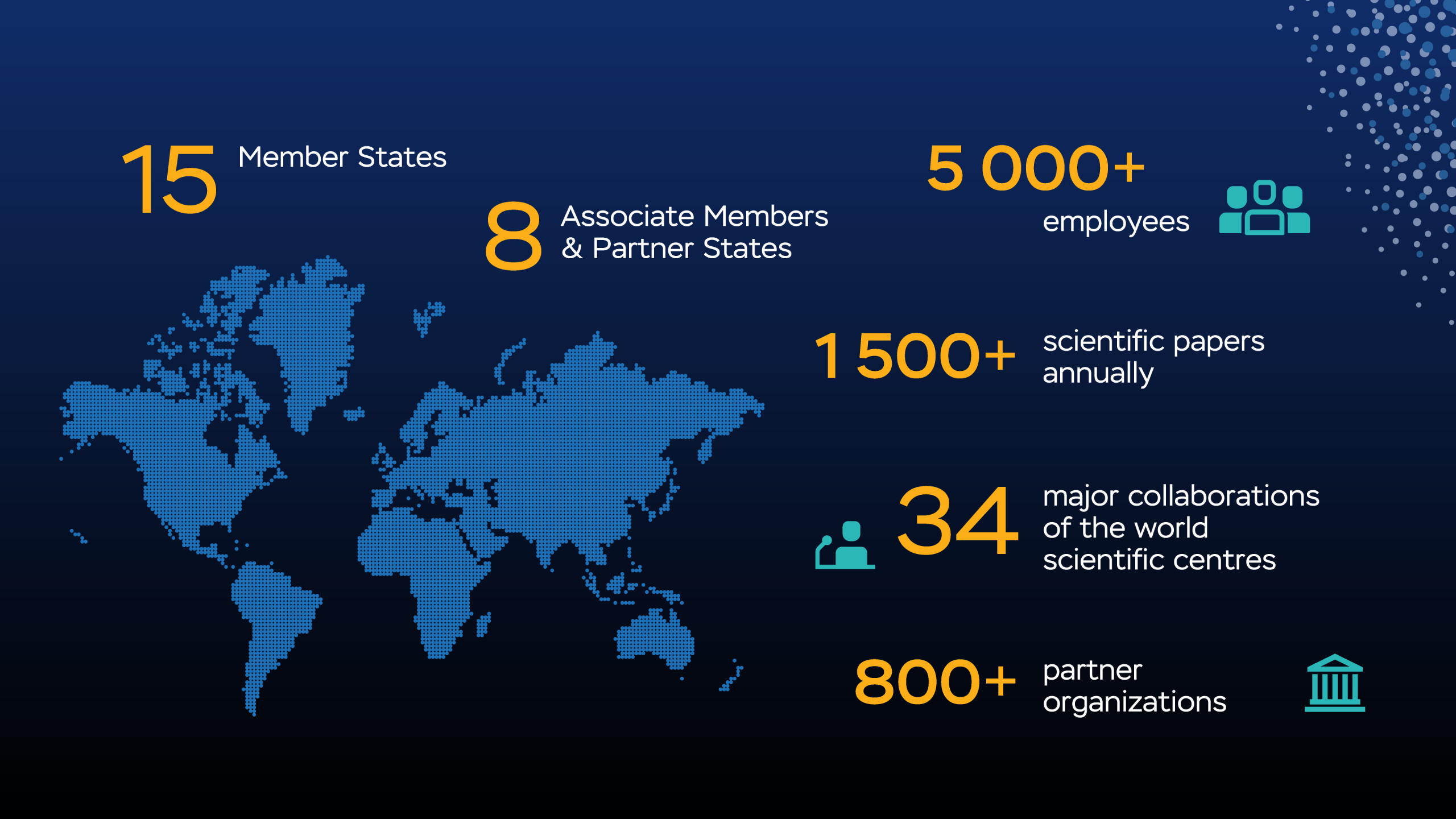
 JINR has bilateral agreements, protocols, and other documents on cooperation with more than 1000 institutions in 74 countries.
JINR has special agreements concluded with:
- Germany (BMBF) in the field of theoretical physics, heavy ion physics and condensed matter physics;
- CERN in the field of high energy physics;
- IN2P3 (France) in the field of nuclear and particle physics;
- C.E.A. (France) in the field of radionuclide metrology;
- INFN (Italy) in the field of nuclear and particle physics;
- Fermilab, BNL, LLNL and other research centres in USA;
- Hungary (KFKI) in the field of condensed matter physics.
JINR also cooperates with institutions and research centres in Russia:
- Russian Research Centre “Kurchatov Institute”, including IHEP (Protvino), PNPI (St. Petersburg Nuclear Physics Institute), ITEP (Institute for Theoretical and Experimental Physics).
- INP (Institute of Nuclear Physics, Moscow).
- BINP (Budker Institute of Nuclear Physics, Novosibirsk) and other research centres.
On 22 November 2021, at the session of the Committee of Plenipotentiary Representatives of the Governments of the JINR Member States held in Bulgaria, a Declaration was adopted to highlight the value of international scientific and technological integration in solving the tasks of strengthening peace, mutual understanding, and socio-economic progress of all the countries.