General information on collaboration
On 22 November 2021, at the session of the Committee of Plenipotentiaries of the Governments of the JINR Member States, members of the CP JINR unanimously voted for the change in the status of the Arab Republic of Egypt from an Associate Member to a full-fledged JINR Member State.
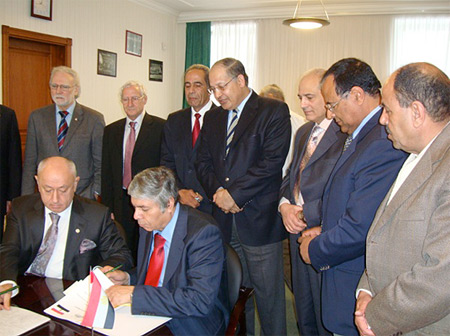
A new stage of cooperation between JINR and the Arab Republic of Egypt started on 3 March 2009 when the Agreement between the Joint Institute for Nuclear Research and the Ministry of Higher Education and Scientific Research of ARE was signed. Ties between JINR and national scientific centres of Egypt and Egyptian scientists, however, have existed for a very long time.
Scientific contacts between Egyptian physicists and their colleagues from Dubna were established at the end of 1960s – beginning of the 1970s, when Ahmed El-Nagy and Mohammed Sherif began to take part in research using photoemulsion techniques at the Laboratory of High Energies (group headed by K. Tolstoy). Cooperation with the Egyptian Atomic Energy Agency, the Cairo University, the Menoufia University, and the Tabbin Institute for Metallurgical Studies took place within the framework of agreements (protocols). In particular, these protocols set the requirements for exchange of scientists and scientific and technical information in accordance with which JINR granted scholarships to several Egyptian specialists. Over 15 specialists have become JINR fellows. Seven Egyptian specialists defended their theses at JINR.
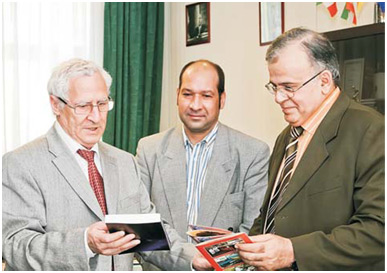
Majority of scientists collaborating with JINR work in Egyptian institutes using methods and techniques developed at JINR and visit Dubna when necessary. In 2010, Prof. Tarek Hussein and Prof. Hussein El Samman came to JINR for working trips. Tamer Abuelfadl visited FLNP, and Eman Hamza visited BLTP for implementation of joint research. Ali Khalil, Nasser Sweilam, Osama Fouad and Khaled Hegab visited JINR as experts for preparation to the 1st Joint Coordination Committee between JINR-ARE.
In 2011, in the framework of funded joint research projects approved by the 1st Joint Coordination Committee, JINR welcomed 17 visitors from ARE; on 1 January 2012, visitors from Egypt have stayed at JINR for 613 days. ARE has also hosted 6 visitors, and the total number of days spent in Egypt was 59. The Egyptian researcher Dr. Mohamed Abdelhady has also visited INFN (Gran Sasso, Bologna, Italy) for 7 days in the framework of a joint project. It should also be noted that 4 researchers from JINR participated in the 8th Conference on Nuclear and Particle Physics (NUPPAC’11) held in Hurghada, ARE, on 20–24 November 2011.
In 2010–2012, the Egyptian student Mahmoud Gaafar was awarded BLTP scholarship and worked at JINR. It further allowed him to become Master of Sciences in Egypt, publish 4 scientific papers and deliver reports at 3 international conferences including the International Conference «Mathematical Modeling and Computational Physics» in Stara Lesna, Slovakia, on 4–8 July 2011 and the International Superconductive Electronics Conference (ISEC 2011) in Hague, Holland, on 18–23 September 2011.
Every year since 2009, the Practice for Young Specialists from ARE has been held at JINR. During these schools the participants have lectures and practical training at JINR laboratories. The knowledge and experience gained at these schools allow their participants to continue their studies in Egypt and give them an opportunity to be involved in the JINR-ARE joint research projects.
Thus, fruitful scientific cooperation of Egyptian physicists with JINR scientists continues to be strengthened and extended. Due to this cooperation, new opportunities for development of direct contacts with the largest accelerating centers of the world are available to scientists from the Arab Republic of Egypt.
The most significant milestone in the relations between Egypt and JINR was the improvement of the status of the country up to the full Member State of the Institute. This decision was unanimously taken by the CP members at the visiting session of the Committee of Plenipotentiaries in Bulgaria on 22 November 2021.
Egyptian scientists take part in the research work on the following themes of the Topical plan for JINR research and international cooperation for the year 2025:
- Large JINR Research Infrastructure
Cooperation on 4 themes. - Theoretical Physics
Cooperation on 2 themes. - Elementary Particle Physics and High-Energy Heavy-Ion Physics
Cooperation on 2 themes. - Nuclear Physics
Cooperation on 1 theme. - Condensed Matter Physics
Cooperation on 1 theme. - Radiation Research in Life Sciences
Cooperation on 2 themes. - Information technology
Cooperation on 1 theme. - Organization of Scientific Activity and International Cooperation. Strengthening Human Resources. Educational Programme
Cooperation on 1 theme.
At present, JINR actively cooperates with the following organizations of the Arab Republic of Egypt:
- Egyptian Academy of Scientific Research and Technology
- Cairo University
- National Research Centre
- Mansoura University
- British University in Egypt
- Ain Shams University
- Menoufia University
- Zagazig University
- Egyptian Atomic Energy Authority
- Egyptian Centre of Theoretical Physics
- Alexandria University
- Regulatory Agency for Nuclear Activities
- Egyptian Petroleum Research Institution
- Egypt-Japan University of Science and Technology (E-JUST)
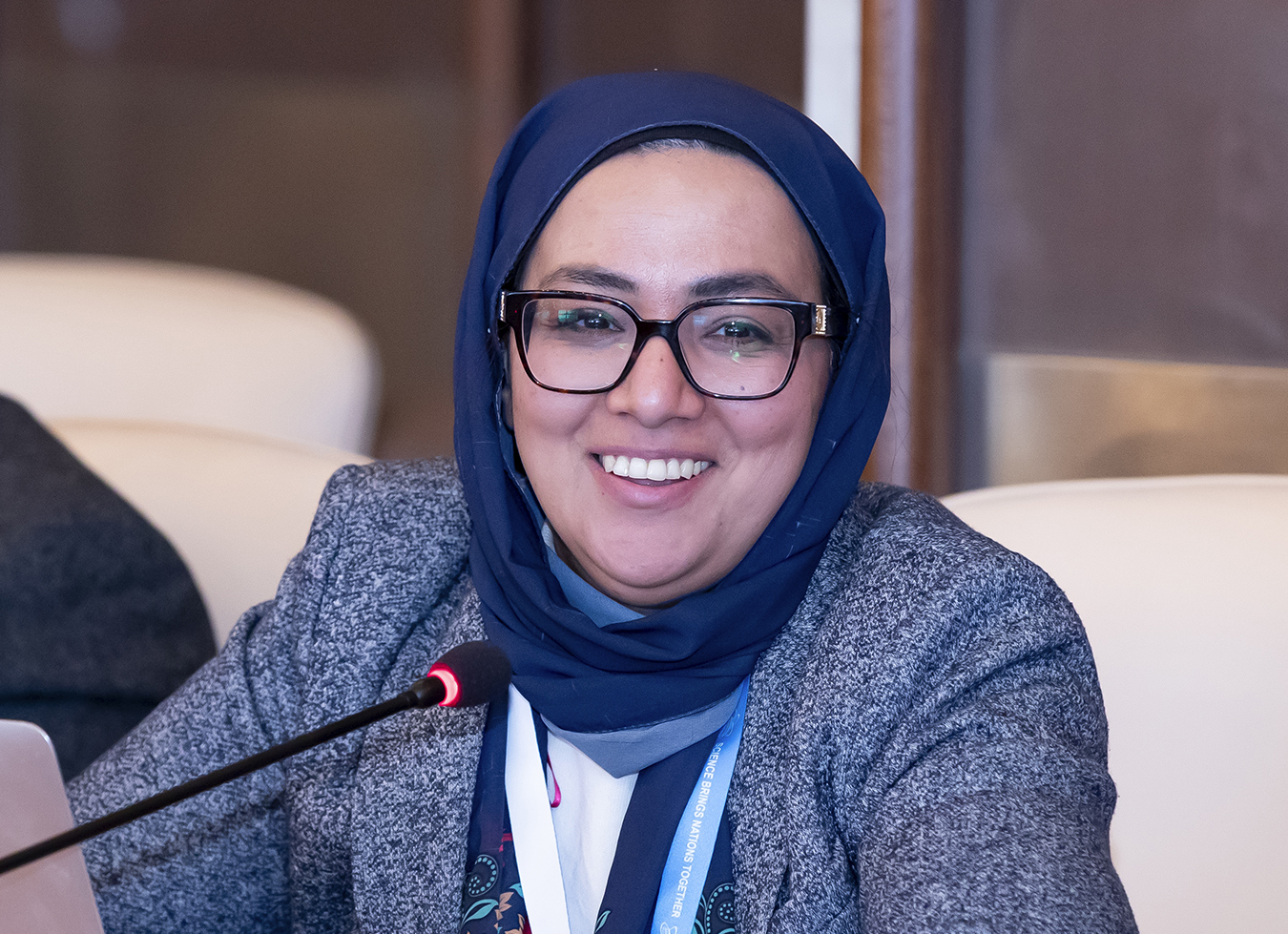
The Plenipotentiary representative of the government of the Arab Republic of Egypt in JINR from September 2024 to the present day is Gina El-Feky, Acting President of the Academy of Scientific Research and Technology of Egypt (ASRT).
Plenipotentiaries of the government of the Arab Republic of Egypt in JINR since 2021:
2021 – 2024
- Mahmoud Sakr, President of the Academy of Scientific Research and Technology of Egypt (ASRT).
2024 – present day
- Gina El-Feky, Acting President of the Academy of Scientific Research and Technology of Egypt (ASRT).
The member of the JINR Scientific Council on the part of Egypt is Amr El-hag Ali, Chairman of the Egyptian Atomic Energy Authority in Cairo.
The Representative of the Government of the Arab Republic of Egypt in JINR and Coordinator of the JINR-ARE Cooperation on the ARE side since August 2019 is Mahmoud Sakr (msakr@asrt.sci.eg), President of the Egyptian Academy of Scientific Research and Technology (ASRT).
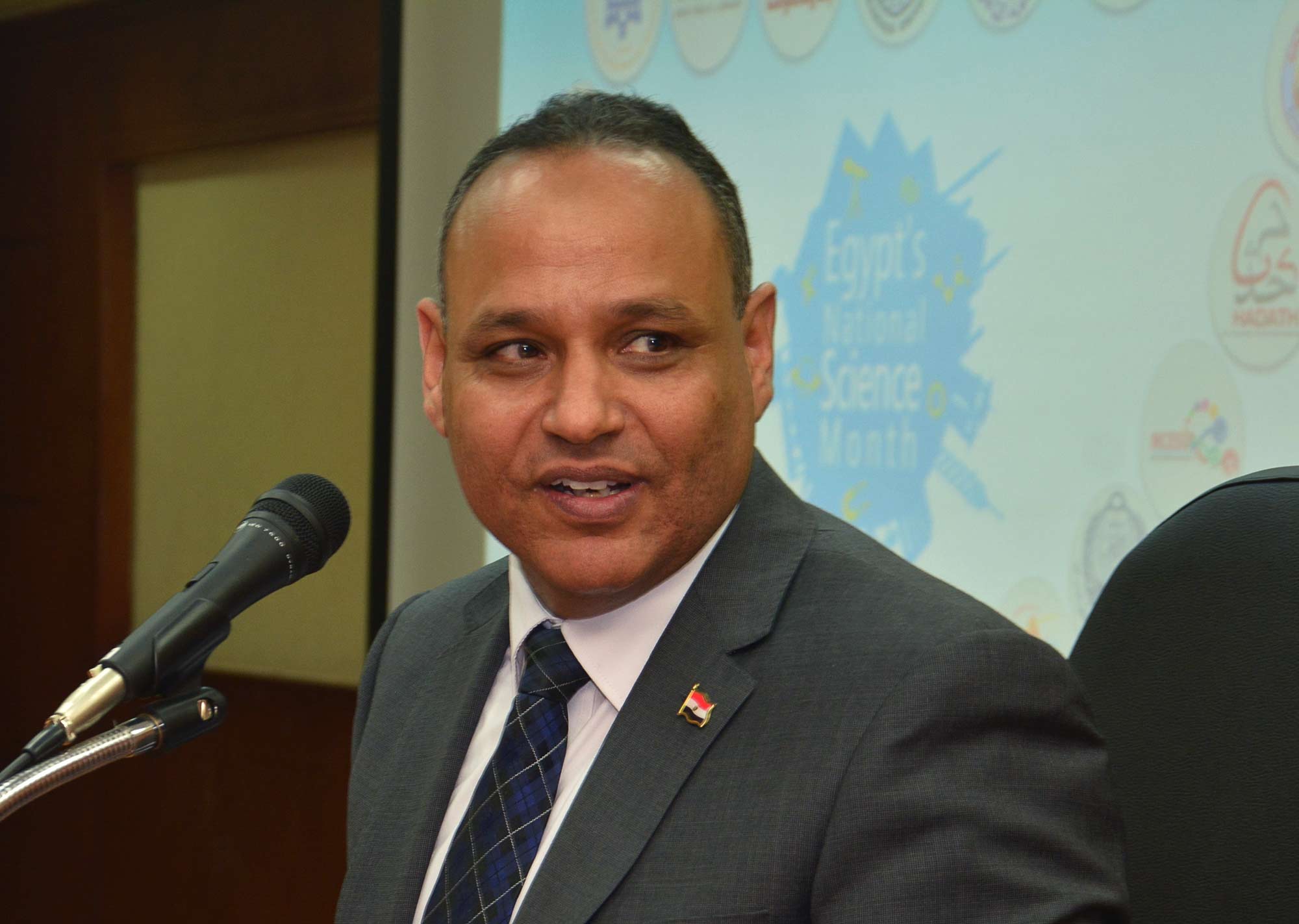
Representative of the Government of the Arab Republic of Egypt before 2019
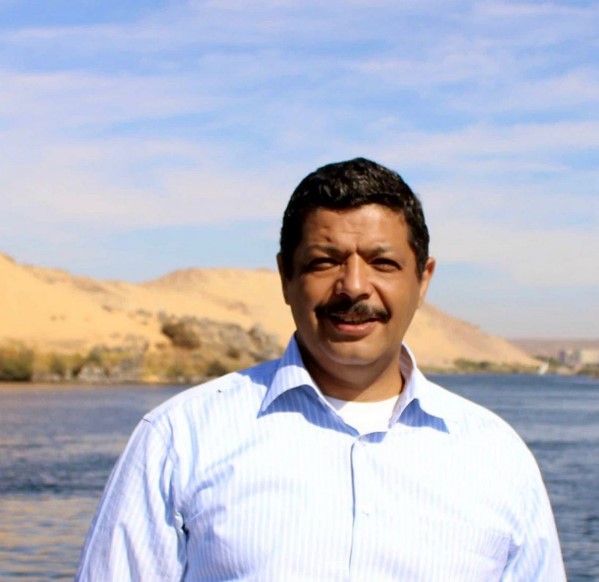
The Representative of the Government of the Arab Republic of Egypt in JINR from 2009 to 2019 was Professor Mohamed Tarek Hussein Zakaria, Advisor of the President, former President of the Egyptian Academy of Scientific Research and Technology.
Prof. Tarek Hussein, born on 22 April 1952, is a theoretical physicist whose research focuses on phenomenological models of hadronic interactions in particle physics and the clustering phenomena of particle production in hadron-nucleus and nucleus-nucleus interactions. In 2004–2007 he was the President of the Academy of Scientific Research and Technology in Egypt, Professor of Theoretical Physics and Vice Dean for Education at the Faculty of Science, Cairo University. Since 2006 he has also been the manager of Cairo University’s Center for Advanced Interdisciplinary Sciences. He is a Member of the Council of Atomic Energy Authority, Egypt.
Prof. T. Hussein received his B.Sc. and PhD in High Energy Particle Physics from Cairo University and has spent most of his career there. In 1995, he was awarded the Egyptian Prize in Physics and in 2000 he was awarded the Kingdom of Saudi Arabia Medal in Physics. In 2009 he received the annual Golden Academic Medal of the State University of Land Use Planning, Moscow, Russia.
Prof. T. Hussein coordinated the Egyptian National Committee on Synchrotron-light for Experimental Science and Applications in the Middle East (SESAME) in 2006. In 2010 he was elected Vice President of the Council on the SESAME project. He is also a member of the Egyptian Physics Society.
Tarek Hussein on cooperation with JINR:
Strong historical and scientific ties have been maintained between Egypt and JINR since the 1960s. This has been done through bilateral agreements with Cairo University, the Egyptian Atomic Energy Authority, the University of Menoufia, and the National Institute for Astronomical and Geophysical Research. It allowed an exchange of scientists and researchers and joint research for the benefit of both parties.
The Egyptian Academy of Scientific Research and Technology, as the coordinator of the research centers in Egypt, demonstrated its willingness to closer cooperation with JINR within the framework of a bilateral agreement on the governmental level, that will allow Egyptian scientific institutes to participate in JINR activities, to use its basic facilities and to participate in the committees of the basic areas of scientific interest to Egypt, as well as to participate in meetings of the Scientific Council of JINR and bilateral or multilateral research that is organized in the Russian and/or Egyptian research centers.
The Egyptian Academy of Scientific Research and Technology hopes that this cooperation will offer a good opportunity for training young Egyptian researchers in various fields in numerous disciplines developed at JINR, as well as in research applications of nuclear safety, radiation biology, and nanotechnology.
Egypt plans to develop cooperation with other Russian scientific and educational organizations, but the project with Dubna shows good promise to be the largest in Russia.
Coordinator of the JINR-ARE Cooperation on the ARE side before 2019
Professor Hussein El Samman (hsamman@aucegypt.edu) – Faculty of Sciences, Menoufia University, Shibin El-Koum and the American University in Cairo.
The languages of international communication at JINR are Russian and English. However, one can hear the speech in many languages in Dubna, including the languages of JINR Member States when the countrymen, the representatives of the same expatriates’ community (the national groups of JINR), meet each other. Over the years of existence of JINR the national groups have developed their traditions, forms of cooperation and collaboration with other national groups. Their leaders, appointed by the plenipotentiaries of the JINR Member States play an organizing role in the life of national groups.
Wael Mahmoud Badawy
Head of the national group, Senior Research Scientist of the Frank Laboratory of Neutron Physics
+7 (496) 216-24-36
email: wael@jinr.ru
Being in constant contact with plenipotentiaries, embassies of the Member States, the JINR Directorate and management services, they take part in the solution of the problems connected with the staying of their colleagues-countrymen and their families in Russia, with organization of their life and leisure. The Council of the leaders of the national groups has regular meetings. The representatives of the Directorate and the services of the Institute are invited to these meetings. The agenda includes discussion of urgent problems of the collaborators from the Member States. Due to this, the Directorate is able to make adequate decisions in time.
On the occasions of major public holidays of the Member States, the national groups arrange receptions. These festive events are held accompanied by art exhibitions, photo exhibitions, and enrich JINR staff members’ knowledge about the JINR Member States, their people and culture.
The main national holidays of the Arab Republic of Egypt include:
- Christmas – January 7;
- Revolution Day of 2011 – January 25;
- Sinai Liberation Day – April 25;
- Sham Ennessim (holiday marking the beginning of spring) – the date changes annually according to the Coptic calendar;
- Labour Day – May 1;
- Revolution Day of 2013 – June 30;
- Revolution Day of 1952 – July 23;
- Armed Forces Day – October 6;
- Eid al-Fitr (Uraza Bayram) – religious holiday celebrated by Muslims marking the end of the Ramadan;
- Eid al-Adha (Kurban-Bayram) – Islamic holiday aimed to celebrate the end of the annual Hajj to Mecca.
7–11 October 2024
JINR held the first programme “Introduction for the Plenipotentiaries’ Offices and Officials Responsible for Liaison with JINR”14–18 April 2024
The 30th International Seminar on Neutron-Nucleus Interaction (ISINN-30) took place in Sharm El Sheikh27–31 October 2023
JINR delegation visited the Arab Republic of Egypt and held meetings at key scientific centresSeptember 2023
An article on the extraction of terbium by Egyptian students and JINR staff was published in the journal Nanomaterials25–30 September 2023
The third Science School for students of the Children’s University of ASRT, Egypt, was held at JINR22 November 2021
Egypt became a full Member State of JINR| № | Project title | Executive person on behalf of Egypt | Laboratory, Executive person on behalf of JINR | Organization of Egypt |
|---|---|---|---|---|
| 1 | Study of spintronic effects in Josephson junctions with ferromagnet and antiferromagnet barriers | Sarvat Machmud al-Sherbini | BLTP, Yu. M. Shukrinov | Cairo University |
| 2 | Application of Nuclear and related analytical techniques to investigate the Egyptian archaeological materials | Medkhat Akhmed Ibrahim | FLNP, A. Yu. Dmitriev | National Research Centre |
| 3 | Natural Radioactivity Atlas and Radiological Maps for Strategic Regions in Egypt | Muhammad Salah | FLNP, A. Yu. Dmitriev | Mansoura University |
| 4 | Properties of heavy and super heavy elements studied by mass spectrometry and ISOL method | Salama Ahmed al-Sayed | FLNR, L. Crupa | British University in Egypt |
| 5 | Molecular Modeling and Experimental Neutron Scattering Studies of Interactions of the Condensed Matter and Biological (Lipid Membranes) Systems | Khana Guda Abd al-Wahhab al-Hayes | FLNP, Kh. T. Holmurodov | Ain Shams University |
| 6 | Assessment of ecological situation of different ecosystems by using neutron activation and related analytical techniques: an approach of baseline concentrations, pollution indicators, and health hazard | Hussein Mahmood El Samman | FLNP, W. Badawy | Menoufia University |
| 7 | Theoretical study of stability of super heavy nuclei | Wala Muhammad Seif | BLTP, N. V. Antonenko | Cairo University |
| 8 | Development of Water Purification Techniques Combining Nonthermal Plasma for Organic Micropollutants degradation and use of sorbents for heavy metals removal from water | Muhammad al-Shayer | FLNP, I. Zinkovskaya | Zagazig University |
| 9 | Nucleon-nucleus scattering and K-mesons at relativistic energy | Ali Eykhia al-Lisi | BLTP, V. K. Lukyanov | Cairo University |
| 10 | Development of high efficiency n/γ ray discrimination scintillation detectors using organic composite scintillators | Amer Mahmud Amer Hassan | DLNP, A. S. Zhemchugov | Egyptian Atomic Energy Authority |
- El Nagy Ahmed Ahmed – 1993, Doctor of Physical and Mathematical Sciences, LHE – “Interaction of π-mesons, protons, nuclei and neutrinos with photoemulsion nuclei at high energy”
- Al-Sayed Mohammed Abou El Azm Abdel Shakar – 1996, Candidate of Physical and Mathematical Sciences, FLNR – “Luminescence α Al₂O₃ stimulated by heavy ions with the energy ≥ 1 MeV/a.e.m.”
- Mohamed Nashat Mohamed Elshazly – 1999, Candidate of Physical and Mathematical Sciences, FLNR
- Arafat Mohamed Ahmed Adavy – 2002, Doctor of Physical and Mathematical Sciences, FLNR – “Radiation induced modifications of optical, electrical and mechanical properties of glasses, dielectrics and semiconductors”
- Hella H.M.E. – 2003, Candidate of Physical and Mathematical Sciences, LHE – “Experimental study of transmutation of some radioactive wastes using the relativistic proton beam”
- Abdel Ghani Fatah Hassan Elt-Sayed – 2004, Candidate of Physical and Mathematical Sciences, FLNR–FLNP – “Study of fusion reactions induced by ⁴,⁶He and ⁷Li ion beams”
- Ali Saied Ezz El Din Khalil – 2006, Candidate of Physical and Mathematical Sciences, FLNR – “Investigation of Sputtering of Solids Induced by Swift Heavy Ions”
Owing to the Agreement signed at the level of governments between the Arab Republic of Egypt and JINR, new opportunities to continue and develop the program of cooperation with Egypt within the framework of approved joint research projects arose. Such approach to the countries working within the framework of bilateral agreements proved to be quite good. The JINR-RSA cooperation may serve as an example in this context.
The Joint Coordination Committee was formed to solve current issues of the JINR-ARE cooperation and includes three permanent representatives from each side and experts nominated in specific tasks of the Committee.
From JINR:
- Prof. R. Lednický, Vice-Director,
- D. V. Kamanin, Head of the International Cooperation Department,
- S. Z. Pakuliak, Director of the JINR University Centre,
- O. Culicov, Deputy Director for Science, FLNP.
From ARE:
- Prof. Mahmoud Sakr, President of ASRT, Representative,
- Prof. Gina El-Feky, Coordinator,
- Prof. Tarek Hussein, Head of Nuclear Research Network,
- Prof. Atef Abdul Hamid, President of EAEA,
- Prof. Hussein El-Samman, Menoufia University,
- Prof. Sameh Sorour, Helwan University.