General information on collaboration
11 countries including GDR signed the agreement on foundation of the Joint Institute of Nuclear Research in Dubna on 26 March 1956.
By that time, strong cooperation had been established with GDR scientific centres. The Institute of High Energy Physics in Zeuthen, the Central Institute of Nuclear Research in Rossendorf, technical universities in Dresden and Magdeburg, the Central Research Institute of Radiation in Leipzig, and other GDR universities were the main partners at that time.
However, there were scientific intensive contacts with research institutions of the FRG, for example, with the Centre of Heavy Ion Physics in Darmstadt, the Max Plank Institutes, the Heidelberg University and other universities and research organisations.
GDR ended its membership in the Institute in August 1990. A bilateral agreement for cooperation and use of JINR facilities was concluded between the Joint Institute of Nuclear Research and the Federal Ministry of Education and Research (BMBF) of Germany authorized by the FRG Government to represent Germany’s interests at JINR.
Sessions of the Joint Coordinating Committee for the Agreement are held annually, at which attendees consider common projects within scientific programmes of the Institute, and their funding.
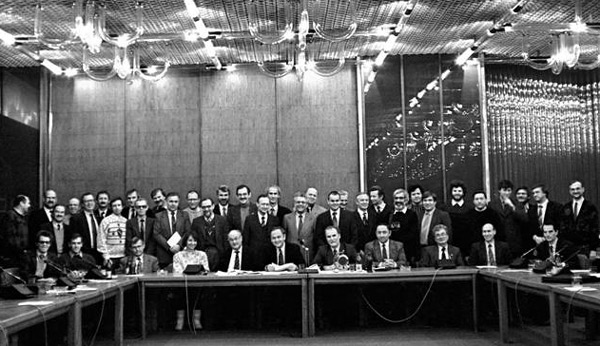
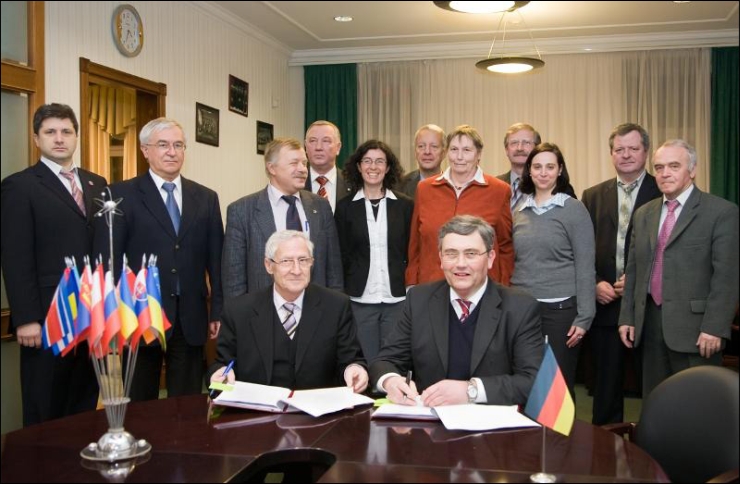
The cooperation was becoming intensive from year to year. Cooperation regarding new transfermium element synthesis with the Helmholtz Centre for Heavy Ion Research (GSI) in Darmstadt has been particularly fruitful. A cooperation protocol was signed between two groups working at large experimental facilities – the SHIP velocity filter (GSI) and the electrostatic separator VASILISA (Laboratory of Nuclear Reactions JINR). Different methods were used in experiments on synthesis and study of radioactive decay properties of new isotopes of heavy elements: at the SHIP separator – the method of “cold” fusion discovered in middle 1970s, and at the VASILISA separator the method of “hot” fusion was studied. Cooperation between radio-biologists from Dubna and Darmstadt has been ongoing since 1985. (https://www.gsi.de)
DESY became the main partner in terms of a number of cooperation projects among German national scientific centres in the 1990s. Business trips to DESY (Hamburg + Zeuthen) make more than a quarter of all business trips of JINR staff members to Germany. JINR performs collaborative experiments with the scientific centre “German Electronic Synchrotron” (DESY). The Dubna group significantly contributed to upgrade of the magnetic spectrometer and to analysis of experimental data over the years of participation in HERMES, an experiment aimed at studying the spin structure of the nucleon. JINR staff have also successfully participated in the H1 experiment. Establishment of two forward proton spectrometers, a proportional chamber for detection of electron and positron scattering, and a new PLUG-detector of the facility, was a substantial contribution of the JINR team to this experiment. JINR participation in DESY experiments is supported with grants of the German Federal Ministry of Education and Research. At present, JINR participates in large collaborative projects with DESY, namely HERA-B and HERMES. (https://www.desy.de)
The analysis of JINR cooperation with German scientific centres shows that more and more scientists from JINR participate in German projects these days. It is a mutually beneficial cooperation, and scientists from JINR and Germany are sure about its effectiveness. JINR takes an active part in projects undertaken at FAIR in GSI (Darmstadt), and in establishment of a powerful X-Ray free electron laser at DESY (Hamburg).
The German party is interested in using the IBR-2 neutron source. German scientists had done significant amount of work on reactor beams earlier. The EPSILON-SKAT diffractometer was reconstructed with BMBF funding, during a thorough upgrade of the IBR-2 reactor.
Cooperation in theoretical physics has been developing successfully in the frames of the Heisenberg-Landau programme which started in 1991. As a result of 600 supported projects, about 1500 joint articles have been published over the last 20 years.
The scientists of Germany take part in the research work on the following themes of the Topical plan for JINR research and international cooperation for the year 2025:
- Large JINR Research Infrastructure
Cooperation on 2 themes. - Theoretical Physics
Cooperation on 4 themes. - Elementary Particle Physics and High-Energy Heavy-Ion Physics
Cooperation on 7 themes. - Nuclear Physics
Cooperation on 3 themes. - Physics and Technology of Charged Particle Accelerators
Cooperation on 2 themes.
At present JINR collaborates with 64 scientific centres and universities from 45 cities of Germany in all scientific field of JINR activity.
The most active partners:
- Humboldt University in Berlin
- Bonn University
- DESY Hamburg
- Heidelberg University
- GSI Darmstadt
- Dortmund University
- Research Centre Dresden-Rossendorf
- Leipzig University
- Mainz University
- Technical Munich University
- Rostock University
- Tübingen University
- Frankfurt am Main University
- DESY Zeuthen
- Erlangen University
- Jülich Research Centre
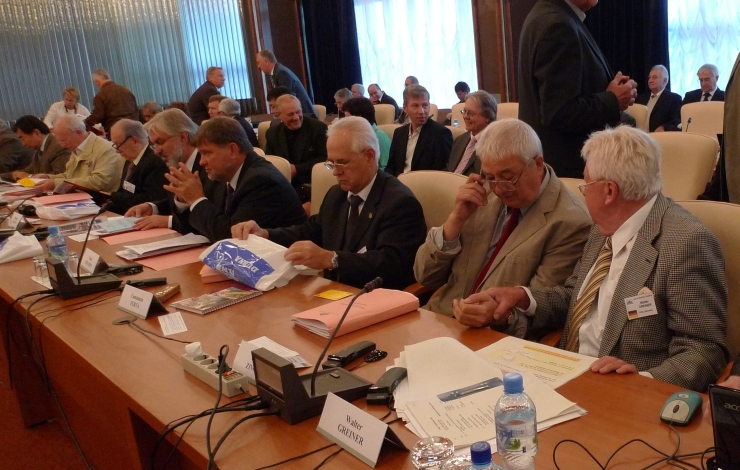 106th Session of the JINR Scientific Council, 23-24 September 2010
The languages of international communication at JINR are Russian and English. However, one can hear the speech in many languages in Dubna, including the languages of JINR Member States when the countrymen, the representatives of the same expatriates’ community (the national groups of JINR), meet each other.
Their leaders, appointed by the plenipotentiaries of the JINR Member States play an organizing role in the life of national groups. Being in constant contact with plenipotentiaries, embassies of the Member States, the JINR Directorate and management services, national groups take part in the solution of the problems connected with the staying of their colleagues-countrymen and their families in Russia, with the organization of their life and leisure. The Council of the leaders of the national groups has regular meetings. The representatives of the Directorate and the services of the Institute are invited to these meetings. The agenda includes discussion of urgent problems of the collaborators from the Member States. Due to this, the Directorate is able to make adequate decisions in time.
Currently 8 German staff members work at JINR laboratories.
RAS Academician
Boris Yu. Sharkov
Executive of the contacts with Germany, Special Representative of the Director of JINR for Cooperation with international and Russian scientific organizations
+7 (49621) 6-22-01
+7 (49621) 6-50-60
+7 (916) 203-00-30
e-mail: sharkov@jinr.ru
- New Year – 1 January
- Great Friday – Easter – 2 days. Easter is celebrated on the first Sunday after the spring full moon. The spring full moon is the first full moon after the day of vernal equinox
- Water Plunge Monday – Easter + 1 day
- Labour Day – 1 May
- The Ascension of Christ – Easter + 39 days
- Trinity Sunday – Easter + 50 days
- The Day of German Unity – 3 October
- First day of Christmas – 25 December
- Second day of Christmas – 26 December
26 March 2021
Ambassador Extraordinary and Plenipotentiary of the Federal Republic of Germany to the Russian Federation Géza Andreas von Geyr visited the Joint Institute for Nuclear Research15 September 2020
The Russian-German Year of Cooperation in Science and Education 2018-2020 was concluded. The event with the participation of G. V. Trubnikov, JINR First Vice-Director, was held in a hybrid format. JINR became an exhibitor at a virtual exhibition held in the frames of the Year’s closing ceremony1 July 2020
The 26th regular meeting of the Coordination Committee on the implementation of the Agreement between the German Federal Ministry of Education and Research (BMBF) and JINR was held25 June 2020
A JINR delegation took part in a regular meeting of the Mixed Russian-German commission on scientific and technical cooperation (MCSTC)6 February 2020
The regular «Helmholtz‑Wintergespräche» event took place in Moscow13 November 2019
Representatives of the Federal Ministry of Education and Research (BMBF) visited JINR12 November 2019
A meeting with a delegation from the Federal Ministry of Education and Research (BMBF) of the FRG took place in the Ministry of Science and Higher Education of the Russian Federation29 August 2019
A visit of a large delegation from the Federal Republic of Germany to the Joint Institute for Nuclear Research was held28 June 2019
A regular meeting of the mixed Russian-German commission on scientific and technical cooperation was held3 – 4 June 2019
High-school students from the John F. Kennedy School, Berlin, visited JINR11 December 2018
In the frames of a working visit of Federal Minister of Education and Research of Germany Anja Karliczek, a bilateral negotiation was held in the House of the Government of the Russian Federation25 September 2018
A Memorandum of mutual understanding between the Joint Institute for Nuclear Research and the Helmholtz-Zentrum Dresden-Rossendorf (HZDR) was signed in Dubna12 – 13 June 2018
The 16th traditional visit to JINR of students from the John F. Kennedy Berlin School took place1 September 2017
A festive ceremony of the inauguration of the world’s largest x-ray laser European XFEL is being held in Hamburg16 November 2016
In the Helmholtz Centre for Heavy Ion Research — GSI (Darmstadt, Germany) the Workshop “Perspectives for Joint Science and Academic Training at FAIR and NICA” was held28 October 2015
The press tour for journalists from England, Bosnia and Herzegovina, Germany, India, China, Serbia, Slovenia, Turkey, France and the Republic of South Africa was held in JINR14 May 2015
A Memorial Seminar of Prof. Anatoly N. Nikitin and Dr. Klaus Ullemeyer was held in FLNP25 February 2015
A Coordination Meeting on Implementation of the BMBF – JINR Agreement was held in Berlin7 August 2013
A delegation of the Helmholtz Association of German Research Centres headed by its President Professor Jürgen Mlynek came to JINR28 February 2013
The 23rd regular meeting of the Coordinating Committee on the implementation of the Agreement on cooperation between the German Federal Ministry of Education and Research (BMBF) and JINR was held at DESY in Hamburg29–31 August 2012
A delegation from the German Federal Ministry of Education and Research (BMBF), headed by Director General for the BMBF Department “Large Research Infrastructures, Energy and Basic Research”, Chairman of the European Strategy Forum on Research Infrastructures (ESFRI) Dr. Beatrix Vierkorn-Rudolf visited the Joint Institute for Nuclear Research23–24 February 2012
The 22nd regular meeting of the Coordinating Committee on the implementation of the Agreement on cooperation between the German Federal Ministry of Education and Research (BMBF) and JINR was held at JINR8–9 December 2011
In the frames of the Russian-German year of science a workshop “Astroparticle Physics. Perspectives in Russia and Germany” is being held at the JINR International Conference Hall20 June 2011
Ambassador Extraordinary and Plenipotentiary of Germany to RF Mr. Ulrich Brandenburg, accompanied by a member of the Embassy Department of Science and Education Mr. Irek Suleimanov, visited JINR24 May 2011
ESFRI Chairman – Assistant to BMBF Director General Dr. Beatrix Vierkorn-Rudolf visited the Joint Institute for Nuclear Research. A discussion of perspectives of cooperation with ESFRI was held at the JINR Directorate.7–8 February 2011
The 21st meeting of the Coordinating Committee was held in the GSI Helmholtz Centre for Heavy Ion Research, Darmstadt; a JINR delegation headed by JINR Acting Director M.G. Itkis attended the meeting22–23 February 2010
The 20th regular meeting of the Coordinating Committee on the implementation of the Agreement on cooperation between the German Federal Ministry of Education and Research (BMBF) and JINR was held at JINR9 December 2010
A meeting of the Steering Committee of Heisenberg-Landau Program, considering the results of 2010 and new applications for 2011, was held in Bonn12 January 2010
Dr. J. Achterberg – Head of the German Research Foundation (DFG) Representative Body in RF and G.N. Melnikova – member of DFG Representative Body – visited JINR