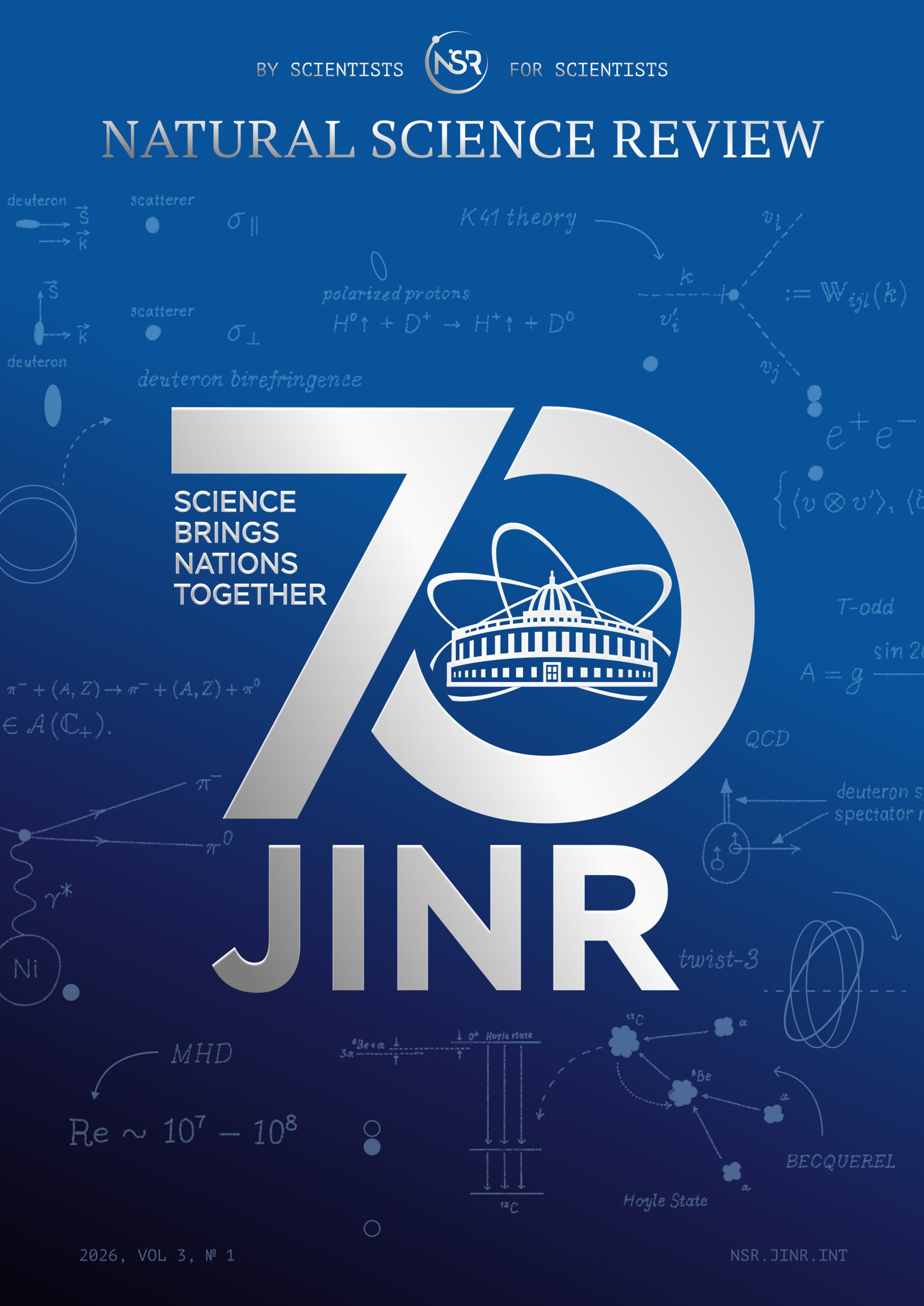
The sixth issue of Natural Science Review, an international online journal published by the Joint Institute for Nuclear Research, features articles on high-energy, particle, condensed matter, mathematical, accelerator, and nuclear physics, as well as a study in environmental sciences. Some of the papers will be included in a collection marking the 70th JINR anniversary.
“A research synthesis on heavy metals as emerging atmospheric pollutants: a systematic review and bibliometric analysis (1973-2024)” by Weerachon Sawangproh, Chetsada Phaenark, and Arika Bridhikitti (Mahidol University) is dedicated to the results of five decades of research (1973–2024) on heavy metal emission sources, transport mechanisms, deposition pathways, and monitoring methods. Supplemented by a bibliometric analysis of 1642 articles, it addresses advances in analytical methods and biomonitoring, including atomic absorption spectroscopy, inductively coupled plasma mass spectrometry, and X-ray fluorescence analysis, as well as the challenges of carrying out long-term projects in this field. The study demonstrates that the development of these methods, combined with the use of mosses as bioindicators, has significantly improved the sensitivity of heavy metal detection.
An article by Andrej Arbuzov, Lidia Kalinovskaya, Alexander Olshevsky, and Vitaly Yermolchyk, “ZFITTER: theoretical calculations and precision tests of the Standard Model”, describes the key features of the ZFITTER computer code in the context of high-precision tests of the Standard Model using data from the LEP Collider (1989–2000). In addition, the work analyses the programme’s features that made it a standard tool for the theoretical interpretation of observations in the phenomenology of electroweak interactions. Perspectives for using the software code at future electron-positron colliders are discussed, and the potential for incorporating higher-order radiative corrections to achieve greater accuracy is demonstrated.
In a review by JINR researchers Alexey Guskov, Andrey Maltsev, and Alexander Olshevsky, entitled “Study of low-energy QCD in meson reactions with the Coulomb field of atomic nuclei”, details the stages of development of theoretical and experimental studies of low-energy QCD parameters, from early works of the Laboratory of Theoretical Physics at JINR to modern measurements at CERN. Pioneering theoretical approaches proposed at JINR for calculating meson parameters in various hadronic models are discussed. These methods are shown to have formed the basis for experiments studying pion polarisability in radiation scattering reactions. Plans are outlined for future studies of the the AMBER Experiment, aimed at precision measurements of kaon polarisability and associated low-energy strong interaction constants.
“Optical transmittance of silica aerogel” by Argine Hakobyan, Artak Mkrtchyan, and Diana Khurshudyan reviews the results of studies of aerogel Cherenkov radiation detectors and the optical characteristics of aerogel samples as part of the SPD Experiment at the NICA Accelerator Complex launched at JINR. To assess the reliability and accuracy of the measurements, the data obtained is compared with similar studies conducted at other international research centres.
The article “The 8Be nucleus and the Hoyle state in dissociation of relativistic nuclei” by Andrei Zaitsev, Denis Artemenkov, and Pavel Zarubin discusses results of the BECQUEREL Experiment conducted at the Laboratory of High Energy Physics at JINR. The authors provide an overview of experiments using nuclear emulsion to study rare and unstable states of atomic nuclei, which manifest as clusters of alpha particles and protons. During the experiment, beams of relativistic nuclei (with energies ranging from hundreds of MeV to hundreds of GeV per nucleon) are passed through thin layers of photoemulsion, leaving three-dimensional tracks of all charged particles formed during nuclear dissociation. High resolution of such an “image” allows measuring the fragments’ flight angles and thus identifying decays of short-lived nuclei, such as 8Be and the Hoyle state (an excited state of the carbon-12 nucleus, which plays a key role in stellar nucleosynthesis). The work presents the results of nuclear clustering experiments revealing a strong correlation between the multiplicity of alpha particles and the formation of the 8Be(0+), 9Be(0+) and 12C(0+) isotopes. According to the authors, the development of automated image processing systems could significantly expand the capabilities of the photographic method in the study of nuclear structure, in low-energy nuclear physics, and in applied problems.
Another work featured in the issue is a review article by Michal Hnatic, Tomáš Lučivjanský, Lukáš Mižišin, Iurii Molotkov, and Andrei Ovsiannikov entitled “Statistical field theory of forced magnetohydrodynamic turbulence”. It focuses on the most notable results obtained over the past forty years, from the application of the statistical field theory approach to the problem of fully developed turbulence in non-relativistic three-dimensional magnetohydrodynamics. Based on the example of a stationary, locally homogeneous stochastic model of fully developed three-dimensional magnetohydrodynamic turbulence, the paper illustrates the application of the mathematical apparatus of statistical physics and quantum field theory, including the theory of ultraviolet renormalisation, diagrammatic expansions in a phase with spontaneous breaking of continuous symmetry, and the perturbative renormalisation group method. These advanced methods enable the effective study of various universal regimes of magnetohydrodynamic turbulence, characterised by corresponding fixed points of the renormalisation group flow, the derivation of experimentally measurable critical scaling parameters for them, etc. The theoretical concept outlined in this paper gives a general description of the behaviour of a fully developed turbulent state in an arbitrary magnetohydrodynamic medium, focusing mainly on a variety of astrophysical applications, including, for example, elucidating the nature of solar and planetary magnetism (geo and solar dynamos), as well as conducting laboratory experiments to study the dynamo effect in turbulent flows of liquid metals (e. g. sodium and gallium).
In “Computational schemes based on the continuous analogue of Newton’s method in the numerical study of complex physical systems at JINR” by Elena Zemlyanaya and Ochbadrakh Chuluunbaatar, an overview is provided of the history of the development and application of iterative methods based on the continuous analogue of Newton’s method (CAMN) at JINR, including recent results of research into a number of complex physical systems using CAMN. By ensuring the rapid convergence of the classical Newton method, the CANM allows creating modified schemes with an extended convergence region that consider the specific features of particular problems. This makes the CANM a flexible computational technology, in high demand for solving various types of nonlinear problems arising in the study of complex systems in nonlinear wave theory, quantum mechanics, nuclear and atomic physics, and other fields.
“Spin phenomena in quantum chromodynamics” by Oleg Teryaev details the general aspects of the theory of spin effects in QCD and its development at the Laboratory of Theoretical Physics at JINR, including the author’s personal experience of collaboration with Anatoly Vasilyevich Efremov (1933–2021). The article outlines the main milestones in the development of spin physics in Dubna and discusses aspects of research into T-odd fragmentation functions. The author compares polarisation effects in hadron and heavy-ion collisions and examines the evolution of views on the role of the axial anomaly in the study of particle polarisation and their interactions. The integration of heavy-ion physics and spin physics is expected to provide answers to important fundamental questions in quantum chromodynamics.
A review by Vladimir Baryshevsky, “High-energy nuclear optics of polarised nucleons and nuclei: research at the Nuclotron-M/NICA Complex”, discusses the phenomena arising when polarised particles (neutrons, protons, antiprotons, nuclei, γ-quanta) pass through matter. These phenomena are analogous to effects known in the optics of anisotropic media: double refraction, dichroism, and rotation of the polarisation plane (spin). These effects can be studied across various energy ranges, including those accessible at the NICA Complex. The quasi-optical coherent phenomena of spin rotation and dichroism are caused not only by strong interactions, but also by interactions of different parity. The work discusses in detail possible experiments at the NICA Complex for the detection and measurement of the magnitude of nuclear optical phenomena in the high-energy region, the measurement of the spin components of forward elastic scattering amplitudes, the study of the influence of quasi-optical phenomena on the production of vector mesons in nuclei, etc.
An accelerator physics review article “Synchrophasotron and Nuclotron equipment for investigation of polarisation phenomena” by a team of authors – Victor Fimushkin, Nikolay Piskunov, Evgeny Strokovsky, Vladimir Ladygin, Yuri Filatov and Evgeny Syresin – describes the development of the unique cryogenic source of polarised deuterons, POLARIS, and the polarimetry of nucleon and deuteron beams. The article covers issues relating to the development of spin physics instruments, reviews the key results of this work, the progress of the polarised particle source, and the prospects for conducting polarisation experiments at the NICA Accelerator Complex. The authors emphasise that the data obtained during research at the JINR accelerator complex had a significant impact on the understanding of the deuteron structure and nuclear interactions, leading to experiments on measuring the form factors of nucleons and the spin structure of three-nucleon systems.
Articles for the seventh issue of Natural Science Review (April-June 2026) are now being accepted. Authors are invited to submit articles and reviews for a special collection marking the 70th JINR anniversary, which will be published in issues throughout 2026.