Run 1 at the NICA Accelerator Complex is coming to an end at the Laboratory of High Energy Physics at JINR. Between March 2025 and April 2026, VBLHEP specialists commissioned key systems, implemented a fundamental research programme, and conducted a wide range of applied studies in radiation biology, medicine, and materials science.
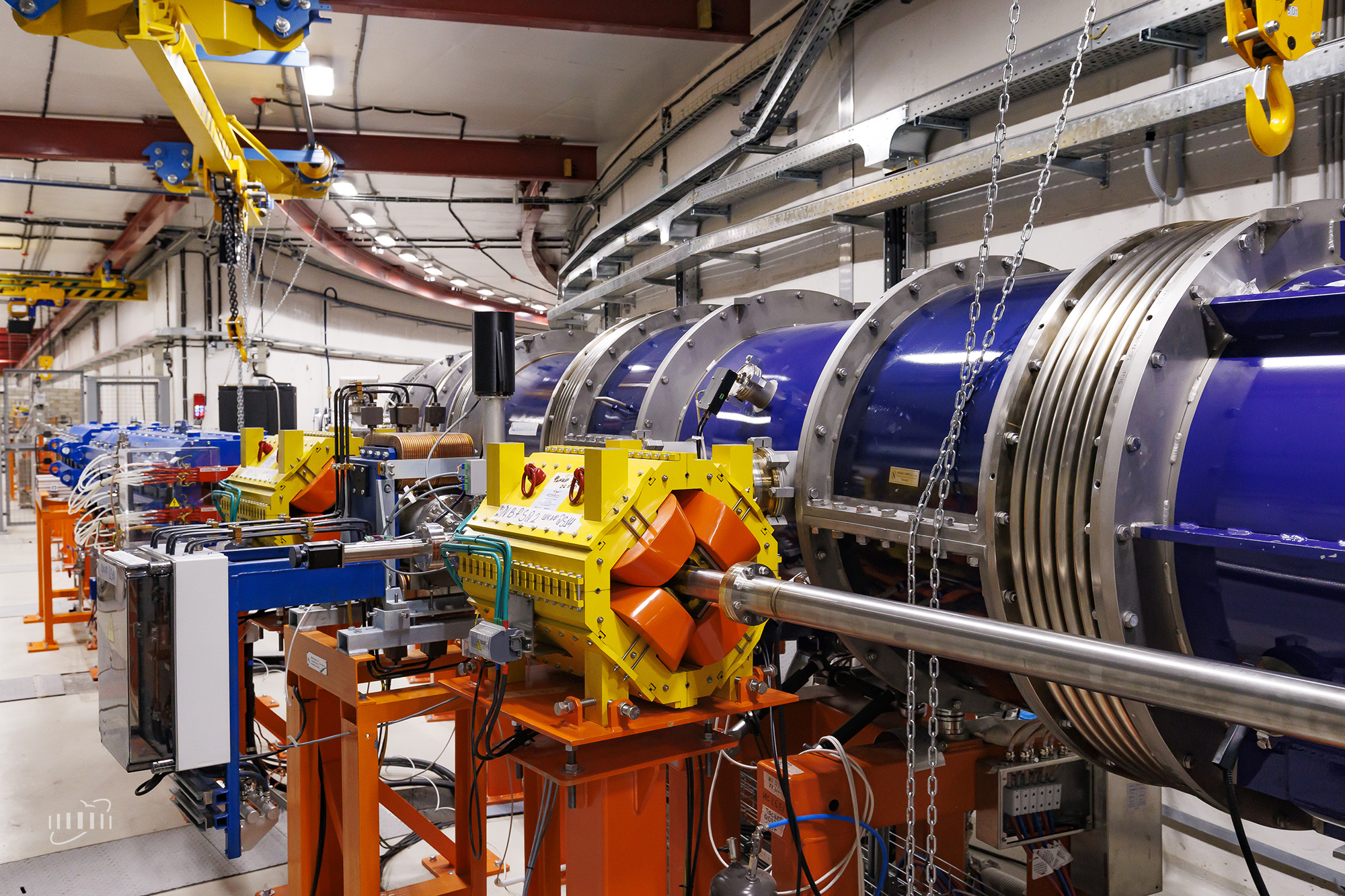
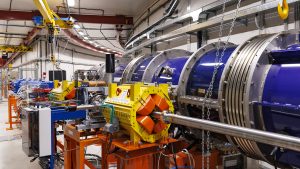
One of the main technological results of the session was the launch of the NICA cryogenic support system at its design capacity. This allowed simultaneous cooling of all key elements of the complex – the Booster, the Nuclotron, the Collider and the superconducting solenoid of the Multi-Purpose Detector (MPD). During the session, it became possible to achieve the design value of MPD’s magnetic field – 0.57 Tl. In addition, beams successfully formed in the Collider rings under a 0.86 T magnetic field.
A significant step forward was made after the modernisation of NICA’s Injection Complex. Due to the optimisation of the operating modes of the KRION-6T Ion Source and the LUTI Heavy Ion Linear Accelerator, as well as the high efficiency of the electronic cooling system, the beam intensity in the Booster was increased by 7 times with 10-fold injection from LUTI. VBLHEP specialists debugged the synchronisation system of the injection complex, ensured stable beam transfer from the Booster to the Nuclotron, and put into operation a system for rapid beam output to the Collider.
An important result of Run 1 was the provision of long-term circulation of beams of xenon nuclei with an energy of 1.76 GeV/nucleon and a lifetime of about 1 hour in each of the Collider rings. At the final stage, circulation of counter-rotating beams in the Collider was achieved, in which the same frequency of circulation of clumps of particles and synchronisation of their passage at the meeting point in the area of the MPD Detector location were ensured in each of the rings. The collider circulating counter-rotating beam indicates the correct and synchronous operation of the most intricate engineering systems of the entire complex.
From 12 February to 4 April 2026, during Run 1, the second physical cycle of the BM@N Experiment (Baryonic Matter at Nuclotron) took place at the NICA Accelerator Complex. Participants of the international BM@N Collaboration produced a data set based on three beam energy values: 1.6, 2.2, and 3 GeV/nucleon. In total, 2.75 billion events were recorded by the detector subsystems of the experimental facility. Compared to the previous cycle in 2023, the volume of collected statistics increased fivefold, primarily due to the commissioning of a new compressor station, which made it possible to extend the pulse of the extracted beam, as well as to increase the overall efficiency of the accelerator complex. The resulting data set is an unprecedented amount of material for subsequent analysis and further implementation of the BM@N physics programme.
In March 2026, the diagnostic equipment of SIMBO (Station for Investigation of Medical Biological Objects) and ISCRA (Irradiation Station of Components of Radioelectronic Apparatus) was tested for the first time on beams of xenon nuclei by the ARIADNA (Applied Research Infrastructure for Advanced Developments at NICA fAcility) Collaboration that completed an extensive programme of applied research. Scientists irradiated biological objects, a head phantom (an anatomically accurate model), samples of high-temperature superconductors, cobalt-based magnetic materials, photoemulsions, microcircuits, and other microelectronics products. These works covered the tasks of radiation biology, medical research, materials science and microelectronics. The programme was implemented with the participation of specialists from VBLHEP, LRB, DLNP, and FLNR at JINR, as well as the Skobeltsyn Institute of Nuclear Physics of Moscow State University, MEPhI University, Belgorod State University, and other external organizations. As a continuation of these works, a session is planned in the second half of April at the SOChI (Station Of Chip Irradiation) designed for research and testing of semiconductor micro and nanoelectronics products based on ion beams derived from the LUTI Linear Accelerator.
Achieving the operating parameters of the accelerator complex’s key engineering systems, forming counter-rotating beams in the Collider, obtaining a record amount of data in the BM@N Experiment, and implementing a broad programme of applied research create a reliable basis for the next runs and further development of NICA as JINR’s international research infrastructure.
In the next beam session, which is scheduled to begin in the fall of 2026, the NICA Collider should ensure collisions of xenon nuclei with energy in the centre of mass system of 4-7 GeV. Before starting, the MPD Detector must be installed in the operating position to register colliding beam events. During this session, it is planned to conduct the third cycle of the BM@N Experiment and continue applied research as part of the ARIADNA programme.