General information on collaboration
Romania was one of the founder states of the Joint Institute for Nuclear Research (JINR) since 26 March 1956.
Romania is one of the important JINR Member States in the amount of participation in the JINR activities, joint research, and scientific and technological relations. The basis of the Romanian participation to the Joint Institute for Nuclear Research was laid down by the famous Romanian scientist, Academician Horia Hulubei. During the first decades of the JINR, outstanding contributions to the JINR activity were brought by the Romanian scientists, Academicians Șerban Țițeica, Ioan Ursu, and Aureliu Săndulescu, Professor Alexandru Mihul.
Romanian physicists actively participated in scientific research of the Institute. Well known Romanian scientists contributed to the management of the Institute and of its laboratories:
JINR Vice Directors:
- Șerban Țițeica – 1962–1964
- Alexandru Mihul — 1970–1973
- Aureliu Săndulescu — 1983–1986
- LHE Deputy Director Ovidiu Balea — 1975–1978
- FLNR Deputy Director Aureliu Sandulescu — 1974–1977
- FLNP Deputy Director Nicolae Popa — 2002–2006
- LIT Deputy Director Gheorghe Adam — 2003–2009
- LIT Deputy Director Sanda Adam — 2009–2013
- LIT Deputy Director Gheorghe Adam — 2013–2018
- FLNP Deputy Director Otilia Culicov — 2013–till now
In recognition of the merits of the Romanian scientists to the JINR development, on the occasion of the 40th Anniversary of the Joint Institute, the Committee of the Member States Plenipotentiary Representatives decided on 25 March 1996 to name alleys on the Institute laboratory grounds in honour of the eminent scientists Horia Hulubei and Șerban Țițeica.
While often expressing specific positions on JINR practical matters, Romania has always recognized the JINR importance for the development of its national centres, for the development of the mutual collaboration.
The two-sided JINR–Romania cooperation reflects the general fact that many scientific problems dealt with at JINR are being solved in close cooperation with research centres of JINR Member States and, vice versa, many problems tackled in the JINR Member States are being solved with assistance of the Joint Institute for Nuclear Research. Concerning the past, we can emphasize the high interest of the Romanian scientists for heavy-ion physics in the seventies-eighties of the past century. Romania actively took part in the buildup of the FLNR cyclotron complex. In particular, in Romania, there was made the transportation system with extracted beams of the U-400 accelerator. Magnetic elements of beam transportation lines for all FLNR accelerators and experimental set-ups were manufactured in Romania. Romanian physicists are actively involved in experiments, processing and interpretation of results on the nuclear structure and mechanisms of reactions.
The round-table “Romania at JINR”, held as a part of the Scientific JINR Council in June 2003, was done with the participation of a representative delegation from all large Romanian cities involved in cooperation with JINR.
The birthday centenary of the outstanding Romanian scientist Șerban Țițeica, included in the UNESCO recommendations for 2008, was celebrated in JINR with attendance of H.E. Constantin Mihail Grigorie, Ambassador Extraordinary and Plenipotentiary of Romania to the Russian Federation.
At the end of the November 2010 Session of the Committee of the Plenipotentiary Representatives at JINR, the National day of Romania was celebrated with the attendance of the Romanian Ambassador and the Plenipotentiary Representative of the Romanian Government at JINR. For the first time, a week of the Romanian cinema was organized in Dubna by the Romanian Institute of Culture.
Three Joint JINR-Romania seminar-schools on neutron physics for investigations of nuclei, condensed matter and life sciences were organized in 2002, 2007 and 2011 by JINR in collaboration with Romanian scientific and high education institutions under the auspices and financial support of Plenipotentiary of Romanian Government at JINR and Romanian Ministry of Education and Science. The Romanian students and young researchers had the opportunity to listen to lectures given by leading scientists of the Frank Laboratory of Neutron Physics and outstanding Romanian Professors and Academicians.
Specific items concerning the cooperation are defined in two-sided protocols for joint research.
The two joint programmes (Țițeica-Markov in theoretical physics and Hulubei-Meshcheryakov in information technologies and computational physics) and the about 100 periodically renewed protocols signed with all the JINR laboratories and the JINR University Center are the compulsory basis for the approval of the grant and project proposals of the Plenipotentiary Representative of the Romanian Government at JINR. Through this mechanism, all the significant Romanian centers are involved in the cooperation with the JINR.
The backbone of the cooperation is secured by the long-term hired Romanian scientists in JINR. During the last decade, their number was maintained at a level of about 20 people, both experienced and young. JINR is a very good place for starting scientific careers. Successful recent instances of young Romanian scientists who have started working in JINR and acquired master and/or PhD : Dr.titles: Eugen Anitas (Head of Sector in BLTP since 2014), Dr Inga Zinicovscaia (Head of Sector in FLNP since 2019), Dr Raul Erhan (formerly senior researcher in FLNP, now postdoc fellow in IET, Kjeller, Norway), Dr Mihaela Paraipan (Senior researcher in VBLHEP), Dr Horia Pasca (formerly at BLTP – Nuclear Physics, now Lecturer at Babes-Bolyai Univ., Romania), Dr Iulia Harca (formerly at FLNR – Synthesis of Super heavy elements, now at IFIN-HH, Romania), Dr Cristina Oancea (DLNP – Proton therapy), Ioana Caracas (formerly at DLNP, continues now her doctoral studies at Univ. Wuppertal, Germany).
Specialists from Romanian institutes come on short-term visits to the JINR laboratories for carrying out joint research and participation in international conferences, and JINR scientists regularly go to Romania for joint scientific activities, to international conferences and schools. It should be emphasized the significant contribution of LIT-JINR scientists and specialists to the development of the WLCG Grid infrastructure in Romania. Both the LIT and Romanian scientists actively contribute to the periodic Grid Conferences organized in JINR and Romania.
Romania is a hospitable host of JINR scientists participating in traditional schools and international conferences. Since its first 1964 edition, the “Carpathian Summer School of Physics” has regularly had keynote speakers coming from JINR. At its 27th edition in June-July 2016, a special round table was devoted to the 60th JINR Anniversary.
A traditional form of involvement of JINR in the growth of young Romanian scientists is their participation in educational programs at JINR. Since the seventies of the past century, groups of senior Romanian students regularly do their summer practice at JINR laboratories. During the last years, their number has significantly grown up, reaching 20 students in the last three years. There is a vivid interest of the Romanian young people in the important form of new cooperation, defined within the JINR Summer Student Program. Romanian students and young scientists are regularly attending the annual JINR International Scientific Conference of the Young Scientists and Specialists and their presentations are highly appreciated during the competition associated to this event.
The scientists of Romania take part in the research work on the following themes of the Topical plan for JINR research and international cooperation for the year 2025:
- Theoretical Physics
Cooperation on 2 themes. - Elementary Particle Physics and High-Energy Heavy-Ion Physics
Cooperation on 5 themes. - Nuclear physics
Cooperation on 2 themes.
Scientific and technical cooperation
There are currently 34 Romanian institutes and universities doing research in collaboration with JINR. The most active partners:
- Horia Hulubei National Institute for R&D in Physics and Nuclear Engineering – IFIN-HH (Bucharest) (19 themes)
- University of Bucharest – UB (Bucharest) (9 themes)
- National Institute for Research and Development in Electrical Engineering (INCDIE ICPE-CA) (Bucharest) (6 themes)
- Institute of Space Science – ISS (Bucharest) (8 themes).
The “Extreme Light Infrastructure – Nuclear Physics (ELI-NP)”, in final implementation stage in Bucharest-Măgurele, under the leadership of Acad. Nicolae Victor Zamfir, the Plenipotentiary Representative of the Romanian Government at JINR during 2005-2016, is going to be the most advanced research facility in the world focusing on the study of photonuclear physics and its applications, comprising a very high intensity laser of two 10PW ultra-short pulse lasers and the most brilliant tunable gamma-ray beam.
This unique experimental combination will enable ELI-NP to tackle a wide range of research topics in fundamental physics, nuclear physics and astrophysics, and also applied research in materials science, management of nuclear materials and life sciences.
ELI-NP has been selected by the most important science committee in Nuclear Physics in Europe – NuPECC – in the Nuclear Physics Long Range Plan in Europe as a major facility.
The Memorandum of Scientific Collaboration on the implementation of the Extreme Light Infrastructure – Nuclear Physics (ELI-NP) Project and the Nuclotron-based Ion Collider fAcility (NICA) Project between the “Horia Hulubei” National Institute of Physics and Nuclear Engineering and the Joint Institute for Nuclear Research was signed during the meeting of the JINR Directorate with leaders of the Ministry of Research and Innovation of Romania on 20 November 2018. The memorandum is aimed to become the basis for development of cooperation between the scientific centres in the frames of developing the ELI-NP and NICA experimental areas as well as defining the experimental programmes of the projects.
Joint JINR-Romania publications – around 200 scientific articles (around 180 in ISI journals) per year, containing specific contributions of Romanian authors in:
- investigation of the confinement/deconfinement phase transitions in dense hadronic matter within the NICA/MPD and BM@N experiments;
- nuclear fission, quasi-fission and multinucleon transfer aimed at defining new ways of obtaining heavy and superheavy nuclei at the DRIBS-III facility;
- physical analysis with high performance detectors of various-type materials (nano, intelligent, vesicular etc) subject to neutron irradiation at the IBR-2M reactor;
- environmental studies based on samples collected in various ecosystems;
- development of new theoretical models for the characterization of phase transitions occurring in new materials or in nuclear processes;
- development of top computing infrastructure facilities requested by the current and perspective large scale research projects;
- development of new approaches and methods in numerical analysis for the computation of physical observables with controlled accuracy;
- new approaches aimed at reducing the risks of the hadron therapy in oncological diseases;
- development of new sample environmental equipment which extend technical capabilities for investigation of condensed matter in extreme conditions by means of neutrons.
JINR Prizes awarded to Romanian researchers for significant contributions in:
Theoretical Physics Research:
- “Cluster approach for describing nuclear fission” – H. Pasca, G. Adamian, A. Andreev, N. Antonenko, R. Jolos, A. Nasirov, T. Shneidman (1st Prize, 2016)
- “Theory of Spin Fluctuations and High-Temperature Superconductivity in Cuprates” – N. Plakida, S. Adam, Gh. Adam, A. Vladimirov, D. Ihle, V.Oudovenko (1st Prize, 2013)
Experimental Physics Research:
- “Magnetic phenomena in intermetallic compounds RCo2: studies of the limits of the itinerant electron metamagnetism concept” – D. Kozlenko, E.Lukin, S. Kichanov, A. Rutkauskas, B. Savenko, E. Burzo, P. Vlaic, Dang Ngoac Toan (1st Prize, 2016)
Applied Physics Research:
- “Determination of the elemental content of Moldavian wines and soils by neutron activation analysis” – I. Zinicovscaia, O. Culicov, M. Frontasyeva, S. Gundorina, O. Duliu, R. Sturza (2nd Prize, 2018)
- “Neutron activation analysis for ecological state assessment of coastal ecosystems of the Black Sea” – A. Kravtsova, P. Nekhoroshkov, M. Frontasyeva, I. Zinicovscaia, N. Yushin, O. Bunkova, I. Stukolova, A. Yakovlev, A. Kamnev (2nd Prize, 2016)
- “Neutron activation analysis in wastewater treatment” – I. Zinicovscaia, M. Frontasyeva, O. Culicov, S. Pavlov, S. Gundorina, L. Cepoi, T. Chiriac, L. Rudi, A. Valuta, T. Mitina (Encouraging Prize, 2015)
- “Structure and Properties of Magnetic Nanoparticles Produced by Bacteria Klebsiella oxytoca: Comprehensive Research and Experimental Validation of Biomedical Applications” – M. Balasoiu, D. Soloviov, A. Rogachev, L. Anghel, O. Orelovich, L. Ishchenko, S. Stolyar, R. Iskhakov, Yu. Raikher (Encouraging Prize, 2014)
Physics Instruments and Methods:
- “Structure of deterministic mass, surface and multiphase fractals: theory and methods of analysing the intensity of small-angle scattering” – A.Cherny, E. Anitas, V. Osipov, A. Kuklin, M. Balasoiu (2nd Prize, 2017)
Books:
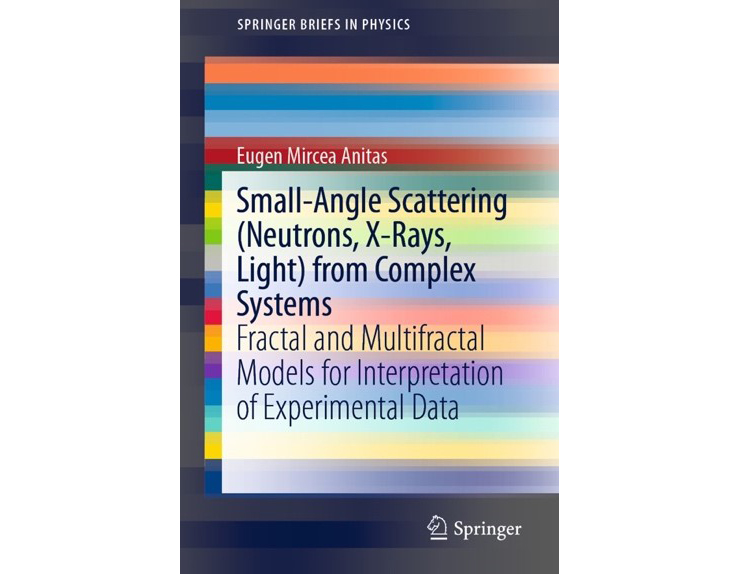
- “Small-Angle Scattering (Neutrons, X-Rays, Light) from Complex Systems: Fractal and Multifractal Models for Interpretation of Experimental Data” by Eugen Mircea Anitas, Springer, Cham, Switzerland, 2019, ISBN 978-3-030-26612-7, https://www.springer.com/gp/book/9783030266110.
- “Elements of Materials Technology in DC plasma” by Ioan Bica, Maria Balasoiu, Madalin Bunoiu, ISBN 978-5-94836-485-8, Technosphera JSC Publishing House, Moscow, 2017.
- “Modern Trends of Nanoscience”, (Eds. M.Balasoiu, A.G. Arzumanian), ISBN 978-973-27-2230-5, Publishing House of Romanian Academy, Bucharest, 2013.
- “Cyanobacteria for Bioremediation of Wastewaters”, Springer 2016, ISBN 978-3-319-26751-7. Editors: Zinicovscaia, Inga, Cepoi, Liliana.
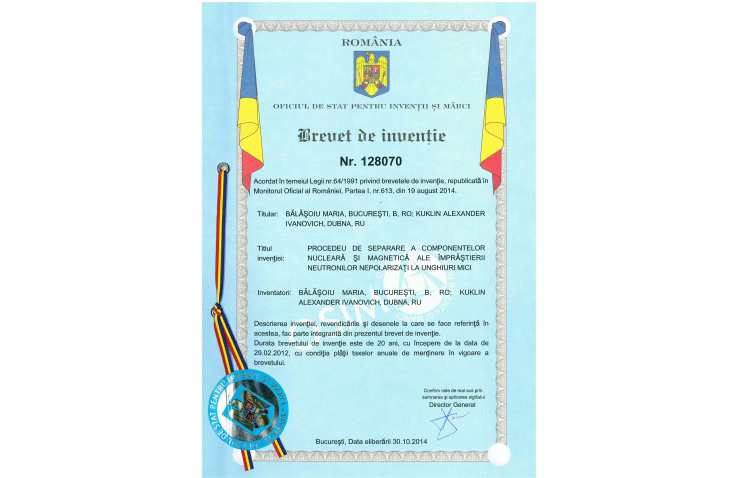
Patents: Patent RO 128070 Method for separating the nuclear and magnetic contributions of small-angle scattering of unpolarized neutrons.
Reports presented at JINR Scientific Council by young Romanian scientists (as recommended by JINR Programme Advisory Committees):
- Feb. 2020: I. Zinicovscaia (FLNP/IFIN-HH) “Neutron activation analysis as a tool for tracing the accumulation of silver nanoparticles in tissues of female mice and their offspring”
- Sept. 2018: I. Harca (FLNR/IFIN-HH) “Fusion-fission and quasi-fission in the near-barrier reaction of 32S + 197Au”
- Feb. 2016: H. Paşca (BLTP) “Energy dependence of mass, charge, isotopic distributions and TKE in neutron-induced fission of 235U and 239Pu”
- Sept. 2013: E.M. Anitas (BLTP) “Small-angle scattering from multi-phase systems: investigation of the crossover between Porod and fractal regimes”
Scientific reports presented at JINR Programme Advisory Committees by Romanian scientists:
June 2019: A. Parvan (BLTP/IFIN-HH): “Transverse momentum distributions of hadrons in the Tsallis nonextensive statistics”, PAC for Nuclear Physics
Granting of the title “Honorary Doctor of JINR” was endorsed by the Scientific Council upon proposal of the JINR Directorate to Professors:
- Sept. 2015: N.V. Zamfir (Romania), Yu. Oganessian (Russia), I. Tighineanu (Moldova), V. Fortov (Russia), P. Fré (Italy), R.-D. Heuer (Germany), J. Khubua (Georgia), H. Stöcker (Germany) for outstanding contributions to the advancement of science and education of young scientists.
- Sept. 2014: Gh. Stratan (Romania), Tran Thanh Van (Vietnam/France), B. Sharkov (Russia) for outstanding contributions to the advancement of science and education of young scientists.
Organization of Joint International Conferences (with outstanding Conference Proceedings and training Schools)
- International Conference Series on Mathematical Modeling and Computational Physics (MMCP) under joint organization (since 2011) of LIT in JINR, several Slovak institutions in Košice and IFIN-HH in Romania.
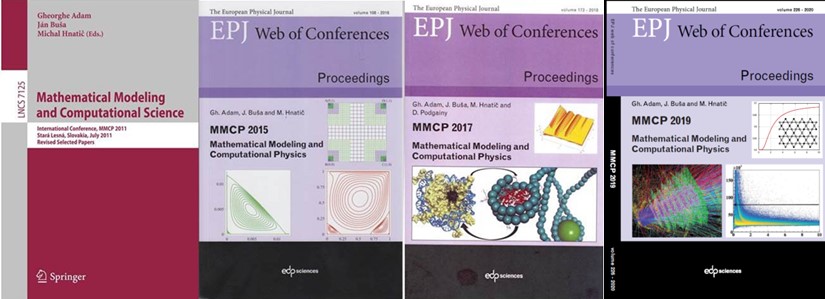
Left: With over 47,000 downloads of the 41 accepted papers at the mid-2020, at a pace of over 500 monthly, the LNCS 7125 volume was annually quoted by Springer since 2013 as one of its top 50% most downloaded eBooks in this collection. The following link points to 123 citations and 47k downloads: https://link.springer.com/book/10.1007/978-3-642-28212-6
Centre-left: EPJ-WoC, Vol.108 (2016), with 58 accepted papers: http://www.epj-conferences.org/articles/epjconf/abs/2016/03/contents/contents.html
Centre-right: EPJ-WoC, Vol.173 (2018), with 100 accepted papers: https://www.epj-conferences.org/articles/epjconf/abs/2018/08/contents/contents.html
Right: EPJ-WoC, Vol.226 (2020), with 48 accepted papers: https://www.epj-conferences.org/articles/epjconf/abs/2020/02/contents/contents.html - International Conference Series on Distributed Computing and Grid-technologies in Science and Education (GRID), organized every two years since 2004 by LIT JINR and sponsored among others by Romanian grants.
- The first International Summer School and Workshop “Complex and Magnetic Soft Matter Systems: Physico-Mechanical Properties and Structure” (CMSMS’12) took place from 3 to 7 September 2012 in Alushta. It brought together 32 specialists (top-level experts and young researchers) from Russia, Romania, Moldova, Belarus, Ukraine, France and Germany working on interdisciplinary problems in soft matter. Total of 37 contributions were collected. Main organizers: JINR, West University of Timisoara, Institute of Continuous Media Mechanics of Russian Academy of Sciences (Perm).
- The second and third editions of CMSMS were jointly organized by JINR, West University of Timișoara, IFIN-HH, Romanian Society of Physics and other institutions. Proceedings published in Journal of Physics: Conference Series, Vol 994 (2018), Eds. Yu. Raikher, M. Bălăşoiu, A. Rogachev, M. Bunoiu; 17 accepted papers.
- Workshop on Condensed Matter Research by Means of Neutron Scattering Methods (CMRNS): First CMRNS event was organized as a joint event of the 15th International Balkan Workshop on Applied Physics and Materials Science (IBWAP 2015), hosted by Ovidius University of Constanta and supported by the Balkan Physical Union, Romanian Physical Society, Romanian Academy, Academy of Romanian Scientists, and JINR. The CMRNS aimed at discussing interdisciplinary research in condensed matter physics, materials science, soft matter, earth and life sciences, and development of neutron instruments at IBR-2 reactor. 14 lecturers from JINR and Romania participated, and students presented 16 posters.
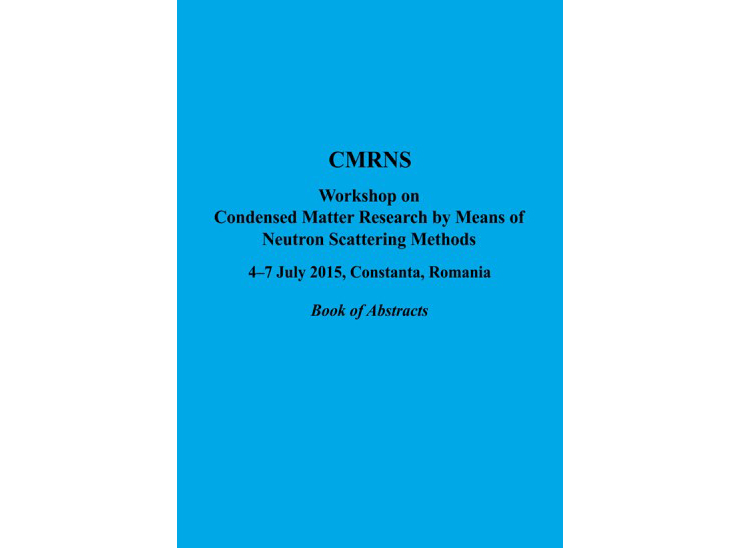
- 2nd CMRNS, held jointly with the 17th International Balkan Workshop on Applied Physics and Materials Science (IBWAP 2017). 16 lectures and 13 posters presented. Goal: overview of key problems and strengthening collaboration.
- First Student Training Course «Advanced Materials Investigation by Means of Neutron Scattering Methods», 27 August – 4 September 2016, JINR, Dubna. Organized by FLNP JINR, WUT (Timisoara), OUC (Constanta). Participants: 20 students and professors from WUT and OUC; Dubna University summer practice students; MIPT and MSU students; young researchers from FLNP Condensed Matter Department.
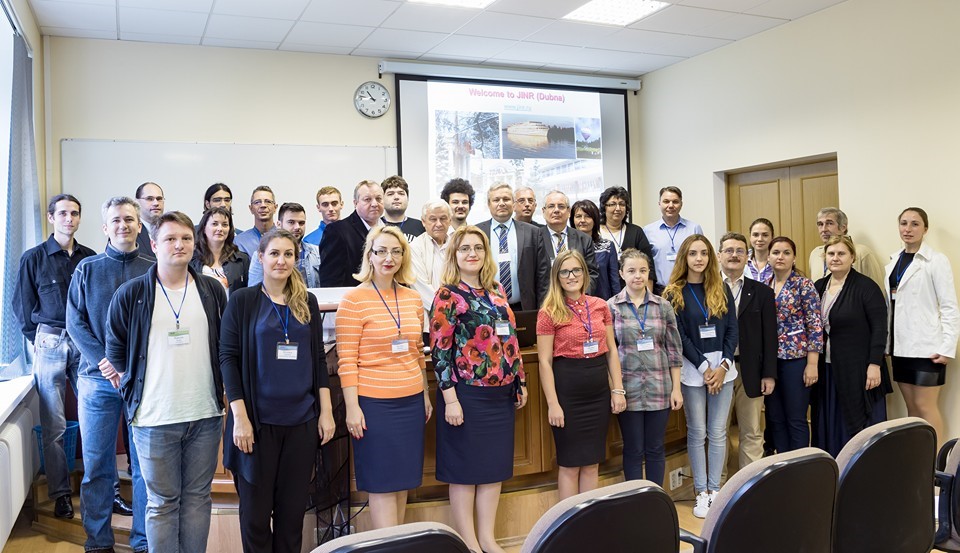
- Second Student Training Course «Neutron Scattering in Condensed Matter Physics» organized by JINR, PNPI (Gatchina), SPbSU, WUT, OUC as a satellite of RNICS-2018 Conference, 15–22 September 2018, Peterhof, Russia. Participants: 19 Romanian students, teachers, and researchers from WUT, OUC, IFIN-HH.
Since 21 July 2016, the Plenipotentiary Representative of the Government of Romania at JINR is Dr. Florin-Dorian Buzatu, Director General of the Institute of Atomic Physics (IFA), Măgurele-Bucharest, Romania.
Florin-Dorian Buzatu was born on 17 April 1957. He graduated from the Faculty of Physics of the University of Bucharest in 1982 with the specialization in nuclear physics. His doctoral thesis “Contributions to the study of the one-dimensional Hubbard model” was defended in 1994 at the Institute of Atomic Physics (IFA). His main scientific interests have been related to the theory of condensed matter physics: strongly correlated electrons, one-dimensional fermionic models, phase transitions in electron and molecular systems.
His current management tasks include the coordination of the Research and Development (R&D) programmes supporting the Romanian participation in European projects and collaborations (EURATOM, F4E, CERN, ELI-NP, FAIR, CEA). He has brought a significant contribution to the coordination of the preparation of the Romania’s Application file for hosting the Extreme Light Infrastructure (ELI) during the ELI Preparatory Phase (2008–2010).
His professional career started at Horia Hulubei National Institute for R&D in Physics and Nuclear Engineering (IFIN-HH) in Bucharest-Măgurele. He has grown as a prominent scientist and a R&D management leader within IFIN-HH, with which he remained closely associated over the years. In his capacity as Scientific Director of IFIN-HH, during March 2005 – January 2008, Dr. Florin-Dorian Buzatu coordinated the preparation of the Romania Application file for membership at CERN and the Core Financing Programme of the Institute.
The five-year period (1991–1996) spent in the Bogoliubov Laboratory of Theoretical Physics of the JINR and the three-year fellowship (1998–2001) at the Department of Chemistry of the Texas Christian University (Fort Worth, TX, USA) were particularly beneficial and valuable for his scientific achievements.
More about the Romanian Plenipotentiary Florin-Dorian Buzatu can be found on his Curriculum vitae at the IFA webpage.
Plenipotentiary Representatives of the Government of Romania at JINR since 2005:
2005 – 2016
- Nicolae-Victor Zamfir, Member of Romanian Academy, General Director of Horia Hulubei National Institute for R&D in Physics and Nuclear Engineering (IFIN-HH), Director of the “Extreme Light Infrastructure – Nuclear Physics (ELI-NP)” Project;
2016 – present day
- Florin-Dorian Buzatu, Director General of the Institute of Atomic Physics (IFA), Măgurele-Bucharest, Romania.
Gheorghe Stratan – Chief Researcher of the Joint Institute for Nuclear Research, Professor of Horia Hulubei National Institute for R&D in Physics and Nuclear Engineering (IFIN-HH) (Bucharest), Head of the Department of History and Methodology of Science of the Babeș-Bolyai University faculty (Cluj-Napoca, Romania) (2003–2008).
Born on 31 August 1941 in Lipnic, Romania.
Doctor Honoris Causa of JINR (title conferred in 2014 at the 116-th Session of the JINR Scientific Council).
Scientific interests: Theoretical nuclear physics, history of physics, educational programmes, science and society.
Cătălin Borcea – Co-chairman of the Scientific Council for a term of three years (elected at the 124-th session, September 2018), Scientific Researcher gr. I in the Horia Hulubei National Institute for R&D in Physics and Nuclear Engineering (IFIN-HH), the Nuclear Physics Department, Professor at the Horia Hulubei National Institute of Physics and Nuclear Engineering (Bucharest, Romania).
Born 25 December 1943 at Focsani, Romania.
Main scientific interests: Heavy ion physics including radioactive beams, physics of nuclei far from stability, astrophysics, precision measurements of nuclear data.
Achievements of the scientific career:
- Study of intermediate structure in Isobaric Analog Resonances
- Determination of fission cross sections for U and Pu isotopes induced by thermal neutrons by an absolute method
- Determination of electric form factors of proton and neutron by low momentum transfer of 4 GeV electrons
- Study of light particle emission close to the kinematic limit in heavy ion induced reactions at E/A~10 MeV (subject of PhD thesis)
- Synthesis and study of decay and properties of heavy H and He isotopes (4-6H, 6-10He)
- Systematics of atomic masses, regularities, smoothness of the multi-parametric mass surface; mass extrapolating methods
- Discovery of doubly magic nucleus 100Sn
- Discovery of the doubly magic nucleus 48Ni
- Discovery and study of two proton radioactivity
- First elastic scattering experiment with the halo nucleus 11Li
- Momentum distribution of 8B and the character of confined halo of this nucleus
- Spectroscopy of nuclei close to the drip line, revealing the erosion of classical magic numbers and appearance of other magic numbers in nuclei with high neutron excess
- Measurement of fusion cross sections with loosely bound projectiles close to Coulomb barrier
- Commissioning of the nTOF facility at CERN
- Precision measurement of (n, n’, gamma) cross sections and covariance assessment for many isotopes in the frame of a Nuclear Data project at JRC-IRMM-Geel (Belgium)
Members of the Scientific Council from Romania since 1956:
1956–1960, 1964–1965, 1969, 1971
- Horia Hulubei, Member of the Romanian Academy, Professor, Head of the Chair of the Structure of Matter at the Bucharest University, Director of the Institute of Atomic Physics (IAP) (1949-1968), Chairman of the Atomic Energy Board of the Romanian Council of Ministers, Member of the State Council of Romania;
1964–1976, 1978
- Șerban Țițeica, Member of the Romanian Academy, Vice-President of the Romanian Academy, Foreign Member of the USSR Academy of Sciences, Vice-Director of IAP;
1956–1959, 1969
- Valer Novacu, Corresponding Member of the Romanian Academy, Professor of the University of Bucharest;
1964
- Nicolae Vîlkov, Scientific Secretary of IAP;
1965 — 1967, 1972 — 1976
- Paul Drăgichescu, Director of an IAP Laboratory, and IAP Department;
1967 — 1968
- Marius Petraşcu, Professor, IAP Vice-Director;
1971
- Radu Chişleag, Acad. Horia Hulubei’s adviser at the State Council of Romania;
1972 — 1977
- Dănilă Barb, Professor, IAP Deputy Director (1968-1977), Director of the Institute of Physics and Technology of Materials (IPTM), Bucharest (1977-1989);
1977 — 1988
- Ioan Brânduş, Doctor of physical and mathematical sciences, Scientific Secretary of the Central Institute of Physics, Bucharest (1977-1989);
- Ivașcu Marin, Doctor of physical and mathematical sciences, Director General of the Institute of Physics and Nuclear Engineering (IPNE), Bucharest (1977-1989); Director General of the Central Institute of Physics, Bucharest (1977-1989);
1978 — 1980
- Alexandru Berinde, Professor, Deputy Director of IPNE;
1988
- Eugen Cruceanu, Head of an IPNE Laboratory;
1980
- Ovidiu Balea, Professor, Head of an IPNE Laboratory;
1981 — 1983
- Gheorghe Semenescu, Professor, Senior Researcher, Head of an IPNE Department;
1981
- Alexandru Glodeanu, Deputy Director of IPTM;
1982 — 1983,1985 — 1988
- Venera Boldea, Senior Researcher of IPNE;
1984, 1987
- Călin Beşliu, Professor of the University of Bucharest;
1988
- Maria Haiduc, Senior Researcher, Head of an IPNE Laboratory;
1990 — 1992
- Dorel Bally, Professor of the University of Bucharest, Founder of the Romanian school of neutron physics, Head of an IPTM Laboratory;
1960 — 1967, 1970, 1990 — 1993, 1997
- Dorin Poenaru, Doctor of physical and mathematical sciences, IPNE Scientific Director (1990-1997);
1998 — 2000
- Mihai Petrovici, Director General of IFIN-HH, Bucharest;
2000 — 2003
- Gheorghe Mateescu, Director General of IFIN-HH, Bucharest;
2003 — 2012
- Gheorghe Căta-Danil, Professor, Head of Chair of Physics of the Polytechnic University Bucharest, Head of the Department of Nuclear Physics of the IFIN-HH, Bucharest;
2003 — present day
- Gheorghe Stratan, Chief Researcher of the Joint Institute for Nuclear Research, Professor, Horia Hulubei National Institute of Physics and Nuclear Engineering (Bucharest, Romania);
2012 — present day
- Cătălin Borcea, Senior Researcher I of IFIN-НН, Professor at the Horia Hulubei National Institute of Physics and Nuclear Engineering (Bucharest, Romania).
Academician Emil Burzo, member of the Romanian Academy, Director of Excellence Centre on Condensed Matter Physics, Director of the Master and PhD programs in Solid State Physics, and Member of the Presidium of the Romanian Academy and President of the Cluj-Napoca Branch of the Romanian Academy, was an active Member of the Programme Advisory Committee for Condensed Matter Physics from 2006 to 2016.
The languages of international communication at JINR are Russian and English. However, one can hear the speech in many languages in Dubna, including the languages of JINR member-states when the compatriots, the representatives of a same national community (the national groups of JINR), meet each other.
Over the years of existence of JINR the national groups have developed their traditions, forms of cooperation and collaboration with other national groups. Their leaders, appointed by the plenipotentiaries of the JINR member-states play the organizing role in the life of the national groups.
Eugen Mircea Anitas
Head of the national group of Romania, Head of Sector in BLTP
+7 (496) 216-25-09
e-mail: anitas@theor.jinr.ru
Otilia Culicov
Deputy Head of the national group of Romania, Deputy Director of FLNP, Deputy of Chief Scientific Secretary of JINR
+7 (496) 216-58-18
e-mail: culicov@nf.jinr.ru
Being in permanent contact with Plenipotentiaries Representatives, Embassies of JINR Member-States in Russian Federation, JINR Directorate and management services, they take part in the solution of the problems connected with the stay of their compatriot colleagues and their families in Russia, with the organization of their life and leisure. The 2018 year marked a dynamic evolution of the number of Romanian scientists employed in the Institute. All the young people in the group have successfully accomplished the first stages of their professional growth. They left the JINR for new positions, as carriers of the excellence level of the scientific research developed in the Institute. They will be new promoters of the scientific cooperation with the Joint Institute.
The Council of the leaders of the national groups meets periodically. The representatives of the Directorate and the services of the Institute are invited to its meetings. The agenda includes the discussion of the urgent problems of the employees from the Member-States and the management gets an opportunity to make appropriate decisions.
- 1–2 January – New Year
- 24 January – The Unification Day
- Orthodox Good Friday (in 2021, 30 April)
- First and second day of Orthodox Easter (in 2021, 2–3 May)
- 1 May – Labour Day, International Labour Day
- 1 June – International Children’s day
- First and second day of the Feast of the Holy Trinity (in 2021, 20–21 June)
- 15 August – Assumption Day
- The day of the scientific researcher (19 November) [Day off in the scientific research institutes]
- 30 November – St. Andrew’s Day
- 1 December – National Day, the Great Union Day
- 25–26 December – First and second day of the Christmas
15 November 2022
The Joint Institute for Nuclear Research pays tribute to the prominent Romanian physicist Horia Hulubei (1896–1972)9 December 2020
Representatives of Romania took part in a representative international workshop devoted to the conception of JINR Information Centres1–10 September 2019
The 8th International Pontecorvo Neutrino Physics School took place in Sinaia, Romania18–21 February 2019
The 32nd regular Task Force Meeting of the ICP Vegetation took place in Târgoviște, Romania (Valahia University)8 December 2018
Residents of Dubna gathered at the “Mir” Cultural Centre to celebrate the 100th anniversary of the formation of the unitary state of Romania19–20 November 2018
The Autumn Session of the Committee of Plenipotentiary Representatives of JINR Member States was held in Bucharest, Romania, chaired by the Russian Representative G.V. Trubnikov4 October 2017
A delegation from central Romanian TV channels TVR and TVR International visited JINR4 March 2017
At the Embassy of Romania in Moscow, a Romanian Evening was held dedicated to the Mărțișor tradition5 April 2016
Celebrations marking the 60th anniversary of the Joint Institute for Nuclear Research were held at the “Mir” Cultural Centre with outstanding international participation. Romania was represented by Dr. Ioan Ursu, Vice-President of the Romanian National Authority for Scientific Research and Innovation, H.E. Vasile Soare, Ambassador Extraordinary and Plenipotentiary of Romania to the Russian Federation, and Dr. Florin-Dorian Buzatu, Director General of the Institute of Atomic Physics in Bucharest-Măgurele2–4 November 2015
JINR DAYS IN ROMANIA were held in Bucharest, Romania, dedicated to the 60th anniversary of JINR30 November 2014
H.E. Ambassador Extraordinary and Plenipotentiary of Romania to the Russian Federation Vasile Soare and accompanying persons visited JINR24–30 July 2011
The 3rd Joint JINR–Romania Seminar on Neutron Physics for Investigations of Nuclei, Condensed Matter and Life Sciences was held in Târgoviște, Romania11–16 September 2007
The 2nd Joint JINR–Romania Seminar-School on Neutron Physics for Investigations of Nuclei, Condensed Matter and Life Sciences was held in Baia Mare, Romania1–7 July 2002
The Joint JINR–Romania Summer School on Neutron Physics for Investigations of Nuclei, Condensed Matter and Life Sciences was held in Baia Mare, Romania