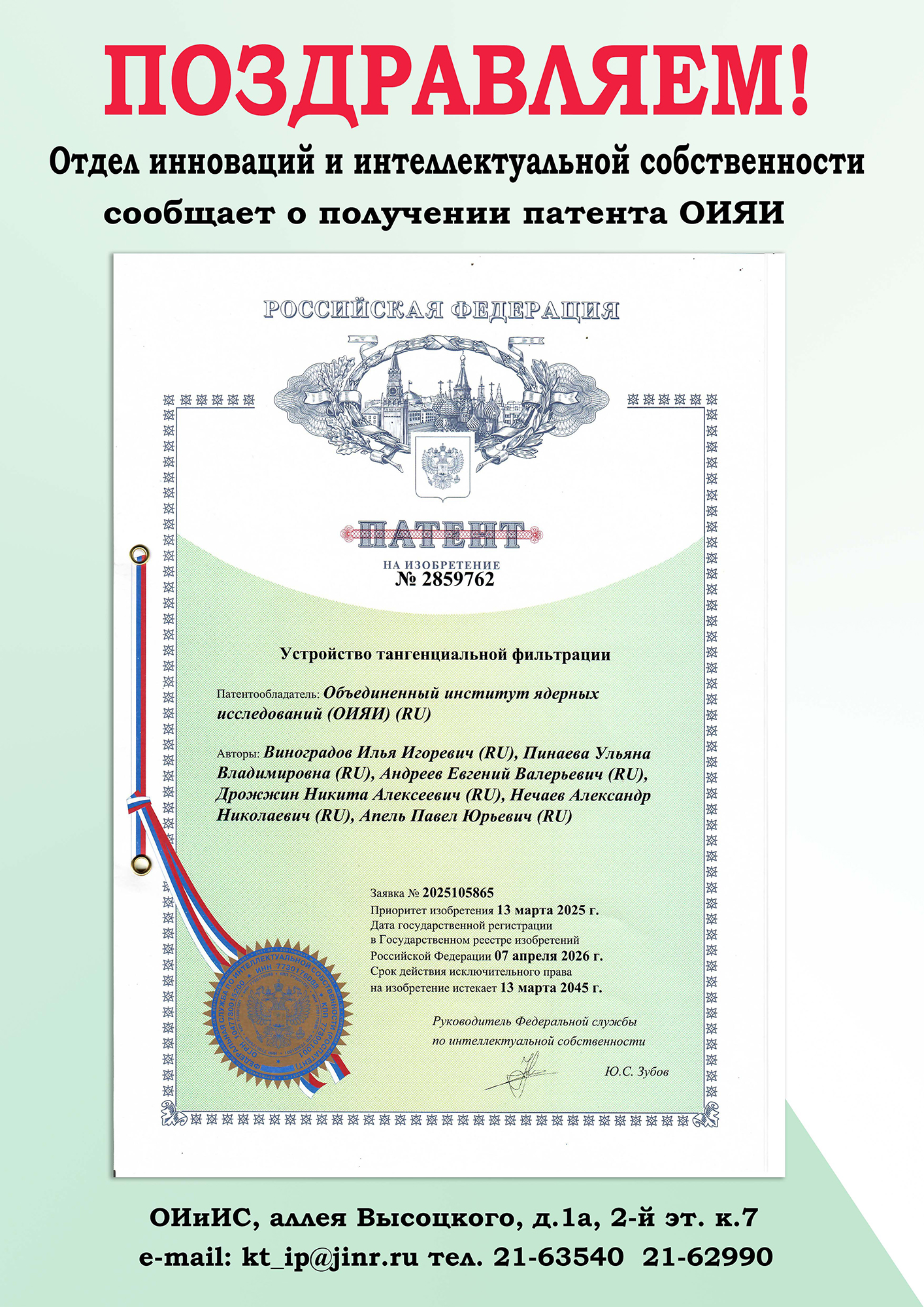
Employees of the Centre of Applied Physics of the Laboratory of Nuclear Reactions at JINR received a patent for a development titled “Tangential filtration device”. The main feature is the opportunity to use the device several times for various research purposes, including micro, ultra and diafiltration. The device will find applications in biotechnology, pharmaceuticals, and laboratory diagnostics.
The principle of tangential filtration is based on the fact that the liquid moves along the surface of a semi-permeable membrane under pressure: one part of the flow passes through the membrane and leaves the system in the form of permeate (filtrate), and the second part continues to move along the membrane and returns to the recirculation tank in the form of retentate (concentrate), gradually decreasing in volume. Compared to other solutions, this approach allows maintaining high filtration performance while reducing membrane contamination and the loss of the target component.
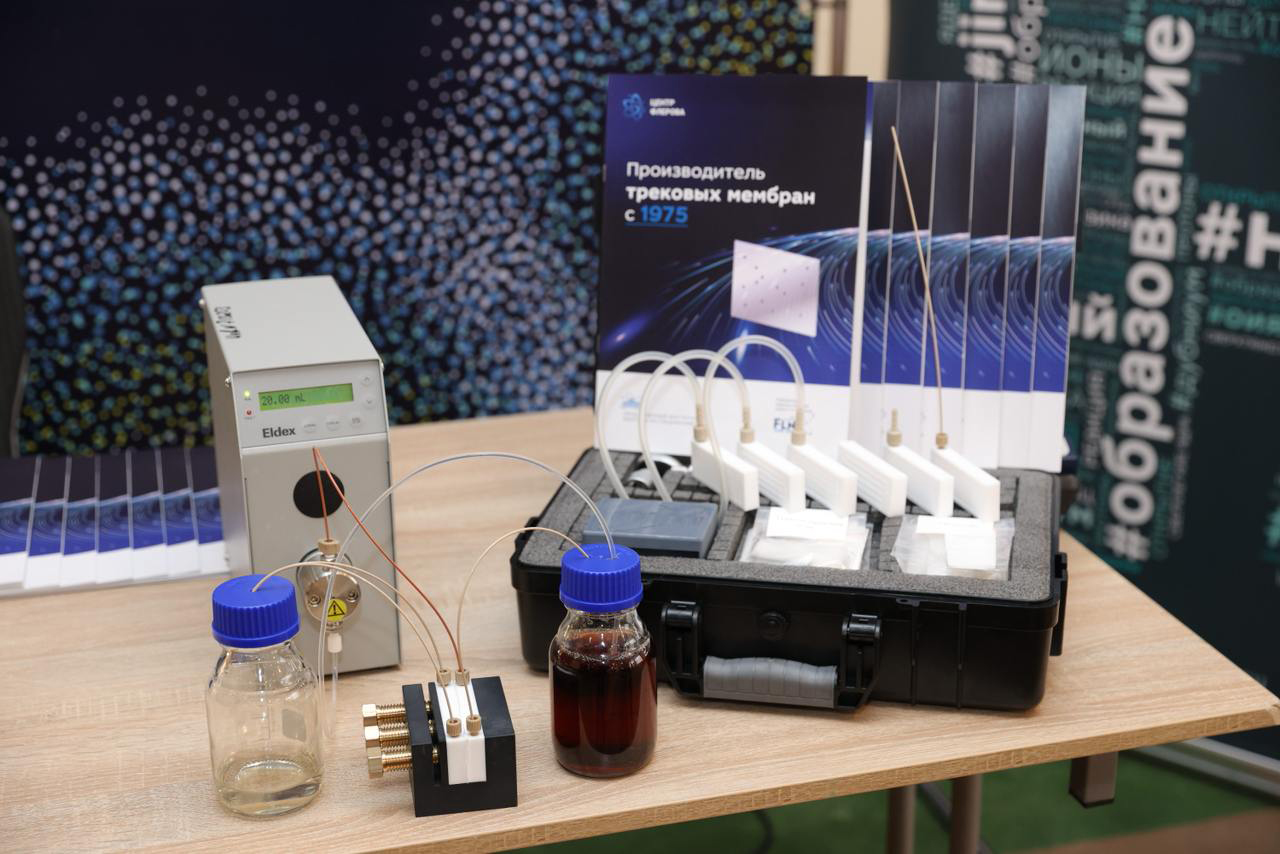
The device developed at the FLNR JINR Centre of Applied Physics consists of two chambers, with a flat membrane element placed in between. A serpentine channel is formed inside the chambers, through which liquid is supplied, moving tangentially to the surface of the membrane element. The tube system provides the source fluid injection, as well as retentate and permeate removal.
Unlike analogues, where chambers need to be glued or welded, this invention uses chambers made of elastic material, sealed due to the pressure formed by a U-shaped clamp, a clamping bar, and screw clamps. A significant advantage of this solution is the opportunity to reuse the device and replace the membrane without glue and welding. This simplifies the maintenance of the entire system and makes it more convenient for laboratory use. In addition, this design reduces local stresses in the membrane and the risk of cracking. To work with viscous media, one of the chambers can additionally be equipped with a special grid that creates a turbulent flow to reduce concentration polarisation on the membrane surface.
Such devices can be used in both laboratory and industrial environments. First of all, they are necessary for effective purification and separation of liquids: culture media, blood plasma, along with buffer and other solutions. The opportunity of implementing ultra, micro, and diafiltration processes in a tangential flow using the invention was confirmed experimentally. The scientists demonstrated the ultrafiltration of a hemoglobin solution, and the step—by-step separation of a model suspension containing polystyrene particles of various sizes, from micrometre to nanometre range.
The RU 2859762 patent was registered on 7 April 2026. The authors of the invention are Ilya Vinogradov, Uliana Pinaeva, Evgeny Andreev, Nikita Drozhzhin, Alexander Nechaev, and Pavel Apel. The authors express their gratitude to the centre’s Senior Technology Transfer Specialist Olga Kristavchuk for her assistance in preparing the patent application.
Congratulations to the employees of the FLNR JINR Centre of Applied Physics on receiving state registration!