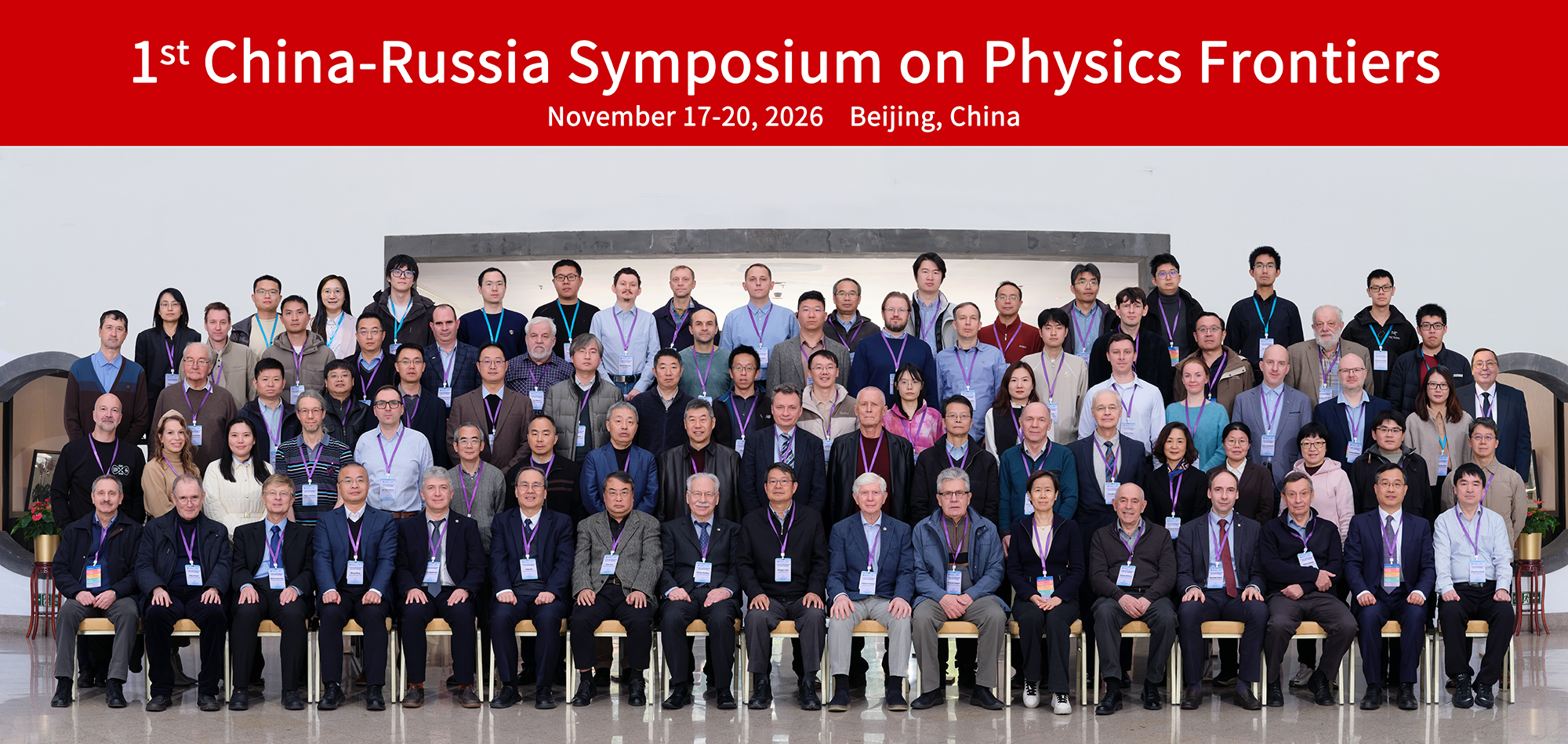
On 18–19 November 2026, Beijing hosted the first China–Russia Symposium on Physics Frontiers. The event was organized by the Chinese and Russian Academies of Sciences as part of a bilateral cooperation agreement signed in October 2025. A substantial delegation from the Joint Institute for Nuclear Research took part in the forum.
The main goal of the symposium is to exchange experience and strengthen scientific collaboration between leading research centres of China and Russia. The programme covered key areas of modern fundamental science: particle and nuclear physics, thermonuclear fusion research, and condensed matter physics.
On 18 November, at a plenary meeting of the symposium, Director of the Laboratory of Theoretical Physics at JINR Dmitry Kazakov gave a talk on the Standard Model studies. On the same day, other scientists from the Joint Institute – the Laboratory of High Energy Physics and BLTP – made presentations at the nuclear physics session as well. Valery Lebedev (VBLHEP) discussed the results of Run 1 at the NICA Accelerator Complex and plans for developing the megascience project. Dmitry Nikiforov (VBLHEP) gave a talk on the creation of superconducting magnets at JINR, and Oleg Teryaev (BLTP) dedicated his presentation to polarisation effects in hadron and heavy-ion collisions at NICA. Nikolai Antonenko (BLTP) talked about research into the fission barriers of superheavy nuclei. Yuri Murin (VBLHEP) commented on the preparation of test experiments at Russian accelerators using Chinese monolithic active pixel sensors (MAPS).
The following day, the nuclear physics session continued with talks by representatives of the Laboratory of Nuclear Problems and the Laboratory of Nuclear Reactions: Mikhail Nozdrin (DLNP) discussed the LINAC-200 Linear Accelerator, Alexander Karpov (FLNR) spoke about JINR’s programme of superheavy element research, and Alexey Lubashevskiy (DLNP) presented studies of fundamental neutrino properties and rare processes in the nuGeN experiment at the Kalinin Nuclear Power Plant.
The symposium finished with a round table on cooperation prospects. The main topics were joint research areas, academic mobility mechanisms, and the training of young specialists.