Physicists at the Joint Institute for Nuclear Research are working on antibacterial and anti-tumour drugs based on a natural organic compound found in cruciferous vegetables such as broccoli, radish, cauliflower, and white cabbage. Scientists found a way to place an active ingredient into a nanocapsule that acts as both a protective “armoured container” and a “smart navigator”. This was announced at the International Conference “Synchrotron Radiation: Science, Knowledge, Innovations, Future” (SKIF-2026) by senior researcher at the Laboratory of Neutron Physics ar JINR Yulia Gorshkova.
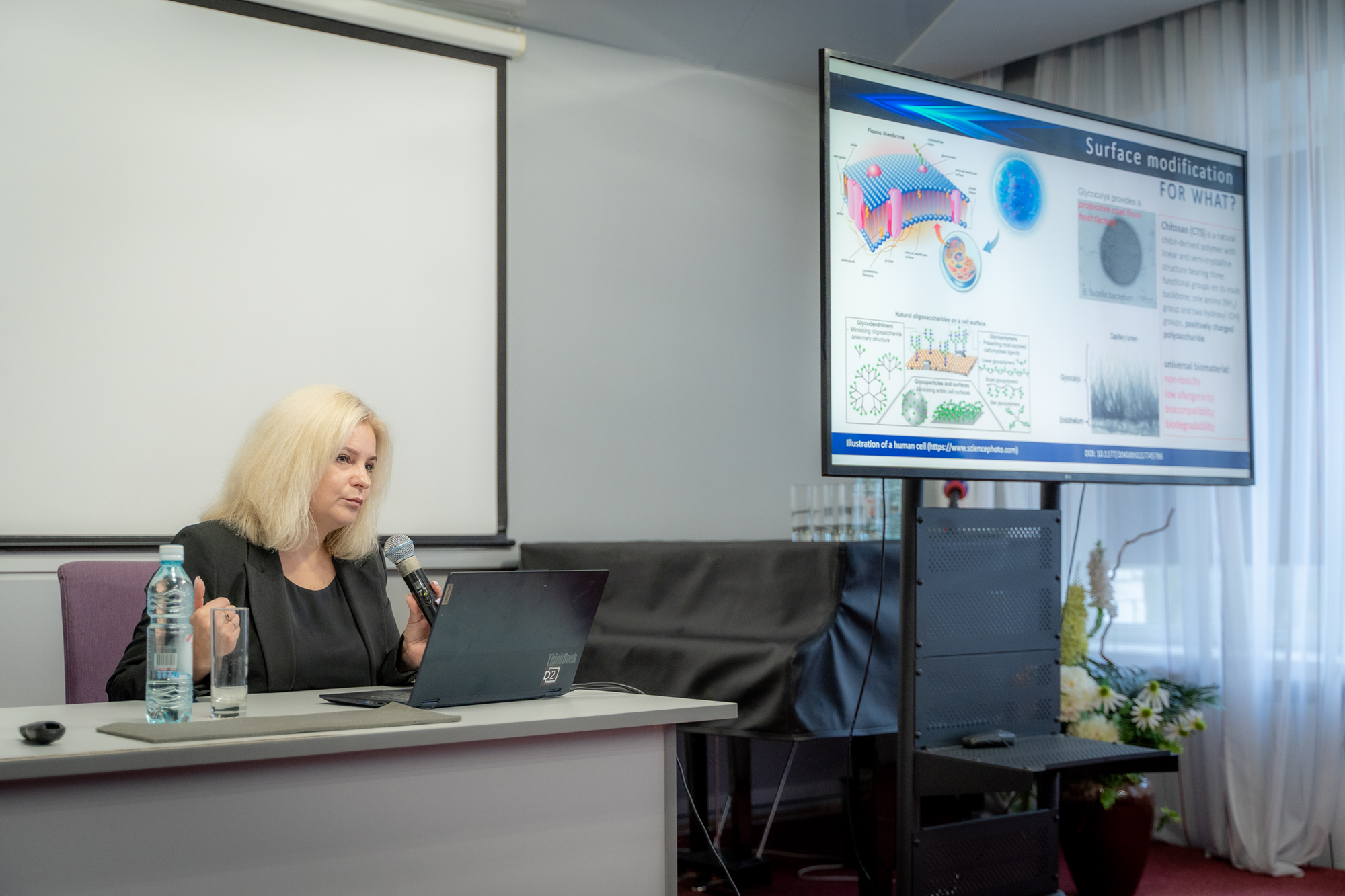 Photo by Olga Zaitseva
The development is based on sulforaphane, an organic compound (isothiocyanate) formed in cruciferous vegetables during the enzymatic breakdown of glucosinolates – special sulphur-containing substances. In global pharmacology and medicine, great attention is payed to this small molecule: the number of research articles dedicated to it in the international PubMed database is growing exponentially. Scientists’ interest is driven by the proven biological activity of sulforaphane, which can selectively trigger the death of tumour cells and effectively destroy antibiotic-resistant bacterial strains.
However, a serious obstacle stands in the way of creating a real medicine – the critical instability and low bioavailability of the molecule in its free form. Upon entering the human body, unprotected sulforaphane encounters three barriers:
- Instant destruction. The molecule is extremely sensitive to temperature, light, and the aggressive acidic environment of the gastrointestinal tract.
- Lack of targeting. The substance is rapidly distributed throughout healthy tissues, failing to accumulate in the primary site at the required therapeutic concentration.
- Rapid withdrawal. The body metabolises and excretes isothiocyanate before it can have a therapeutic effect.
Scientists use biomimetic liposomes for the protection and targeted delivery of drug compounds. These nanoparticles insulate the fragile molecule from degradation in the bloodstream, ensure its prolonged release, and allow for targeted delivery of the therapeutic agent into affected cells. However, without understanding the precise mechanisms of sulforaphane integration into the protective lipid membrane, it is impossible to calculate the dosage and guarantee the stability of the future drug.
In their new study, the JINR physicists deciphered the nanostructural parameters of sulforaphane integration into a lipid bilayer, laying the groundwork for the design of stable smart drugs. Scientists obtained comprehensive data on the behaviour of this system using small-angle X-ray scattering combined with complementary methods: Fourier-transform infrared spectroscopy, differential scanning calorimetry, and computer modelling.
As Yulia Gorshkova explained at the SKIF-2026 conference, this work is a clear example of how fundamental X-ray scattering physics and related methods allow for the design of smart drugs at the nanoscale. Understanding structural changes in membranes is necessary to accurately predict the transport, accumulation, and biological activity of delivered molecules, from plant extracts to therapeutic RNA and DNA.
Background information:
The International Conference “Synchrotron Radiation: Science, Knowledge, Innovations, Future” (SKIF-2026) is taking place from 18 to 23 October 2026 with the support of the Russian Science Foundation and is timed to coincide with the opening of the Siberian Ring Photon Source Collective Use Centre (SKIF Collective Use Centre). Conference participants are discussing current trends and prospects for research using synchrotron radiation methods for fundamental science and industrial applications, the capabilities of synchrotron radiation sources and their generation devices as well as the development of equipment and software for experimental stations.
Organisers of the event: Boreskov Institute of Catalysis of the Siberian Branch of the Russian Academy of Sciences (SB RAS), SKIF Collective Use Centre, SB RAS Budker Institute of Nuclear Physics, Ministry of Science and Higher Education of the Russian Federation, Kurchatov Institute National Research Centre, Government of the Novosibirsk Region, and SB RAS.