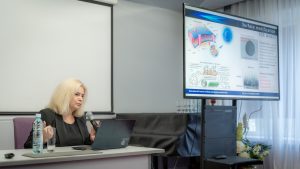
From 24 to 28 August 2026, Vienna hosted the Technical Meeting on Data Needs for Ion Beam Analysis of the International Atomic Energy Agency (IAEA). Among paritcipants were researchers and specialists from leading nuclear physics organizations. Senior researcher at the Laboratory of High Energy Physics at JINR Andrei Zaitsev made a presentation on the modern capabilities of nuclear track emulsion and provided an update on the studies conducted as part of the BECQUEREL Project.
The event was aimed at determining the sufficiency of existing nuclear data for modern and future applications of ion beam analysis, taking into account the development of new experimental methods, the emergence of new data needs, and the increasing use of artificial intelligence and machine learning methods in experiments and data processing.
The meeting participants discussed the IBA’s current needs for high-quality nuclear data, including cross sections of elastic backscattering, nuclear reactions, and gamma-ray spectrometry. Particular attention was paid to gaps in existing data that limit quantitative analysis and measurement of uncertainties, as well as to the development of methods for assessing, verifying, and distributing nuclear data. The prospects for the development of the IBANDL international database were also among the issues discussed.
In his talk entitled “Modern applications of nuclear emulsions in heavy ion physics”, Andrei Zaitsev spoke about the results of research into relativistic nuclear fragmentation based on the unique capabilities of nuclear emulsion. The high spatial and angular resolution of the method allows studying correlations between fragments and identify low-energy nuclear states (8Be, 9B, and the Hoyle state in 12C). Emphasis was placed on the current stage of development of the emulsion technique. The advancement of automated and intelligent microscopy as well as the use of computer vision, AI, and machine learning methods opens up the opportunity to shift from the standard visual analysis of individual events to studies with significantly higher statistics.
In addition, the speaker presented the results of work at the NICA Accelerator Complex. The combination of nuclear emulsion with automated microscopy allows using emulsion plates not only to study individual nuclear interactions, but also to quantify the spatial distribution and characteristics of a heavy ion beam. The CR-39 polymer-based solid-state track detectors was considered as an additional independent detector for measuring the beam profile and fluence.
In addition, Andrei Zaitsev discussed the prospects of using nuclear emulsion in studies of alpha radioactivity, nuclear fission, and low-energy ion beams. During the discussion, the need for systematic calibration studies based on well-known nuclear reactions and processes at various energies and irradiation conditions was emphasised. Obtaining such data at a high statistical level will make it possible to improve the metrology of nuclear track emulsion, create reference sets of experimental data, and develop automatic analysis methods.
The JINR employee’s participation in the IAEA technical meeting helped introduce the international scientific community to the modern capabilities of nuclear track emulsion and discuss the prospects for using it in ion beam research. The presented results emphasise the value of preserving and further upgrading this technology.
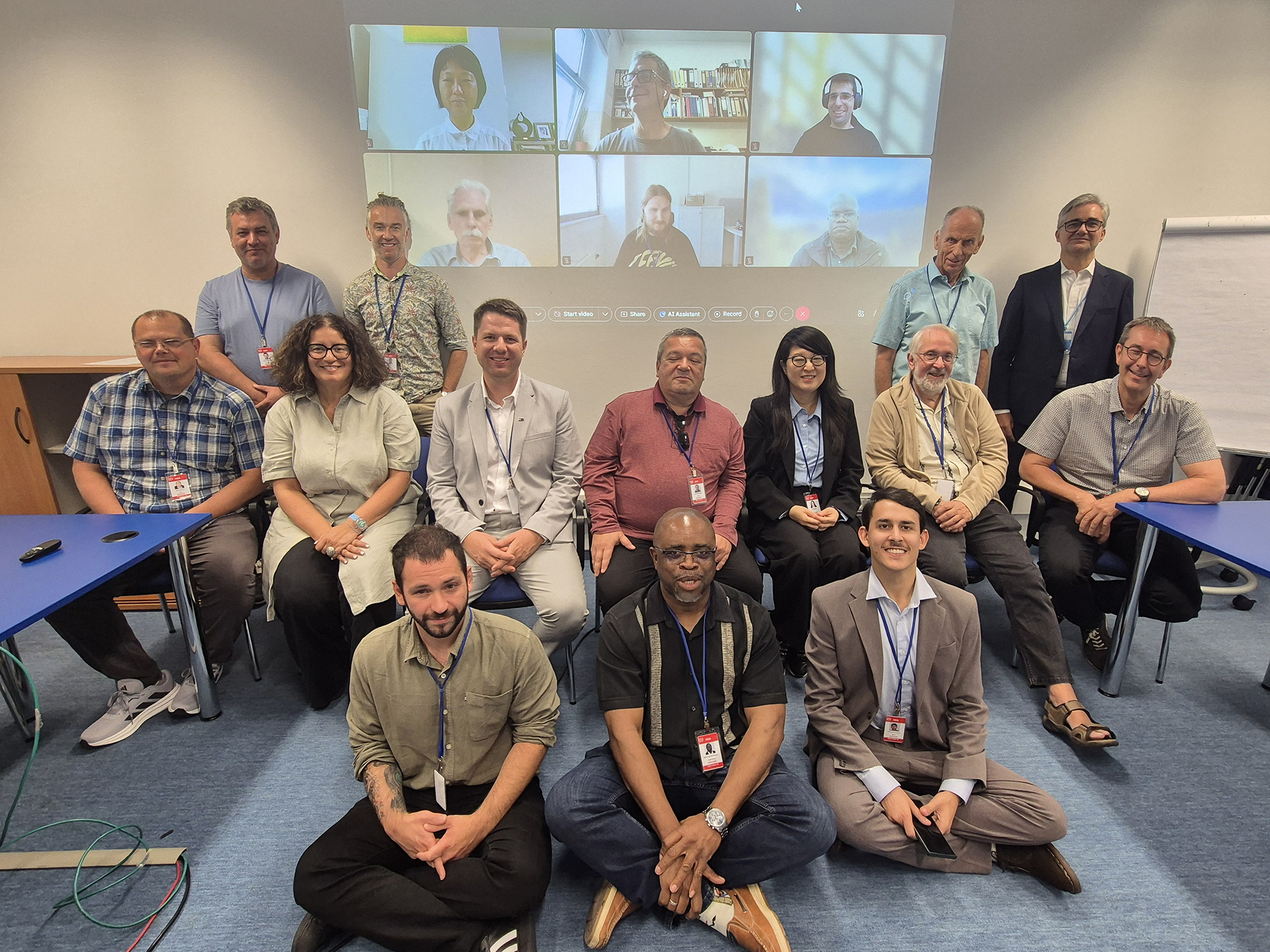 Andrei Zaitsev is the third from the left, second row