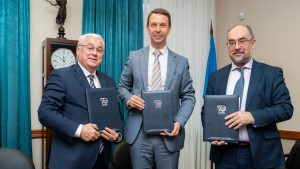
From 20 to 22 October 2026, the 18th International Meeting of the MPD (Multi-Purpose Detector) Collaboration took place at the Laboratory of High Energy Physics at JINR. Scientists discussed the Multi-Purpose Detector‘s readiness for the NICA Collider’s beam and the upcoming work with experimental data. The key goals of the next beam run are conducting the technical commissioning of the detector subsystems in basic configuration, debugging the centralised data collection and readout system as well as evaluating and analysing the achieved equipment performance.


VBLHEP JINR Director Andrey Butenko gave the first talk. Addressing the participants, he emphasised that the collaboration had reached a historic milestone: “In just a few months, we will obtain the first signals and begin processing real data acquired with the MPD Detector. We have been working towards this for two decades – from 2006, when the NICA Project was just launched”.
NICA Chief Engineer Evgeny Syresin provided an overview of the progress of the accelerator complex. He presented the results of the first beam run, which concluded at the start of the year, and outlined the main objectives of the ongoing run, which started on 3 September. Key achievements of the previous stage include injecting a xenon ion beam into the collider rings, ensuring their stable circulation, synchronising them to collide at the MPD interaction point, and observing the first beam collisions at limited intensity and energy in commissioning mode.
In this run, VBLHEP specialists are focusing on sequentially reducing beam losses at all facilities of the complex. During injection into the Booster, using the electron cooling system, an intensity of about 6·107 ions was achieved with minimal losses. A comprehensive modernisation of the beam transfer channel from the Nuclotron to the collider allowed improving the efficiency of beam extraction from the Nuclotron and its transfer. Special attention in the talk was given to the inclusion of new equipment in the collider rings into the commissioning cycle. During the summer, engineers installed:
- two RF3 Accelerating Radiofrequency System cavities;
- elements of the longitudinal stochastic cooling system (at this stage, the system operates with a frequency bandwidth of 20% of the full spectrum);
- a 6-metre high-precision solenoid for the high-voltage electron cooling system;
- beam collimation and profile measurement systems.
After moving the Multi-Purpose Detector to its operating position at the end of October, specialists will begin the first physical tests in the mode of interaction of a low-intensity beam with a gold wire. This stage will allow testing both the MPD Facility itself and the NICA Collider systems before a colliding beam run scheduled for early 2027.
MPD Collaboration Spokesperson, VBLHEP Chief Researcher Victor Riabov provided an update on the experimental facility’s readiness for the first beam runs. In his talk, he highlighted the completion of the summer campaign to map the magnetic field at a nominal value of 0.5 T. The measurement results will ensure the optimal operation of the central tracker for accurate particle registration.
In addition, progress was made in assembling the facility’s internal subsystems. Over the past six months, 50 half-sectors of the electromagnetic calorimeter were fully mounted in the power carbon-fibre frame, and the installation of 28 modules of the time-of-flight system finished. The time projection chamber, having preliminarily undergone a full cycle of commissioning tests, was installed into the central tracker’s magnet aperture. At the final stage, a carbon-fibre cartridge containing the beam pipe, fast forward detectors, and associated support structures were integrated inside the detector. The installation of cables as well as water and air cooling systems for the detectors is now nearing completion.
In regard to plans for the upcoming run, Victor Riabov noted that the MPD Collaboration is switching from computer modelling to working with real data. Since the collider luminosity will increase gradually in the initial stage, the Multi-Purpose Detector will primarily work in the wire interaction mode. The team’s immediate tasks remain the technical commissioning of the facility, calibration of all detector systems, and recording of the first real events.
Collaboration’s Technical Coordinator, Head of the MPD Scientific and Experimental Department Vyacheslav Golovatyuk discussed the practical aspects of integrating the elements of the MPD Detector in its basic configuration. After providing an update on preparing the subsystems, he outlined the plans for upcoming installation. The facility was put in its operating position on 26 October.
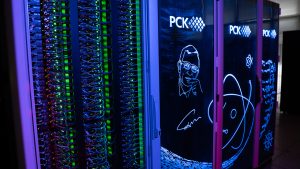
The first day’s programme continued with a series of specialised presentations. Evgeny Antokhin (Budker Institute) and Vyacheslav Klyukhin (Skobeltsyn Institute of Nuclear Physics) presented the results of in-situ measurements and three-dimensional modelling of the MPD solenoid’s magnetic field map. Head of the VBLHEP Ion Collision Reconstruction Sector Oleg Rogachevsky commented on the progress and development of the experiment’s computing infrastructure required for data processing.
In total, the 18th MPD Collaboration Meeting featured over 20 scientific and technical talks devoted to the Multi-Purpose Detector. On the second day, participants who arrived in Dubna visited the NICA Complex to witness the scale of the work carried out in the MPD Experimental Hall and at the collider. The results of the meeting and the collaboration’s immediate plans were summarised during an open discussion on 22 October.