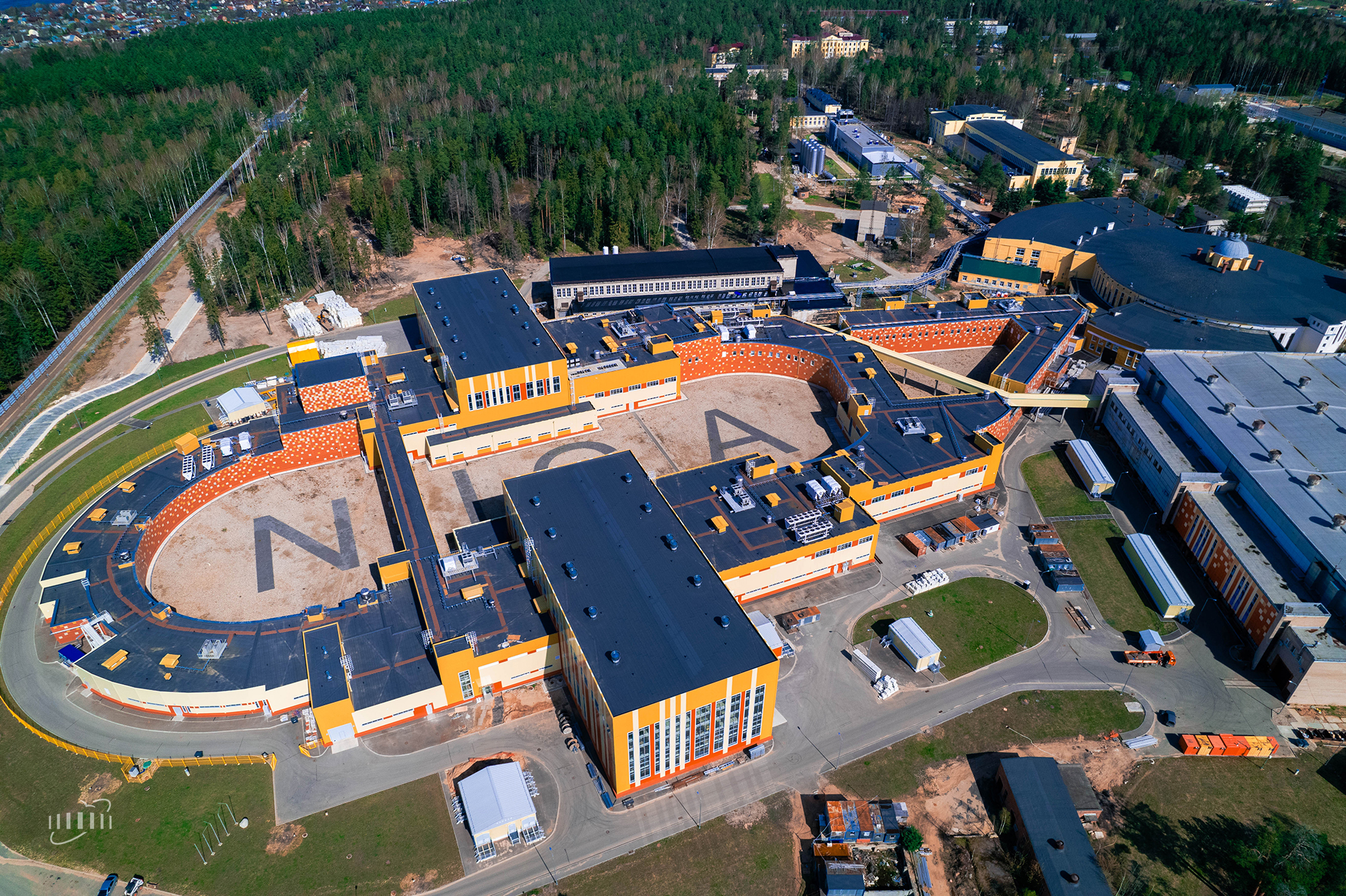
On 27 August 2026, the second run was initiated at the NICA Accelerator Complex in its basic configuration as part of the preparation for the comissioning of the collider and MPD systems. Chief Engineer of the NICA Accelerator Complex Evgeny Syresin spoke about the plans and main tasks for this run.
The main purpose of the run is to start and adjust the main MPD systems in the detection mode of the collisions of counter-rotating xenon ion beams with a minimum “test” intensity to confirm their operability.
The run began with the launch and configuration of the KRION-6T Heavy Ion Source at the LUTI Linear Accelerator. On 3 September, employees of the Accelerator Division of the Laboratory of High Energy Physics at JINR began simultaneously cooling the magnetic systems of the superconducting synchrotrons – the Booster and Nuclotron. According to the plan, after the Booster magnets enter operating mode, a xenon ion beam will be injected into it and accelerated, then transferred and accelerated in the Nuclotron. By the end of September, work will begin on transporting low intensity beams (less than 1% of the design intensity) through transfer channels from the Nuclotron to the collider in order to start configuring injection into the collider in early October. In the second half of October, VBLHEP employees plan to install the MPD Detector in the operating position at the beam collision point.
The employees’ task is to register the interactions of the beams with the vacuum chamber elements in the MPD and adjust the detector equipment in a more stable environment as ions will interact with the substance noticeably more than two colliding beams with limited intensity, which should make the adjustment process easier. This is the first task for the current run.
The second task is to switch to colliding circulating counter-rotating beams in the centre of MPD by the end of the year. To do this, scientists will need to increase the particle density of the bunches circulating the collider compared to the first run. After that, the registration of colliding nuclei in the NICA Collider will begin.