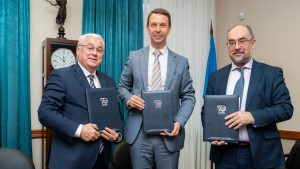
On 22–23 January 2026, the 62nd meeting of the Programme Advisory Committee for Nuclear Physics (PAC NP) took place at the JINR International Conference Centre. The meeting participants discussed the latest results of experiments at the Superheavy Element Factory, neutrino physics research, and the design of a new facility for materials science and personnel training.


PAC NP Chair Valery Nesvizhevsky gave the opening speech. At the beginning of the meeting, the participants paid tribute to the memory of Vice-Director of the Joint Institute for Nuclear Research, Corresponding Member of the Russian Academy of Sciences Sergey Nikolaevich Dmitriev. The Chair read out a condolence letter by a committee member, Professor Emanuele Vardaci (University of Naples Federico II, Italy).
Next, Valery Nesvizhevsky presented information on the implementation of the recommendations of the previous, 61st meeting. In addition, the PAC members heard a talk by Advisor to JINR Director Mikhail Itkis on the resolution of the 138th session of the Scientific Council (September 2025) and the decisions of the Committee of Plenipotentiaries of the Governments of the JINR Member States (December 2025).
Chief Engineer of the Laboratory of Nuclear Problems at JINR Sergey Yakovenko put forward a proposal for a new project, the PASTech Technological Complex. The aim of the project is to create a compact facility for solid-state studies using positron annihilation spectroscopy (PAS). The complex will allow studying the structure of various materials and defects caused by physical factors (ageing, external loads, radiation exposure) and will provide educational and methodological opportunities for the training of engineers in accelerator and cryogenic technology.
Monoenergetic beams of low-energy positrons are especially valuable for materials science: adjusting particle energy makes it possible to scan a sample from the surface to a depth of several dozens of microns. This opens up opportunities for analysing the characteristics of thin films and modifying the surface and subsurface layers, as well as structures commensurate with the depth of positron penetration.
Since 2016, DLNP has successfully operated a similar compact facility for conducting solid-state studies using PAS methods. According to Sergey Yakovenko, this experience will allow JINR specialists to create a unique new technological complex. Representatives of scientific organizations of Azerbaijan, Bulgaria, Russia, South Africa, and Vietnam are already interested in conducting research at the facility.
The Programme Advisory Committee approved the proposal to launch the PASTech Project. It will be implemented over the next two years.
Head of the Gas-filled Separator Group at the Laboratory of Nuclear Reactions at JINR Dmitry Solovyov provided an update on the Superheavy Element Factory Complex experiments. In the coming years, specialists’ main goal will be the synthesis of the element 119 of Mendeleev’s Periodic Table. According to the scientist, these studies will help verify theoretical predictions about the existence of an “island of stability” of superheavy nuclei.
As part of preparatory experiments to select the optimal projectile-target combination, scientists not only discovered three new isotopes (288Lv, 289Lv, and 280Cn), but also confirmed the promising reactions of 43Am + 54Cr and 249Bk + 50Ti. Dmitry Solovyov noted that in order to work with the required amount of target material, the halls of the SHE Factory are being upgraded to obtain a class I work permit in accordance with the sanitary standards for radiation safety (OSPORB-99/2010).
The second part of the talk was devoted to the preparation of the GASSOL Gas-filled Separator for research into superheavy elements’ chemical properties. Delivery of the facility’s key element, a superconducting magnet, is expected in February 2026.
The head of the FLNR JINR Sector No. 3 Nikolay Aksenov commented on the prospects for research on the chemical properties of superheavy elements at the SHE Factory. In his talk he presented the latest experimental results on the study of flerovium, obtained in the 242Pu(48Ca,3n) reaction: scientists studied the interaction of the individual atoms with a gold surface. Analysis of eight registered decay chains of isotopes 238Cn and 287Fl revealed the presence of two deposition zones for flerovium, at room temperature and around –100°C. The adsorption of Fl atoms on a gold surface in the cryogenic region confirms the significant influence of relativistic effects on its chemical behaviour. The first experiments may be conducted after 2028.
Between 2026 and 2028, FLNR JINR scientists will participate in experiments at the accelerators of the Institute of Modern Physics, Chinese Academy of Sciences (IMP CAS).


The head of the DLNP JINR Sector of Weak Interactions Mark Shirchenko presented the latest physical results and development plans for the DANSS Experiment. The DANSS detector, located beneath the active zone of the VVER-1000 industrial reactor at the Kalinin Nuclear Power Plant, has been continuously registering antineutrinos since 2016 and has accumulated a unique dataset of over 9 million events to date. The main objective of the experiment is the search for sterile neutrinos, however, their existence has not yet been confirmed to date.
In addition to fundamental research, the experiment demonstrates significant potential in solving applied problems. The DANSS neutrino spectrometer allows for the calculation of reactor thermal power with an accuracy of approximately 1% over weekly intervals. In addition to this, the collaboration reconstructed the temporal evolution of the proportions of fissile isotopes in nuclear fuel (235U and 239Pu), which also highlights the experiment’s applied potential.
The talk presented plans for the modernisation of the experimental facility as part of the DANSS-2 project. This programme will aim to improve sensitivity, increase the volume of statistics data, and reduce dominant systematic uncertainties. Modernisation involves the complete replacement of the detector’s sensitive volume with the minimum possible changes to its mechanical design. This will allow for an improvement in energy resolution from ~34% to ~15% at an energy of 1 MeV and an increase in effective statistics by 40–50%. The expected improvements will expand the experimental capabilities as part of JINR scientific programme and applied neutrino monitoring of nuclear reactors.
The head of the DLNP Sector of Nuclear Radiation Spectrometry Alexey Lubashevskiy presented a talk on the state of experimental studies on the search for double beta decay. He commented on the latest results and JINR contribution to leading global collaborations in this field, including the LEGEND, NEMO3/SuperNEMO, and CDEX experiments.
In the second half of the meeting, employees of the Laboratory of Neutron Physics and FLNR JINR demonstrated scientific presentations. DLNP senior researcher Pavel Prusachenko commented on research on differential and total cross-sections of 14.1 MeV neutron scattering on carbon nuclei. The talk, dedicated to the peculiarities of multinucleon transfer (MNT) reactions, was presented by the Head of the FLNR Sector No. 5 Alexey Bogachev.


В завершение первого дня члены ПКК ЯФ заслушали семь коротких сообщений по ядерной физике, представленных молодыми учеными из Лаборатории ядерных проблем. Комитет отметил высокое качество всех научных и научно-методических работ и их презентаций. Лучшими докладами стали:
- «Исследование потока галактических нейтрино с помощью телескопа Baikal-GVD» — младший научный сотрудник ЛЯП Батжаргал Ульзутуев,
- «Рефрижераторы растворения 3He–4He, используемые для получения сверхнизких температур» — научный сотрудник ЛЯП Иван Городнов,
- «Разработка нового нейтринного композитного детектора COFE (Chemical Optical Fluoride Engineering)» — младший научный сотрудник ЛЯП Ксения Антохина.
Согласно решению ПКК ЯФ доклад Батжаргала Ульзутуева будет представлен на 139-й сессии Ученого совета ОИЯИ, которая пройдет 19–20 февраля 2026 года.
23 января члены Программно-консультативного комитета по ядерной физике встретились с представителями дирекции ОИЯИ. По итогам заседания были приняты рекомендации ПКК и рассмотрены предложения в повестку следующей, 63-й сессии, которая состоится летом 2026 года.