Researchers from the Laboratory of Nuclear Problems at JINR, together with colleagues from scientific centres in Russia and Kazakhstan, discovered a single beta decay of the zirconium-96 isotope (96Zr). It took physicists several years of continuous measurements to confirm the discovery of the rarest single beta decay process in nature.
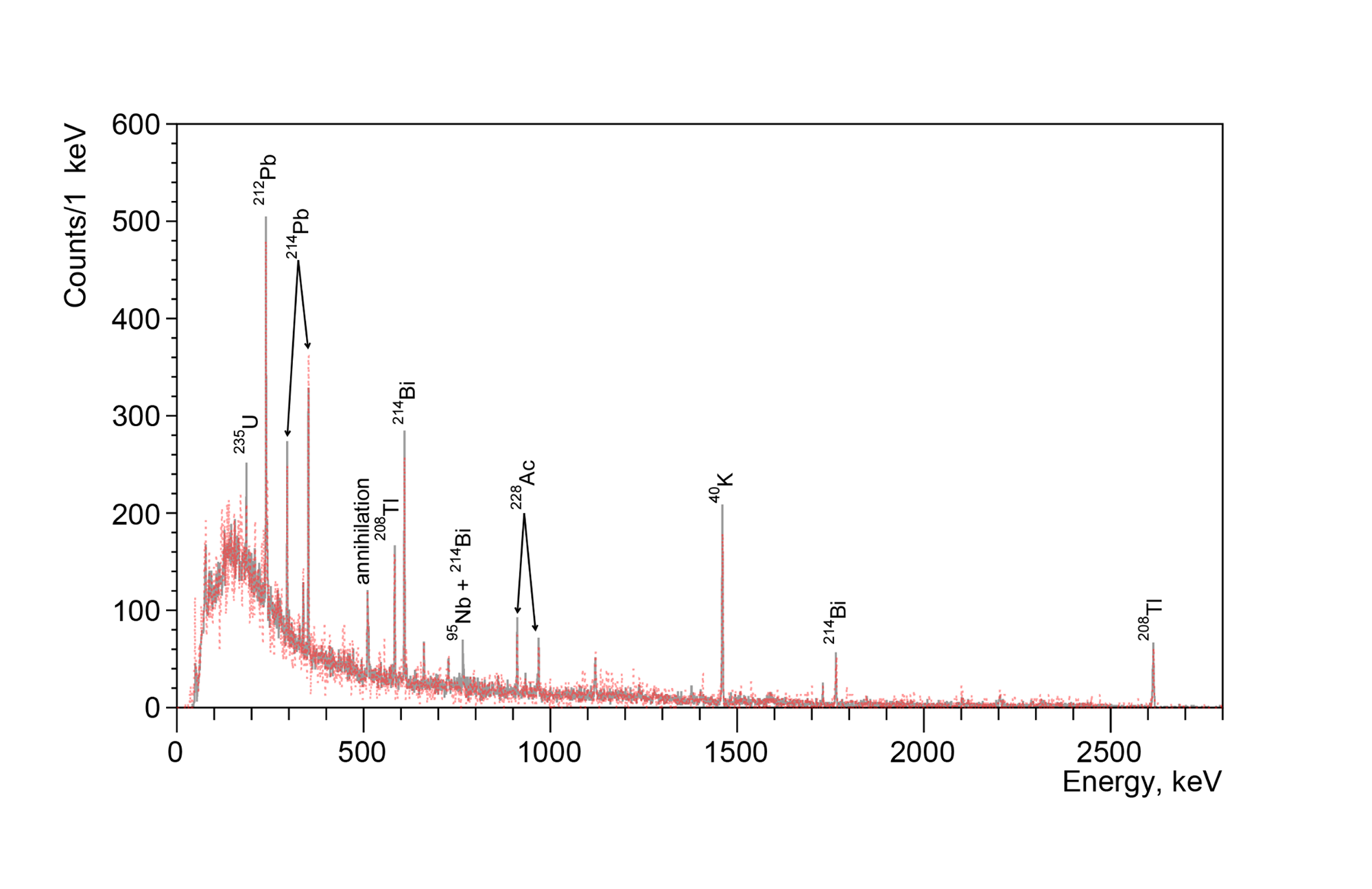 Gamma-ray quantum spectra in the 0-2800 keV energy range. The black line represents measurements using enriched zirconium samples for 12 625.34 hours. The red dotted line represents background measurements for 2 896.98 hours, normalised to 12 625.34 hours
The experiment, which initially aimed to study the zirconium-96 double beta decay, took place at the Baksan Neutrino Observatory of the Institute of Nuclear Research of the Russian Academy of Sciences at a depth of 4 900 metres water equivalent. In the study, the scientists used a low-background SNEG facility based on a detector made of extremely pure germanium.
The search for neutrinoless double beta decay (0vßß) is one of the most important tasks in modern nuclear and particle physics. The detection of this hypothetical process, not explained by the Standard Model, would demonstrate the possibility of violating the Lepton number and prove the Majorana nature of neutrinos (the identity of neutrinos and antineutrinos). Studying 0vßß decay can reveal why there is significantly more matter in the universe than antimatter. Thus, spectrometric search for neutrinoless double beta decay directly links nuclear physics with astrophysics and cosmology.
Today, 96Zr is the most promising option for future experiments studying 0vßß decay. The half-life of this unstable isotope exceeds the age of the universe by about a billion times. The probability of double beta decay of zirconium-96 (with the same mass of detectors) is almost a hundred times higher than the probability of decay of another promising nuclei, germanium-76. In addition, the decay energy of 96Zr is higher than the upper limit of the gamma ray energy of natural radioactivity.
The success of the experiment was largely possible thanks to the quality of the studied material. In natural zirconium, the scientists needed only 2.8% of the isotope. In 2022, Rosatom Corporation developed a special 96Zr enrichment method for JINR and delivered unique samples to Dubna. After initial research at the Joint Institute, the material was sent to the Baksan Neutrino Observatory of the Institute for Nuclear Research of the Russian Academy of Sciences.
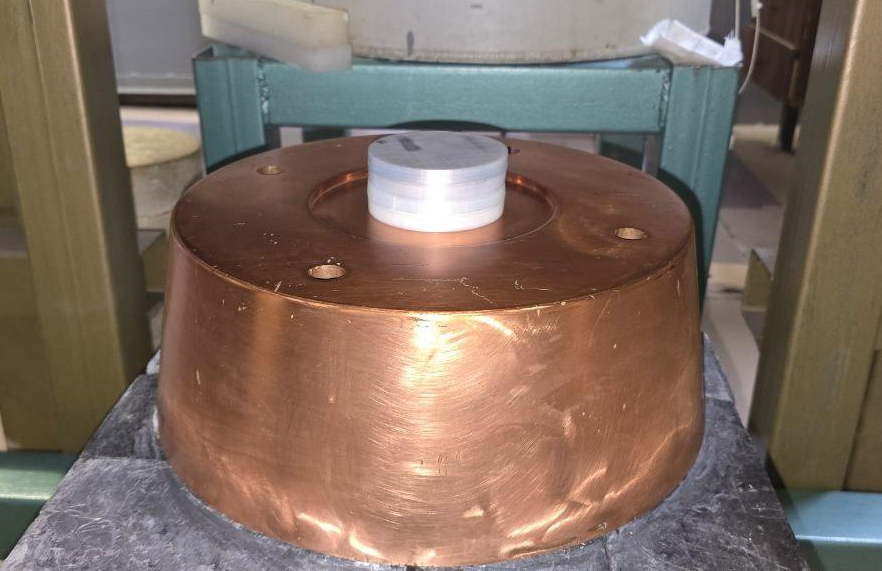 Samples of enriched zirconium in low-background nylon containers on the experimental facility platform
The first result of the work is the discovery of the rarest natural single beta decay. It is noteworthy that, according to calculations, this open transition occurs in nature even less frequently than the double beta decay of the zirconium-96 nucleus with the emission of two antineutrinos.
The scientists plan to search for the double beta decay of zirconium-96 into excited states of molybdenum-96 and create specialised detectors to study the ground state decay. A detailed description of the research and the results obtained are already available in the electronic preprint archive: https://arxiv.org/abs/2605.18344.