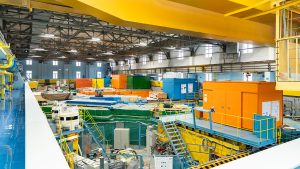
On 10 June 2026, the Nature journal published the first physics results of JUNO (Jiangmen Underground Neutrino Observatory) – an international neutrino experiment. Scientists managed to improve the accuracy of neutrino oscillation parameter measurements by a factor of 1.6. The Joint Institute for Nuclear Research played a significant role in preparing and implementing the large-scale project: JINR specialists have been working in the collaboration for the past ten years.

The JUNO Collaboration started collecting data in August 2025. The first two months of work demonstrated that the detector’s parameters meet design expectations, and the facility allows performing neutrino oscillation measurements with record accuracy. A group of 50 JINR physicists and engineers greatly contributed at all key stages of the experiment’s implementation: from planning, development, and assembly of the detector and electronics to the creation of a major computing centre (one of three in Europe), as well as the application of event selection and statistical data analysis algorithms.
A neutrino is one of the lightest and most weakly interacting fundamental particles. It passes through matter almost freely, which is why measuring its properties is extremely difficult. The JUNO Experiment focuses on the precise measurement of reactor antineutrino oscillations. Oscillations are a quantum phenomenon in which neutrinos change their type (flavour) during propagation. From the characteristic shape of the antineutrino energy spectrum, the parameters of these transitions can be reconstructed, allowing specialists to approach determining the neutrino mass ordering.
The JUNO Detector is located in China, at a depth of about 700 metres underground. Its central part is a giant spherical facility containing 20 000 tonnes of liquid scintillator. Weak light flashes caused by antineutrino interacting with the detector substance are registered by tens of thousands of photosensors, allowing for highly accurate reconstruction of antineutrino energy.
The first JUNO data already provided the most precise measurement of neutrino energy to date: the energy resolution is about 3 % at MeV. This corresponds to the experiment’s design parameters and is a key condition for fulfilling JUNO’s main task of determining the neutrino mass ordering.
In addition, the collaboration performed the first simultaneous high-precision measurement of two key neutrino oscillation parameters. Despite relatively little data accumulated, the approach helped achieve a record increase in accuracy, surpassing the combined results of experiments from previous decades.
The publication of first JUNO results in Nature marks a significant milestone for the project, provind that the experiment is not just operational, but also capable of delivering world-class measurements. As statistics accumulate, JUNO will be able to test the three-flavor neutrino oscillation theory with high accuracy, approach solving the problem of neutrino mass ordering, and possibly indicate new physics manifestations.
“By participating in the JUNO Project from the very first day, JINR substantially contributed to creating the facility and carrying out measurements”, Deputy Director of the Laboratory of Nuclear Problems, Head of the JUNO Group at JINR Dmitry Naumov commented.
“At the moment, our Institute is engaged in data analysis and physical interpretation, continuing the traditions of neutrino research laid down in Dubna many years ago”, Head of the DLNP JINR Reactor Neutrino Sector, Deputy Head of the JUNO Group at JINR Maxim Gonchar noted.
“Another remarkable thing is that while preparing and conducting the experiment, our team gained invaluable experience in creating an experimental facility, analysing data, and working in a large international team. This experience will certainly be useful for the Laboratory’s future projects”, Head of the DLNP JINR Sector of Research Methodology, Deputy Head of the JUNO Group at JINR Nikolay Anfimov added.