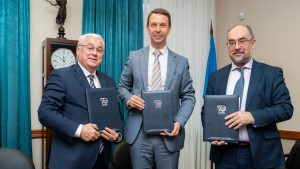
On 18–19 June 2026, the 63rd meeting of the Programme Advisory Committee for Nuclear Physics (PAC NP) took place at the Joint Institute for Nuclear Research. Participants discussed the progress of an experiment to synthesise element 119 of Mendeleev’s Periodic Table as well as issues concerning the development of the JINR research infrastructure.


At the start of the event, PAC NP Chair Valery Nesvizhevsky discussed the implementation of the previous meeting’s recommendations. JINR Vice-Director Latchesar Kostov spoke on the resolution of the 139th JINR Scientific Council session and the decisions of the March 2026 meeting of the Committee of Plenipotentiaries.
The first part of the programme was dedicated to Superheavy Element Factory studies. Head of the Sector of the Synthesis and Properties of Superheavy Nuclei at the Laboratory of Nuclear Reactions at JINR Vladimir Utenkov provided an update on the experiment to synthesise element 119. The experiment utilises the DC-280 Accelerator Complex and the DGFRS-2 Gas-Filled Separator. To synthesise element 119, a beam of titanium-50 (element 22) nuclei will collide with a target made of berkelium-249 (element 97). The target material, 249Bk (approximately 20 mg), was produced in the SM-3 Reactor at the Research Institute of Atomic Reactors (Dimitrovgrad, Russia).
As noted by Vladimir Utyonkov, the analysis of data from previous experiments allowed determining the optimal beam energy for titanium, corresponding to an excitation energy of compound nuclei around 40 MeV. For the reliable identification of new isotopes, scientists will use the genetic correlation method. In the 249Bk+50Ti reaction, the alpha decay of element 119 isotopes is expected to potentially trigger the formation of new nuclei of tennessine (291,292Ts) as well as the already studied nuclei of moscovium (287,288Mc), nihonium (283,284Nh), and other elements.
The sensitivity of the experiment achieved to date is 480 femtobarns (fb). According to the scientist, detecting even a single event of element 119 synthesis requires a sensitivity level of 180–200 fb and an integral beam dose of titanium ions on the order of 1019.
In the same vein were the talks by Chief Researcher of the Laboratory of Theoretical Physics at JINR Gurgen Adamian and FLNR Scientific Leader, Academician of the Russian Academy of Sciences Yuri Oganessian. They discussed the theoretical predictions of the nuclear structure and formation cross-sections of new superheavy elements with atomic numbers 119 and 120. The scientists justified the advisability of using titanium-50 and berkelium-249 in the reaction to synthesise element 119: according to theoretical calculations, the combination could lead experimenters to success.
Director of the Laboratory of Neutron Physics at JINR Egor Lychagin delivered the next presentation, devoted to the progress and prospects of the IBR-2 Pulsed Reactor as well as preparations for creating a new neutron source at FLNP. At the beginning of 2025, after a long shutdown, the reactor was successfully put into operation and returned to its normal working mode. This allowed for the full resumption of the international user programme, which welcomed about 300 new researchers in the last year and a half. The laboratory is actively solving the issue of extending the facility’s service life.
Egor Lychagin spoke about the concepts for next-generation neutron sources, the creation of which is now particularly important for the Institute. He highlighted that a number of engineering limitations and complexities with obtaining neptunium fuel led to a decision to reconsider the concept of the Neptun Project. As an alternative, specialists began work on the design of the IBR-4 facility. This concept is based on existing fuel types and design solutions similar to the IBR-2 Reactor. It is expected that by using beryllium reflectors, modern neutron extraction optical systems, and advanced moderators, the parameters of the new source will fully meet the key needs of experimenters.


The Head of the FLNP JINR Nuclear Materials Science and Ion Implantation Nanotechnology Sector Aleksandr Doroshkevich presented the results of the modernisation of the EG-5 electrostatic accelerator of charged particles and plans for its further development. This facility is designed to solve a wide range of fundamental and applied problems with high precision. It provides scientists with opportunities to conduct research into reactions with fast quasi-monoenergetic neutrons, develop nuclear physics methods for elemental composition analysis, and carry out experiments in neutron radiation materials science.
When discussing the results already achieved, Alexander Doroshkevich noted that the FLNP specialists managed to increase the ion beam current from 1.5 to 35 µA, and the energy of the accelerated particles from 2.8 to 3.5 MeV. The facility was equipped with a new solid-state lithium target, which allows for the generation of intense neutron fluxes in the 20–800 keV range. Currently, the accelerator’s characteristics were practically brought up to the designed specifications, and the tasks for modernising the vacuum and gas compression systems were successfully resolved.
To implement the full research and technical potential of the complex, the scientist proposed that the committee consider prolongating the project until 2027. The main objective of the upcoming modernisation phase is to bring the facility to higher performance levels: an energy of 4.1 MeV and a beam current of up to 100 µA, while maintaining energy stability at a level no worse than 500 eV. These parameters are expected to be achieved through the implementation of a new microwave ion source and the deep automation of key accelerator systems. Following the discussion, the members of the PAC NP supported the proposal to prolongate the project.
The meeting continued with overviews by JINR scientists. The BLTP Deputy Director for Scientific Work Nikolai Antonenko delivered an interim report on the “Theory of nuclear systems”. The state and prospects of the JINR neutrino programme were presented by the Deputy Director of the Laboratory of Nuclear Problems Dmitry Naumov. The MLIT Deputy Director for Scientific Work Dmitry Podgainy commented on the development of the scientifc programme of the Laboratory of Information Technologies.
The first day of the meeting concluded with presentations by young FLNR JINR scientists, who delivered six talks on nuclear physics to the PAC members. The committee highly praised the scientific level, methodological thoroughness, and quality of presentation of all submitted research. Following the results of the session, the following talks were recognised as the best:
- “Recent studies of the 238U+54Cr, 242Pu+50Ti, and 237Np+48Ca reactions at SHE Factory”, an FLNR researcher Dastan Ibadullayev.
- “Current state of the 18 GHz ECR ion source DECRIS-5M at FLNR JINR”, an FLNR engineer Kirill Berestov,
- “Study of the fusion-fission and quasifission reaction processes using CORSET spectrometer”, an FLNR senior researcher Aniruddha Dey.
According to the PAC NP decision, the talk by Dastan Ibadullayev will be presented at the 140th meeting of the JINR Scientific Council, which will take place in September 2026.
On 19 June, members of the Programme Advisory Committee for Nuclear Physics met with representatives of the JINR Directorate. Following the meeting, the participants approved the final recommendations of the PAC and considered proposals for the agenda of the next, 64th session, which will take place in the winter of 2027.