On 19–20 February 2026, the 139th session of the JINR Scientific Council took place at the JINR International Conference Centre. The session participants discussed the Institute’s latest results and prospects for further studies. The rich agenda included a series of talks on key research areas, the election of a Deputy Director of the Dzhelepov Laboratory of Nuclear Problems, and the announcement of laureates of prizes for outstanding scientific achievements.


The session started with a presentation by JINR Director, Academician of the Russian Academy of Sciences (RAS) Grigory Trubnikov. Special attention was paid to the progress of the NICA Accelerator Complex. The JINR Director highlighted the remarkable success of the researchers and engineers of the Veksler and Baldin Laboratory of High Energy Physics: on 12 February, counter-rotating beams of xenon nuclei simultaneously circulated both collider rings for the first time. In addition, he noted that active physics data intake started in the new 1.5–3 AGeV xenon beam run of the BM@N Fixed-Target Experiment. Development of the NICA detector infrastructure continues: specialists are mapping the magnetic field of the MPD Facility solenoid as well as creating subsystems for the first stage of the SPD Experiment, testing detector prototypes, and preparing for the mass production of their key elements as part of the project.
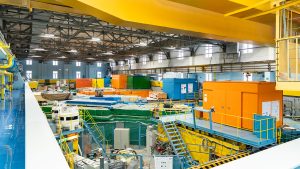
Researchers of the Flerov Laboratory of Nuclear Reactions are engaged in intensive preparation for the synthesis of elements 119 and 120 of Mendeleev’s Periodic Table. An important stage was the latest experiments at the Superheavy Element Factory to synthesise nihonium and flerovium isotopes and study their chemical properties. The DRIBs-III Accelerator Complex serves as a reliable key facility for the execution of the FLNR JINR scientific programme: the U-400 Cyclotron demonstrated outstanding efficiency, having operated 6300 hours per year and providing a broad spectrum of ion beams for fundamental and applied tasks.
Scientists of the Dzhelepov Laboratory of Nuclear Problems are participating in a number of large-scale projects as well. The collaboration of the Baikal-GVD Neutrino Telescope embarked on a new expedition at Lake Baikal to install two new clusters and next-generation detector prototypes. The laboratory’s scientific groups obtained important results in the DANSS and JUNO Neutrino Experiments. The creation of the MSC-230 Medical Superconducting Cyclotron is actively underway: specialists are manufacturing the yoke, high-frequency generator, and coil winding equipment.
Grigory Trubnikov highlighted the JINR University Centre‘s role, placing emphasis on the high importance of outreach activities and educational programmes, which are becoming effective instruments for expanding the Institute’s partner network both in Member States and beyond.
The talk presented in detail the development of the Institute’s multilateral international cooperation.
Particularly active was the advancement of collaboration with Latin American countries. An important event for the Institute was a CP session held in the Cuban city of Varadero in early December 2025 and a series of large-scale events celebrating the 50th anniversary of Cuba‘s membership in JINR. Among them are the JINR–Latin America international workshop and the Hadronic Matter Physics scientific school. In Mexico, a trilateral agreement was concluded with the Secretariat of Science (Secihti) and the National Autonomous University (UNAM). The implementation of plans regarding partnership between JINR and Brazil began with the first meeting of the Brazil–JINR Joint Coordination Committee.
Joint work with partners from Asian countries was equally intensive. During a visit of the leadership of the Vietnam Academy of Science and Technology (VAST), the parties outlined future joint studies and personnel training. The Joint Coordination Committee of JINR and the Ministry of Science and Technology of China approved new projects at the third meeting. Collaboration with India began expanding with the JINR–India scientific workshop in Bhubaneswar, which brought together more than 200 researchers to discuss particle physics, nuclear physics, astrophysics, and neutrino physics.
“JINR is meeting its 70th anniversary in great shape. A full meeting room of the Scientific Council and the high interest of the international community is the best confirmation of the support of our path. The agenda of this session turned out to be rich and truly informative. There are many tasks ahead, but seeing such a lively atmosphere, I am sure that we will have enough strength and energy to implement all our plans together”, Grigory Trubnikov said.
Further exploring the topic of the Institute’s upcoming anniversary, JINR Scientific Leader, RAS Academician Victor Matveev made an important presentation. He suggested that the Scientific Council hold a new major international conference titled “Fundamental properties of matter” in Dubna. This scientific forum should be the final event of the anniversary year. The conference is tentatively scheduled for the end of February 2027.
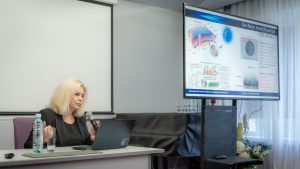
Plans to strengthen international relations were reflected in the talk of the representatives of the National Autonomous University of Mexico, Professors Ana María Cetto and Alejandro Ayala. They presented in detail the research potential of Latin America’s northernmost state. The scientists provided a detailed overview of the history and current progress of nuclear studies in Mexico, demonstrating the prospects for developing cooperation with JINR.
“The aim of our partnership is to complement each other’s strengths. Mexico does not have such large-scale facilities as Dubna, but it has unique experience and personnel able to find non-standard solutions. Now we are taking our cooperation to a new systemic level, focusing on the training of young people”, Ana María Cetto said.
Past President of the International Union of Pure and Applied Physics (IUPAP) Michel Spiro told the session participants about the key initiatives of the United Nations’ International Decade of Science for Sustainable Development (2024–2033).
The first day’s scientific programme finished with the talk of Scientific Leader of the Flerov Laboratory of Nuclear Reactions Yuri Oganessian titled “Towards the synthesis of element 119”. He gave an analysis of the progress on superheavy element synthesis and the prospects for expanding Mendeleev’s Periodic Table. Academician Oganessian spoke about the preparations for the new experiment and the challenges facing researchers.
“This experiment is fundamental: it will answer whether there is a way to even heavier elements, or whether we have already reached the limit. Theories do not yet give a definite answer, so the final word belongs to the experiment, which should begin this year”, Yuri Oganessian emphasised.
At the end of the first day, Vice-Director of the Joint Institute, Academician Vladimir Kekelidze announced the laureates of the JINR Annual Prizes for the best scientific, methodological, and technical research.
At the session, the members of the Scientific Council approved the candidacy of Ayagoz Baimukhanova as Deputy Director of the Dzhelepov Laboratory of Nuclear Problems.
The second day began with presentations by young JINR scientists whose talks were recognised as the best by the Programme Advisory Committees. Dmitrii Dolzhikov (DLNP) presented the first results of the JUNO Experiment on solar neutrino oscillation parameters, and Evgenii Kolupaev (FLNP) spoke about the development of reflectometric studies in oscillating magnetic fields on the REMUR Polarised Neutron Spectrometer.
Head of the DLNP Scientific and Experimental Department of Elementary Particle Physics Alexander Olshevsky ceremoniously announced the winner of the International Bruno Pontecorvo Prize. Professor at the Federal Institute of Technology in Lausanne Mikhail Shaposhnikov became the laureate for the development of theoretical and phenomenological aspects of the neutrino Minimal Standard Model.
JINR Director Grigory Trubnikov announced the awarding of the Honorary Doctor of JINR title to Academician Chen Hesheng (China) in recognition of the Chinese scientist’s significant contribution to the development of joint programmes in high-energy physics and neutron studies.
Michel Spiro received the OGANESSON Prize for outstanding research in high-energy and nuclear physics, along with passionate leadership in global initiatives supporting fundamental science. In addition, a ceremony took place to award Professor Spiro with the diploma and academic dress of an Honorary Doctor of JINR.
The session ended with a general discussion and the adoption of the final resolution. The 140th anniversary session of the JINR Scientific Council will take place in September 2026.