Scientists from the Laboratory of Nuclear Problems at JINR, in collaboration with colleagues from medical research and production centres, created and tested a set of ionisation chambers (IC) for the ophthalmic oncology complex of the OKO Project (Konstantinov Petersburg Nuclear Physics Institute of Kurchatov Institute, Gatchina, Russia). The equipment complex allows controlling beam characteristics – intensity and the measurement of horizontal and vertical profiles – during ophthalmic melanoma proton therapy.
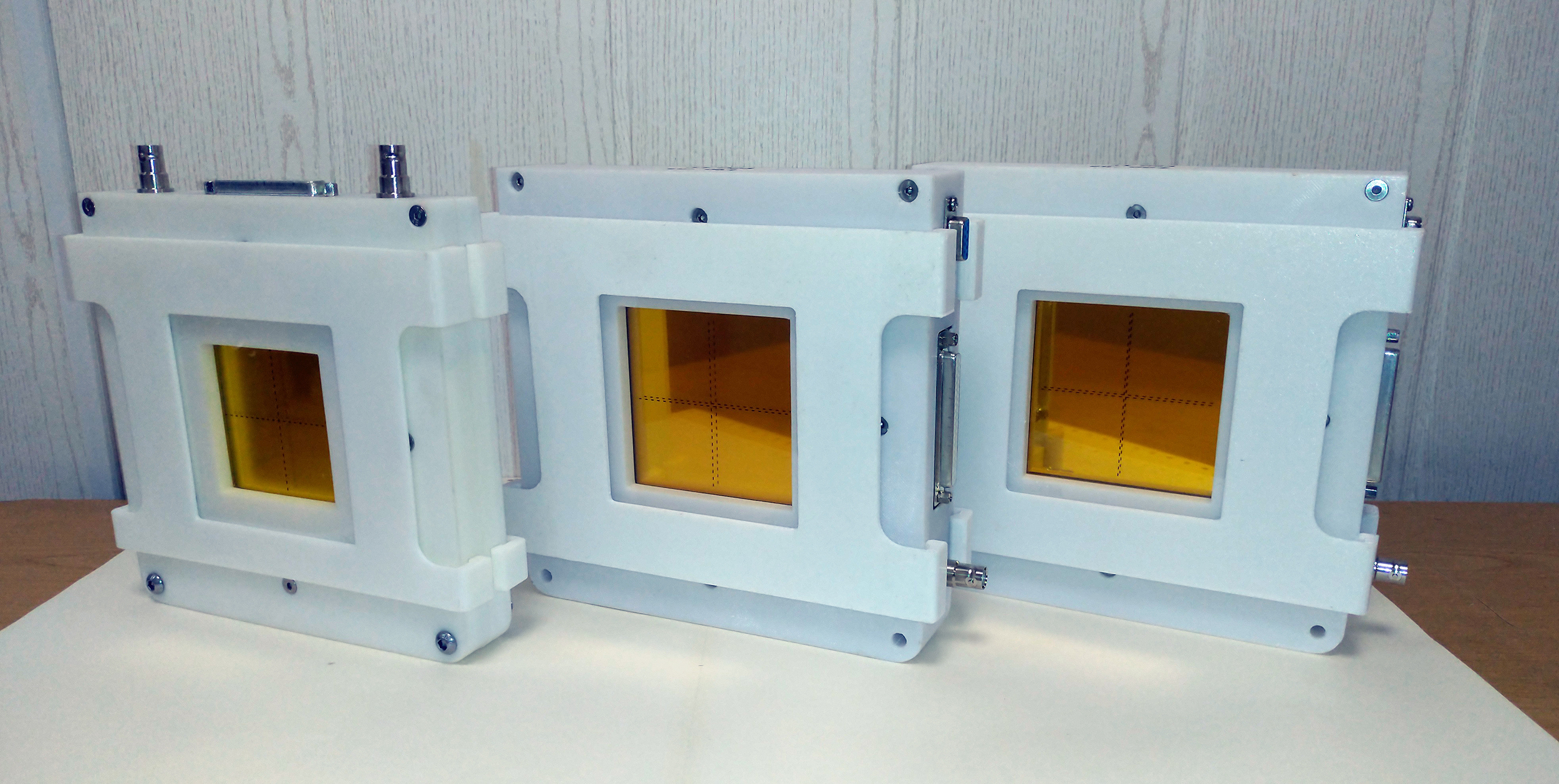 The ionisation chamber set for the ophthalmic oncology complex of the OKO Project
During the irradiation of patients with diseases such as ocular melanoma, proton beam parameter consistency must meet exceptionally high standards. There are several reasons for this: the small size of the irradiated melanoma, the organ’s high radiosensitivity, and the high radiation dose power.
The developed equipment is a ready-made solution that can serve as the basis for more complex systems for proton beam complexes with strict requirements for dosimetry and beam position estimation accuracy. Co-author of the developments, Head of the DLNP Radiation Medicine and Biology Sector Gennady Mitsyn explained it was advisable to separately develop ionisation chambers for each specific facility of beam therapy complexes and that such ICs cost even less than industrial chambers not currently supplied to Russia.
Employees of the Joint Institute for Nuclear Research have more than twenty years of experience in operating ionisation chambers of their own manufacture. For example, similar chambers were created for a pilot experiment aimed at studying how flash therapy affects human cell culture at the JINR phasotron in 2020. It took about a year to create the IC set for the OKO Project, including the electronics and software. “Using high-tech materials in the chambers allowed both increasing their “transparency” to irradiation and improving their characteristics. In addition, the application of modern electronics in the registration hardware enables much faster data transmission and processing”, Gennady Mitsyn commented.
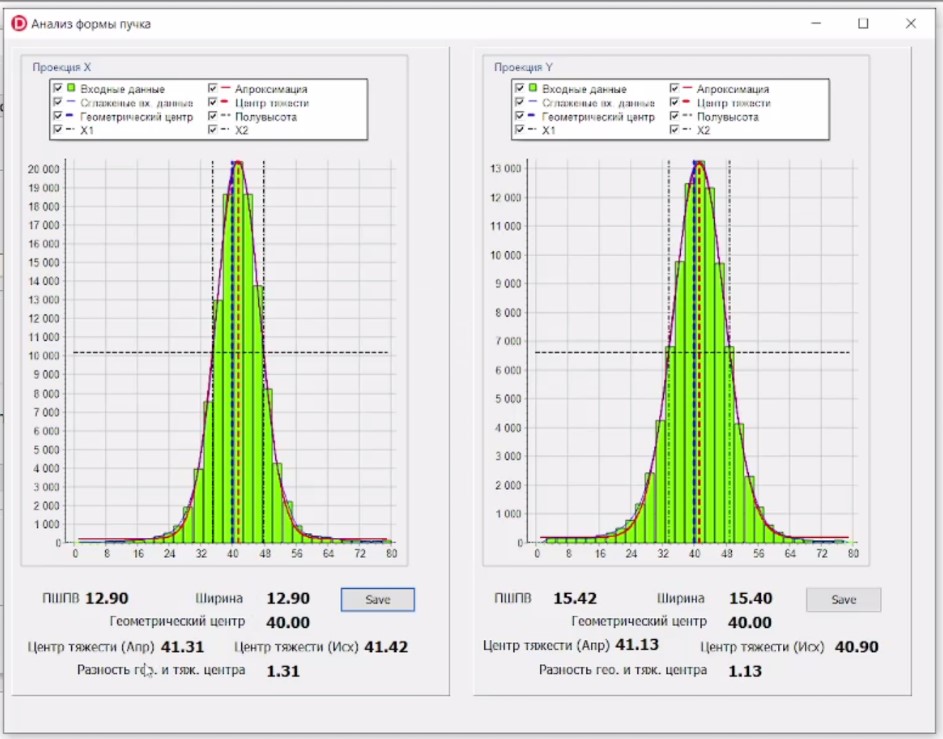 Narrow proton beam profiles measured using the ionisation chamber set
The results of the development, manufacture, and testing are presented in a joint paper by employees of DLNP at JINR, Moscow Radiotechnical Plant, Physics and Technology Centre of Lebedev Physical Institute, and Protom JSC (Protvino, Russia), which was published in the Medical Physics journal (No. 1, 2026). Employees of the Radiation Medicine and Biology Sector of the DLNP JINR Experimental Department of New Accelerators took part in working on the project and preparing the paper: a senior researcher Alexey Agapov, Sector Head Gennady Mitsyn, and a senior engineer Svetlana Uglova. The JINR research team continues to participate in the development and manufacture of ionisation chambers for three more projects.
Background information
A research complex for ophthalmic melanoma proton therapy (the OKO Project) is being created at the Petersburg Institute of Nuclear Physics of the National Research Centre Kurchatov Institute (Gatchina), with the C-80 Cyclotron as its main facility. The proton beam generated by the cyclotron allows irradiating practically all malignant eye neoplasms regardless of location, as well as superficial malignant neoplasms in the area of the eye orbit, head, and neck. The proton therapy complex for ophthalmic diseases is intended for treating patients from across the region. Four to five such complexes are required to provide care for patients of the entire country.