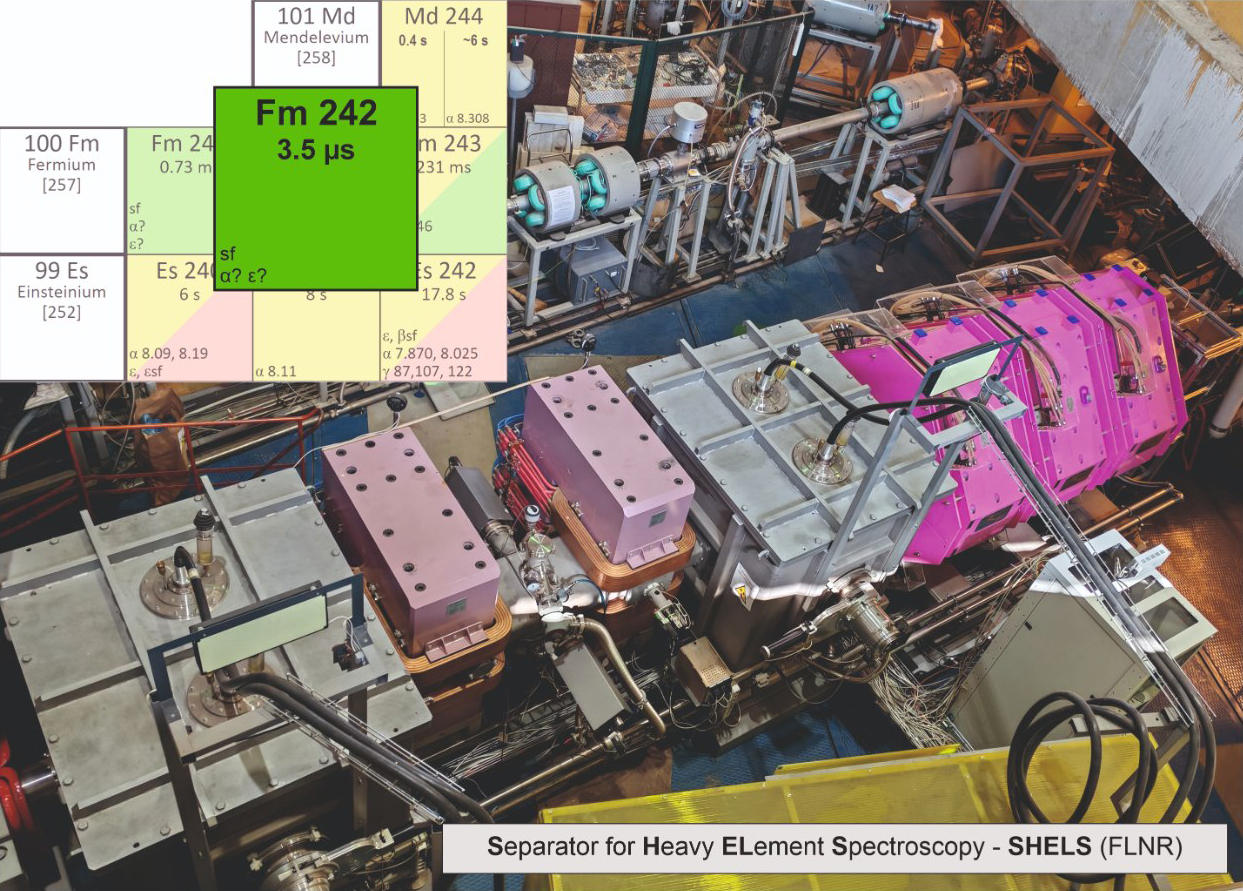
Scientists of the Flerov Laboratory of Nuclear Reactions at JINR obtained new, previously unknown data on the decay of the neutron-deficient fermium isotope – 242Fm. With its true decay characteristics reliably established for the first time, this equals to a rediscovery of the isotope. The experiment was performed at the SHELS Separator.
Short-lived fermium nuclei were produced in complete-fusion reactions of accelerated 38Ar ions with 206Pb and 207Pb targets. As a result, for the first time, it was possible to reliably measure the half-life of 242Fm: T1/2 = 3.5-1.0+1.7 microseconds. In addition, this experiment established that spontaneous fission is the only observed decay channel of this nucleus.
The first report on the discovery of 242Fm was made by Gurgen Mkrtychevich Ter-Akopyan and his colleagues at the FLNR at JINR in 1975 – at the time, the half-life was estimated as 0.8±0.2 milliseconds. Later, in 2008, Jadambaa Khuyagbaatar and colleagues, in an experiment at the SHIP Separator (GSI, Germany), demonstrated that this activity likely belongs to the decay of a lighter, previously unknown isotope, 241Fm. At the same time, due to the limitations of the SHIP registration system, the GSI experimenters only set an upper limit (< 4 microseconds) on the half-life of 242Fm. The new FLNR work resolved this long-standing contradiction and provided reliable decay characteristics of the neutron-deficient isotope 242Fm for the first time.
The study of radioactive decay near the limits of nuclear existence is important for understanding the properties and structure of heavy nuclei. In case of neutron-deficient isotopes of fermium and heavier elements, spontaneous fission is the most common, determining the limit of existence of these nuclei.
The experiment is detailed in the paper by Alexandr Svirikhin and his colleagues (JINR, E15-2026-57, Dubna, 2026). The work is dedicated to Professor Ter-Akopyan, whose pioneering studies largely determined the development of the physics of spontaneous fission of heavy nuclei.
Пресса