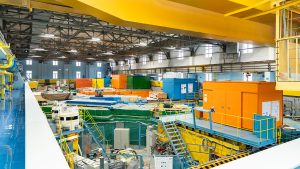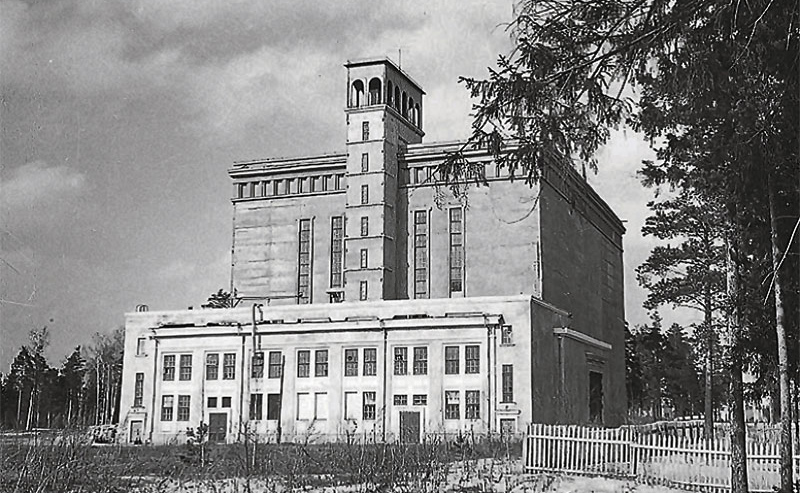
14 December 1949 marked a historic milestone – the launch of the synchrocyclotron, JINR’s first main facility later reconstructed into the phasotron.
Short history:
In 1948, a scientific centre was established on the right bank of the upper Volga River, near the Bolshaya Volga settlement. The new Hydroengineering Laboratory of the USSR Academy of Sciences (USSR AS) was a branch of the Laboratory #2 headed by Igor Kurchatov in Moscow. Mikhail Meshcheryakov was appointed Director of the Hydroengineering Laboratory and Scientific Leader for accelerator development, with Venedikt Dzhelepov as his deputy.
At the insistence of Igor Kurchatov, development of the synchrocyclotron started at the Laboratory No. 2. The accelerator department was established at the Laboratory (headed by Mikhail Meshcheryakov), aimed to develop a prototype of the future synchrocyclotron as soon as possible to check phase stability discovered in 1944 by Vladimir Veksler – the principle underlying the work of all high-energy cyclic accelerators.
The synchrocyclotron was ready for operation within a record-breaking period: it was launched on 14 December 1949. It was a historic event that enabled the development of a new field of research – high-energy particle physics. At the synchrocyclotron, deuterons were accelerated up to 280 MeV, α-particles up to 250 MeV, and later protons up to 480 MeV. Until 1953, the Synchrocyclotron had been the world’s largest accelerator. In 1953, after increasing the diameter of the synchrocyclotron magnet poles up to six metres and a substantial renovation of its high-frequency system, specialists put into operation a 680-MeV proton version of the accelerator.
In 1953, the Hydroengineering Laboratory received the status of an independent academic institute – the USSR AS Institute of Nuclear Problems (INP). In 1956, having joined JINR, INP became the Laboratory of Nuclear Problems. Venedikt Dzhelepov was elected DLNP Director, his tenure lasting until 1988. The Laboratory’s synchrocyclotron became JINR’s first operating main facility, and since 1963, it was universally recognised as the best synchrocyclotron in the world.