General Information on Cooperation
In 1976, the Republic of Cuba became a Member State of the Joint Institute for Nuclear Research. The Committee of Plenipotentiaries of Governments of the JINR Member States, having considered the appeal of the Cuban Government on the intention to join the Agreement on establishment of JINR signed on 26 March 1956 and on the recognition of the JINR Charter, accepted the Republic of Cuba as a JINR Member State.
The first collaborators from Cuba were theoretical physicists Rolando Durán, Jorge Molina and Carlos Rodriguez. In the following years, the number of Cuban researchers at JINR has been increasing: Cuban physicists worked not only in LTP, but also in other JINR laboratories as well (LNR, LNP, LIT).
Among the first staff members from Cuba at JINR was Dr. Castro Diaz Balart, who worked at JINR in 1972–1974 under the name of Jose Raul Fernandez Diaz.
In the early 1980s, FLNR researchers regularly visited their colleagues in Havana to participate in construction of the microtron. At the beginning of the 1990s, a large delegation of DLNP and FLNR specialists was sent to Cuba on the invitation of the host country that was going to construct its own cyclotron centre. However, due to economic challenges in the country of that time, the project was not implemented. In the late 1990s, JINR staff members visited Havana for several times to support operation of the microtron.
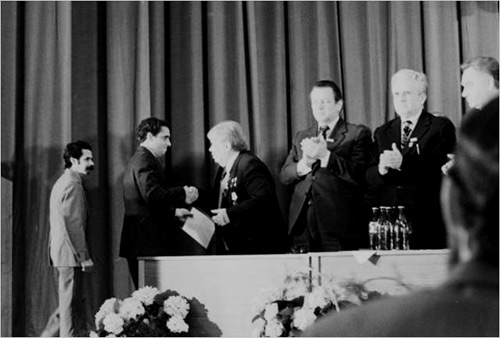
Unfortunately, the challenging economic situation of the 1990s influenced the participation of Cuba in the JINR activities, and since 1992, Cuba did not pay its membership fee. Since 1997, Cuba did not participate in almost all JINR activities.
In 2006, on the eve of JINR’s 50th anniversary, negotiations took place between JINR Director Prof. A.N. Sissakian and H.E. Mr. Jorge Martí Martínez, Ambassador Extraordinary and Plenipotentiary of the Republic of Cuba to the Russian Federation. During the meeting, an agreement was reached on Cuba’s intention to renew its participation in JINR and on the necessity of an official JINR delegation visit to Cuba. In April 2007, such a visit to Havana took place. The JINR delegation was led by JINR Vice-Director M.G. Itkis, accompanied by Chief Scientific Secretary N.A. Russakovich and Director’s Assistant G.M. Arzumanyan.
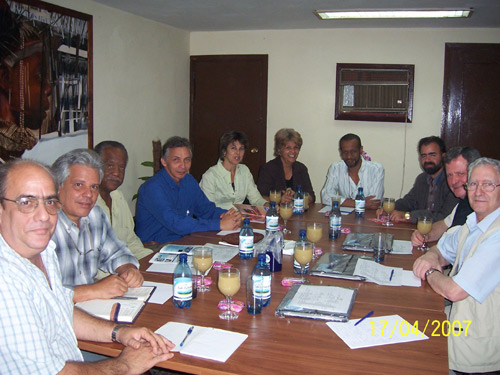
The delegation visited several scientific institutes specializing in nuclear physics, as well as the Center for Genetic Engineering and Biotechnology, located in Havana and its surroundings.
Meetings and negotiations also took place at the Ministry of Science, Technology and Environment of the Republic of Cuba regarding the renewal of Cuba’s active participation in JINR.
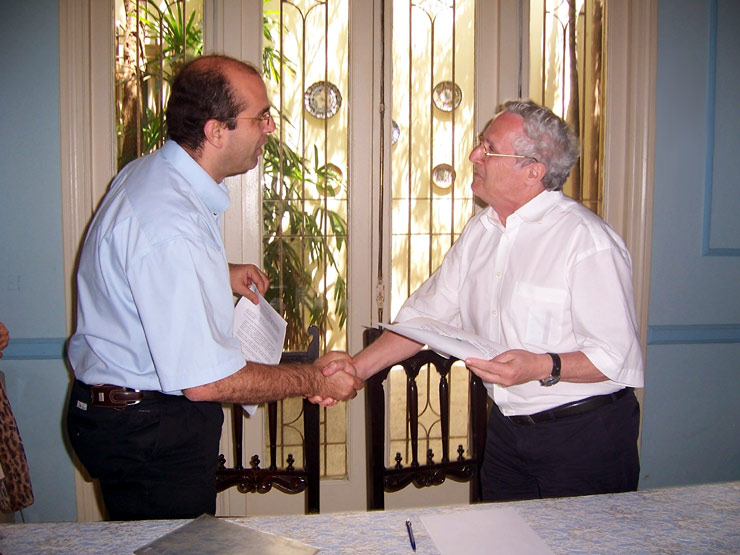
As a result of the negotiations, a Memorandum was signed, in particular noting that both sides agreed to request the Committee of Plenipotentiaries to cancel the accumulated debt of the Republic of Cuba to JINR for the period 1992–2007. In November 2007, the Committee approved this proposal and cancelled Cuba’s debt for the specified period, taking into account that Cuba would resume its participation in JINR and regularly pay its contribution to the Institute’s budget starting from 2008. Another point of the document stipulated the appointment by the Government of the Republic of Cuba of a new Plenipotentiary Representative and a member of the JINR Scientific Council from Cuba.
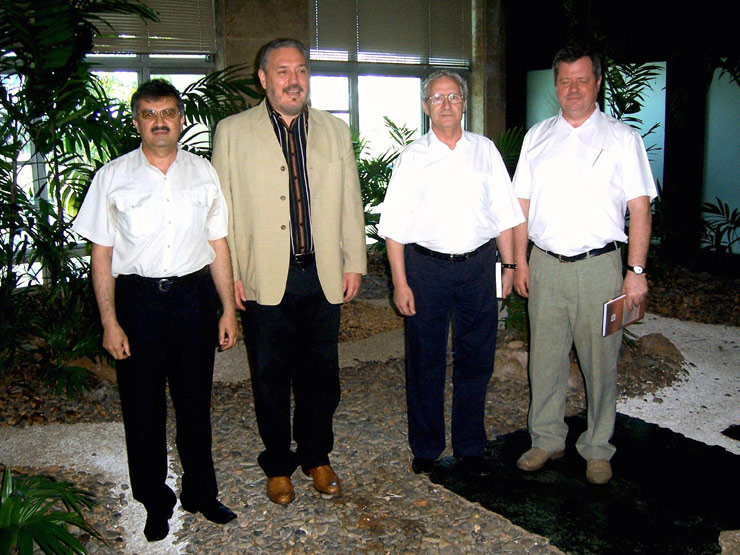
The outcomes of the Havana visit and negotiations were summarized at the Cuban State Department, where the JINR delegation was received by Dr. Fidel Castro Díaz-Balart, Scientific Advisor to the President of the Republic of Cuba.
In 2007, Jorge Fernández Chamero (Director of a department of the Ministry of Science, Technology and Environment of Cuba) was appointed Plenipotentiary Representative of Cuba in JINR, and Fernando Guzmán Martínez (Rector of the Higher Institute of Technologies and Applied Sciences) – member of the JINR Scientific Council.
In September 2014, Cuba delegated its representatives to work at the Flerov Laboratory of Nuclear Reactions and the Dzhelepov Laboratory of Nuclear Problems: Senior Researchers Dr. Antonio Leyva Fabelo (Dzhelepov Laboratory of Nuclear Problems) and MSc. Adelmo Montalvan Estrada (Flerov Laboratory of Nuclear Reactions).
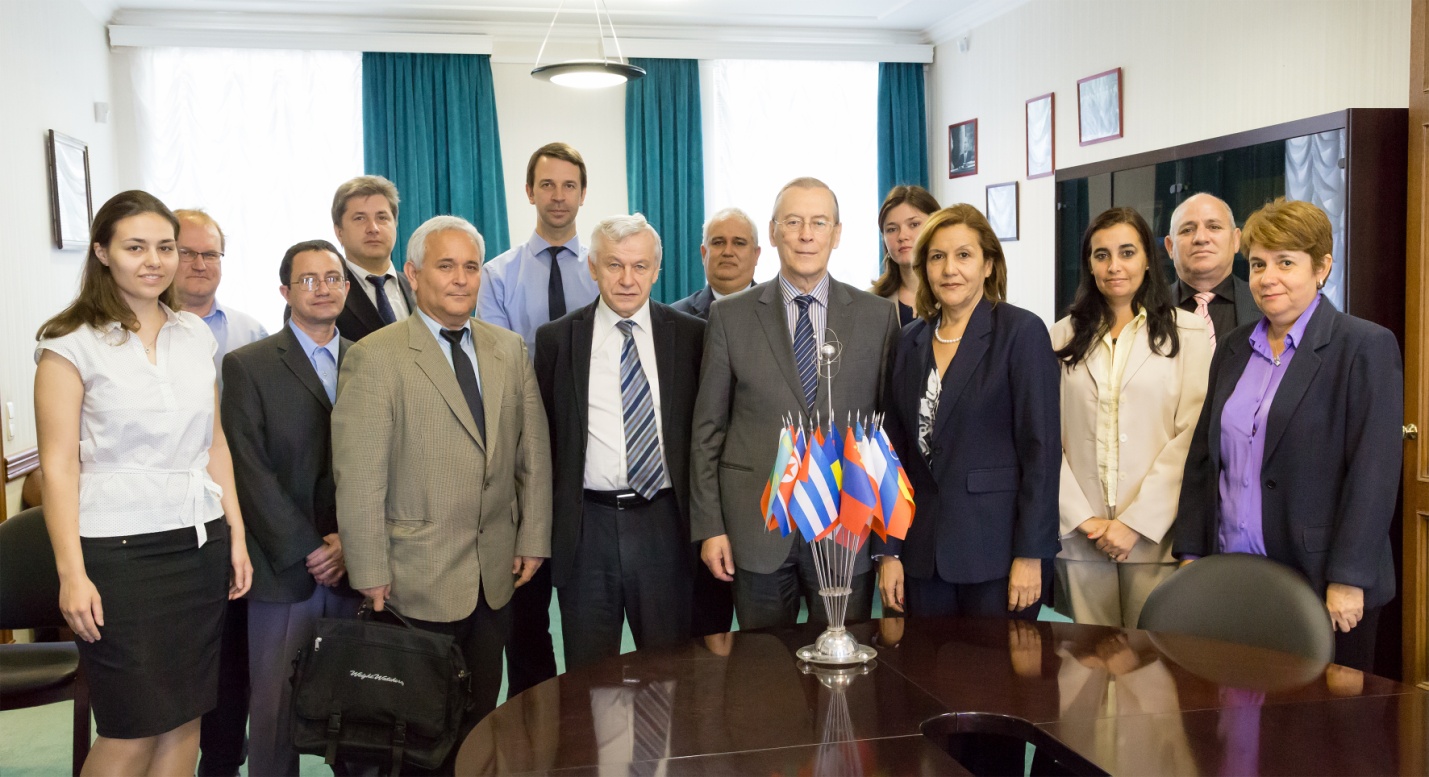
A delegation from the Ministry of Science, Technology and Environment of Cuba, headed by Minister Dr. Elba Rosa Pérez Montoya, visited JINR on 2 June 2015. In 2015, Cuban students also participated in the International Student Practice at the JINR University Centre.
JINR’s unique experience over the decades demonstrates that contributions from Member States (financial and material) are always fully repaid and eventually returned to the country. For instance, JINR is widely recognized as an international school of high professional qualification for individuals coming here for work or internships.
Present day
Currently, the cooperation of Cuba and JINR is developing successfully in different directions.
Cuban scientists are involved in several research programs of the Institute, including the development of new semiconductor detectors for fundamental and applied research, the physics programme of the SPD and MPD detectors in the frames of the NICA mega-science Project, and the modernization of the LINAC-800 linear electron accelerator.
More than 20 young Cuban scientists have already participated in the educational programmes of JINR. Starting in 2014, Cuban students have continuously participated in the JINR Summer Student Programmes. Since 2015, Cuba has participated in the International Student Practice (ISP) as well.
In the period 2015–2019, nine graduate students of InSTEC completed internships at DLNP JINR, which allowed them to enrich their Bachelor’s theses with outstanding results obtained in this laboratory of recognized international prestige.
Since 2017, Cuba has annually participated in the International Training Program for Administrative and Scientific Staff JEMS “JINR Experience for Member States and Partner Countries”, as well as in the Helmholtz International Summer School “Nuclear Theory and Applications in Astrophysics”.
Scientists from the Republic of Cuba participate in scientific themes of the Topical Plan for JINR Research and International Cooperation for the year 2025:
- Elementary Particle Physics and High-Energy Heavy-Ion Physics
Cooperation on 3 themes. - Nuclear Physics
Cooperation on 1 theme. - Radiation Research in Life Sciences
Cooperation on 1 theme. - Organization of Scientific Activity and International Cooperation. Strengthening Human Resources. Educational Programme
Cooperation on 1 theme.
At present, JINR actively cooperates with the Higher Institute of Applied Science and Technology (InSTEC).
Since March 2023, the Plenipotentiary Representative of the Government of the Republic of Cuba in JINR is Dr. Gonzalo Walwyn Salas, Director of the Centre for Radiation Protection and Hygiene (CPHR).
The plenipotentiaries of the government of the Republic of Cuba in JINR since 2007:
2007 – 2013
- Jorge Fernández Chamero, Director of a department of the Ministry of Science, Technology and Environment of Cuba;
2013 – 2018
- Fidel Castro Díaz-Balart, Scientific Advisor to the President of Republic of Cuba;
2019 – 2023
- Angelina Díaz García, Director-General of the Centre for Advanced Research of Cuba – CEAC (Havana, Cuba);
2023 – present day
- Gonzalo Walwyn Salas, Director of the Centre for Radiation Protection and Hygiene (CPHR).
Since June 2019, the member of the JINR Scientific Council is Dr. Iván Padrón Díaz, Director of the Centre of Technological Applications and Nuclear Development – CEADEN (Havana, Cuba).
Members of the Scientific Council from Cuba since 1976:
1976, 1980–1986
- Valuerdi Monico Leonard, Director of the CAS Department of Science and Technology, Scientific Secretary of the National Board of Cuba for Peaceful Use of Nuclear Energy, professor, Head of the Department of the Executive Secretariat for Nuclear Issues of the Cuban Council of Ministers, Senior Researcher of FLNR JINR;
1978–1979
- Ernandes Aurelo Tulio, Deputy Director of INP CAS, Researcher of FLNR JINR;
1981, 1983, 1985
- Melian Manuel, staff member of the Cuban Embassy in USSR, staff member of the Executive Secretariat for Nuclear Issues of the Cuban Council of Ministers;
1983
- Entralgo Elias, Deputy Director of INP CAS;
Rubio Derbi, Researcher of FLNR JINR;
1984–1985
- Rigol Jorge, Researcher of FLNP JINR;
1984, 1986
- Toledo René, Researcher of DLNP JINR;
1986
- Aurelo Tuleo, Representative of the Cuban Embassy in USSR;
1987
- Cabesas Roberto, Head of a department of INP, Senior Researcher of the Centre for Applied Nuclear Research;
1987, 1989, 1990
- Codorniu Daniel, INP Director, Director of the Centre for Applied Nuclear Research;
1987–1988, 1990–1991
- Pedrero Edwin, Head of a Department of INP, professor, Head of a Department in the Centre for Applied Nuclear Research, Prorector of the Higher Institute for Nuclear Physics and Technologies;
1989
- Lopez Roberto, Head of a Department in the Higher Institute for Nuclear Physics and Technologies, researcher;
1991–1993
- Fernandez Francisco, Senior Researcher of LCTA-JINR;
1993
- José Morin, Advisor to the Cuban Embassy in Russia, Chairman of Executive Secretariat for Nuclear Issues;
1995
- Rigol Jorge, Senior Researcher of FLNR JINR;
1993–1996
- Blanca José, Scientific Advisor to the Cuban Embassy in Russia, Doctor of physical and mathematical sciences, Vice-Chairman of the Cuban Nuclear Energy Agency;
2007–2012
- Fernando Gusman Martinez, Rector of the Higher Institute for Technologies and Applied Sciences;
2012–2016
- Ivan Padron Diaz, Director of the Centre of Technological Applications and Nuclear Development – CEADEN (Havana, Cuba);
2016–2019
- Anjelina Diaz Garcia, Director of the Centre for Advanced Research of Cuba – CEAC (Havana);
2019 – present day
- Iván Padrón Díaz, Director of the Centre of Technological Applications and Nuclear Development – CEADEN (Havana, Cuba).
The languages of international communication at JINR are Russian and English. However, one can hear the speech in many languages in Dubna, including the languages of JINR Member States when the countrymen, the representatives of the same expatriates’ community (the national groups of JINR), meet each other.
Over the years of existence of JINR the national groups have developed their traditions, forms of cooperation and collaboration with other national groups. Their leaders, appointed by the plenipotentiaries of the JINR Member States play an organizing role in the life of national groups.
Katherin Shtejer Diaz
Head of the national group of the Republic of Cuba, DLNP JINR Senior Researcher
+7 (496) 216-35-60
email: kshtejer@jinr.ru, kshtejer@gmail.com
Being in constant contact with plenipotentiaries, embassies of the Member States, the JINR Directorate and management services, they take part in the solution of the problems connected with the staying of their colleagues-countrymen and their families in Russia, with organization of their life and leisure. The Council of the leaders of the national groups has regular meetings. The representatives of the Directorate and the services of the Institute are invited to these meetings. The agenda includes discussion of urgent problems of the collaborators from the Member States. Due to this, the Directorate is able to make adequate decisions in time.
On the occasions of major public holidays of the Member States, the national groups arrange receptions. These festive events are held accompanied by art exhibitions, photo exhibitions, and enrich JINR staff members’ knowledge about the JINR Member States, their people and culture.
- Liberation Day of Cuba – January 1–2;
- International Workers’ Day – May 1;
- National Uprising Day. Attack on the barracks of Moncada and Carlos Manuel de Cespedes by a group led by Fidel Castro in 1953 – July 26. Also are holidays – July 25 and 27;
- Anniversary of the start of the war for independence from Spanish colonialism in 1868 – October 10;
- Catholic Christmas – December 25;
- The New Year’s Eve party and celebration on the eve of the victory of the Cuban Revolution in 1959 – December 31.
25–28 February 2024
the International School on Nuclear Methods and Applied Research in Environmental, Material and Life Sciences (NUMAR-2024), organized by JINR and AENTA, took place in Varadero25 February – 5 March 2019
a JINR team led by Vice-Director B.Yu. Sharkov worked in Havana to explore collaboration opportunities with the Centre for Advanced Research of Cuba1–5 February 2016
JINR Days in Latin America were held in Havana as part of JINR’s 60th anniversary celebrationsJuly 2015
Cuban students participated in the International Student Practice at the JINR University Centre2 June 2015
A delegation from the Ministry of Science, Technology and Environment of Cuba, headed by Minister Dr. Elba Rosa Pérez Montoya, visited JINR9 December 2014
Rector of InSTEC Dr. Barbara Garea Moreda and colleagues visited JINR and Dubna State UniversitySeptember 2014
Cuba delegated Senior Researchers Dr. Antonio Leyva Fabelo and MSc. Adelmo Montalvan Estrada to work at JINR27 September 2013
JINR Plenipotentiary of Cuba Prof. Fidel Castro Díaz-Balart became Honored Professor of Lomonosov Moscow State University