From 7 to 3 August 2026, the Bogoliubov Laboratory of Theoretical Physics is hosting the Quantum Field Theory and Applications summer school. The event is organized by BLTP JINR as part of the DIAS-TH (Dubna International Advanced School of Theoretical Physics) programme. More than 40 students and postgraduates from the universities of Moscow, Samara, Sarov, St. Petersburg, Tomsk, Vladivostok, and Voronezh took part in it.
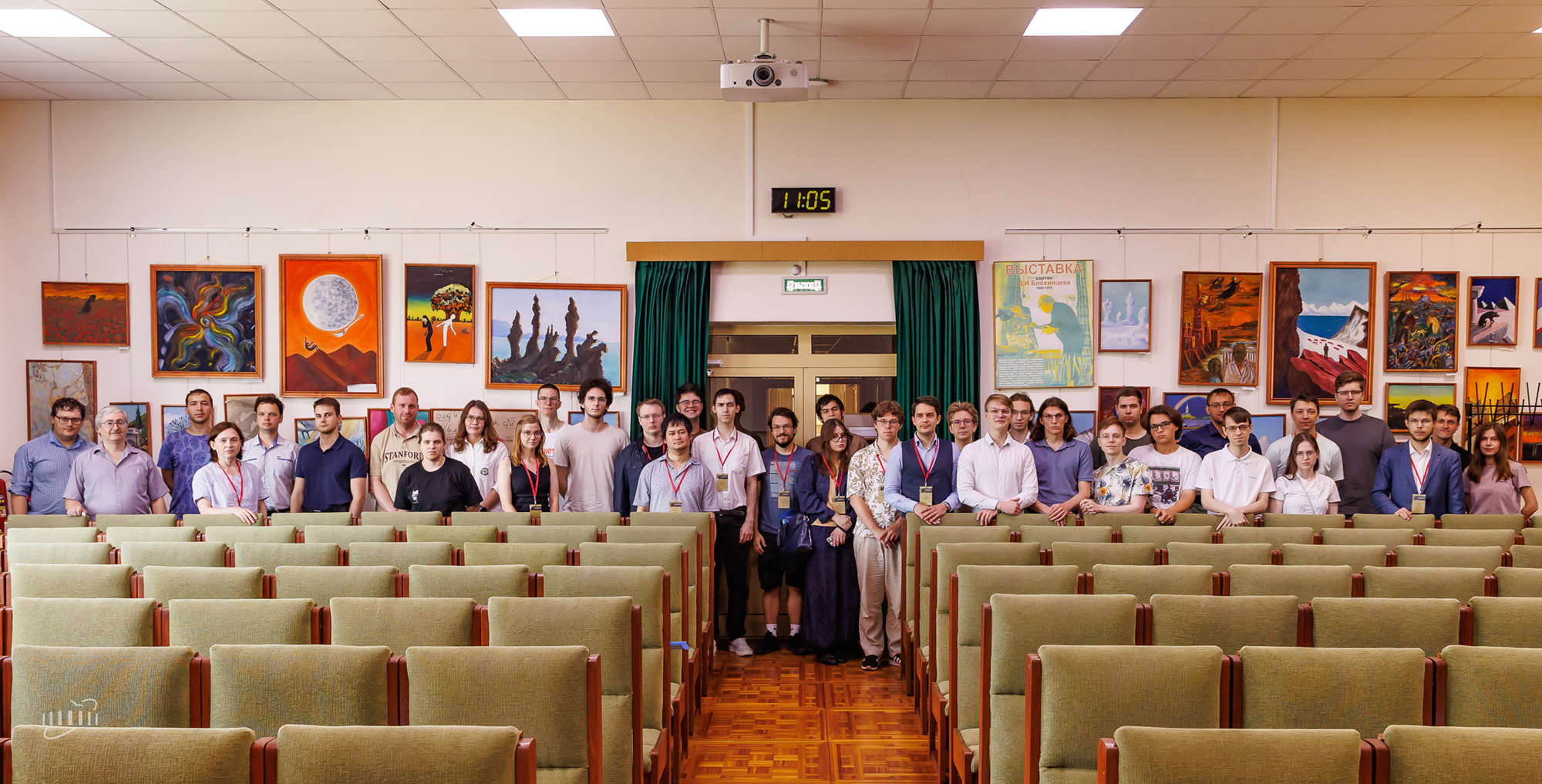

On the first day, JINR Vice-Director, DIAS Rector Elena Kolganova delivered a welcome speech. She reminded that theoretical physics schools have been held at BLTP JINR for more than twenty years. Each year, the laboratory organizes these events on different topics, bringing together many participants. The JINR Vice-Director said that the laboratory’s website presents recordings of lectures by famous scientists, lecturers of schools of previous years. At the end of her speech, she encouraged students to actively participate in discussing and asking questions on lecture materials and wished them inspiration and success in science.
The Quantum Field Theory and Applications school is being held at JINR for the first time. The goal of the school is to show that the BLTP remains a leading Russian and global centre for quantum field theory studies, as well as to attract young specialists to joint scientific work with laboratory researchers.
The scientific programme includes introductory lecture courses aimed at students of different scientific background. The course by BLTP senior researcher Nikita Lebedev is devoted to the basics of relativistic quantum field theory and intended for students who already know the non-relativistic quantum mechanics, but have not yet studied quantum field theory systematically.
Lectures by BLTP chief researcher Evgeny Ivanov introduce students to the basic concepts of supersymmetric theories in four dimensions, with an emphasis on N=1 supersymmetry. Starting with a discussion of symmetries in physics, the scientist defines supersymmetry and studies its basic properties. After that, representations of N=1 supersymmetry in four-dimensional space-time are constructed, and the concept of a superspace and a superfield is introduced.
Professor of the Theoretical Physics Department at the Moscow State University Faculty of Physics Konstantin Stepanyants discusses the idea of constructing a unified theory of strong and electroweak interactions based on some broad group of gauge symmetries, such as SU(5) or SO(10), which spontaneously breaks down to the Standard Model at energies of 1016 GeV. Such models are called Grand Unified Theories in the literature. Students will learn how such theories are created and what predictions they lead to. The course will discuss both the successful results and the unresolved problems of this concept.
Another course is devoted to quantum gravity. The course of Lebedev Physical Institute leading researcher Andrey Barvinsky on quantum gravity and cosmology includes an introduction to the canonical formalism of the gravitational field, quantisation of gauge systems with connections, and the theory of the cosmological wave function. Special attention is paid to the application of these formalisms to the study of known quantum states that serve as sources of initial data for cosmological evolution: the Hartl-Hawking wave function, the Vilenkin tunneling wave function, and the microcanonical density matrix of the Universe. In addition, students are briefly introduced to the theory of cosmological inflation.
A live broadcast of the lectures is available on the BLTP JINR website.