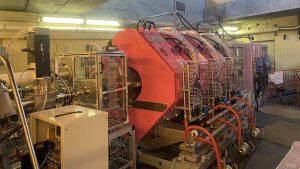
The multiplicity of prompt neutrons emitted in the spontaneous fission of seaborgium isotopes (258,260Sg) was measured for the first time at the Joint Institute for Nuclear Research. The experiment was conducted by specialists from the Flerov Laboratory of Nuclear Reactions at a complex of facilities: the SHELS Separator and the SFiNx Detection System. Scientists from the Bogoliubov Laboratory of Theoretical Physics participated in modelling and interpreting the results. The data obtained is important for studying superheavy element fission and developing advanced theoretical approaches.
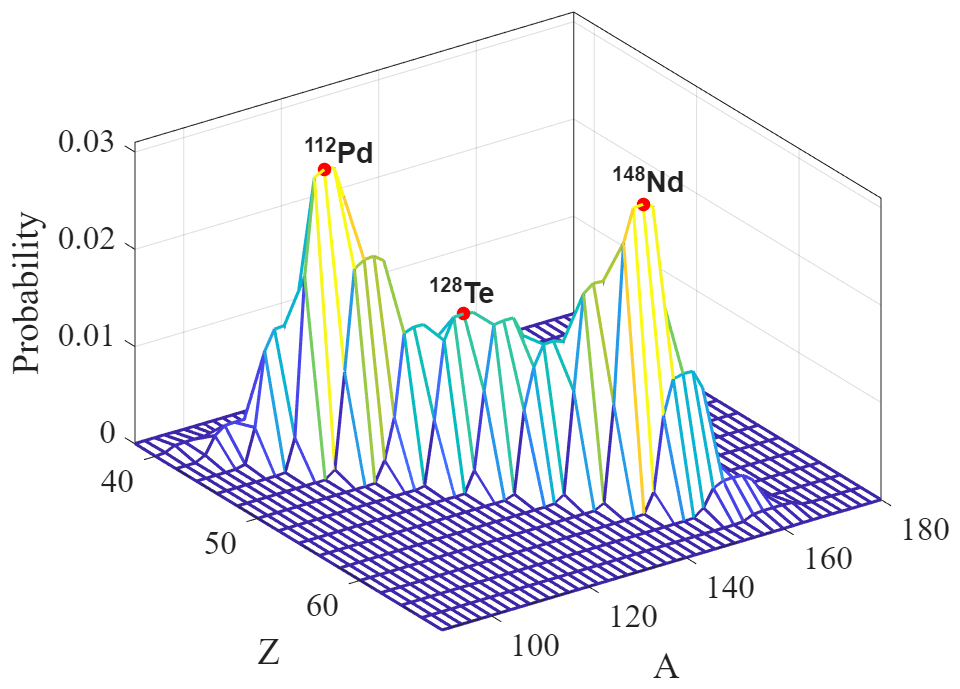 Calculated mass-charge distribution of fragments for the spontaneous fission of seaborgium-260
Spontaneous fission is one of the fundamental processes determining the stability of the heaviest nuclei. Measuring the number of prompt neutrons emitted during decay provides physicists with important information about the configuration of the nucleus at the scission point. To date, among the elements for which measurements were successfully conducted, seaborgium (Z=106) has the highest nuclear charge. Research on such heavy systems is extremely complex from an experimental standpoint, so the obtained results can remain unique for many years.
To synthesise seaborgium isotopes, the physicists used complete fusion reactions of accelerated beams of chromium-52 and chromium-54 nuclei as well as a lead-207 target (52,54Cr+207Pb). The efficient isolation of seaborgium nuclei from the flow of byproducts was ensured by the upgraded SHELS Separator. The capture and registration of emitted fission neutrons were performed by the highly efficient SFiNx System.
During the experiment, for the first time, the scientists reconstructed the prompt neutron multiplicity distribution of seaborgium-260. The average number of neutrons per fission event was 5.03 ± 0.14. In the fission of isotope seaborgium-258, this value was determined to be 4.9 ± 0.4. In addition, the researchers managed to measure the half-lives of both nuclei with higher confidence limit and determine the probability of alpha decay of seaborgium-260.
The study was carried out by an international team of scientists from Russia, Kazakhstan, and Iran. Detailed results were published in the Physical Review C journal.