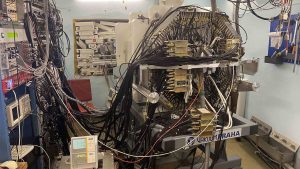
For the first time, specialists of the Joint Institute for Nuclear Research measured the average number of prompt neutrons emitted during the spontaneous nuclear fission of rutherfordium-260. The experiment was conducted by the Flerov Laboratory of Nuclear Reactions at the U-400 Cyclotron using the SHELS Separator and the SFiNx Detection System with the participation of scientists from the Bogoliubov Laboratory of Theoretical Physics. The data obtained deepens scientists’ understanding of the decay mechanisms of transuranic elements and opens up new opportunities for studying nuclei near the boundaries of nuclear stability.
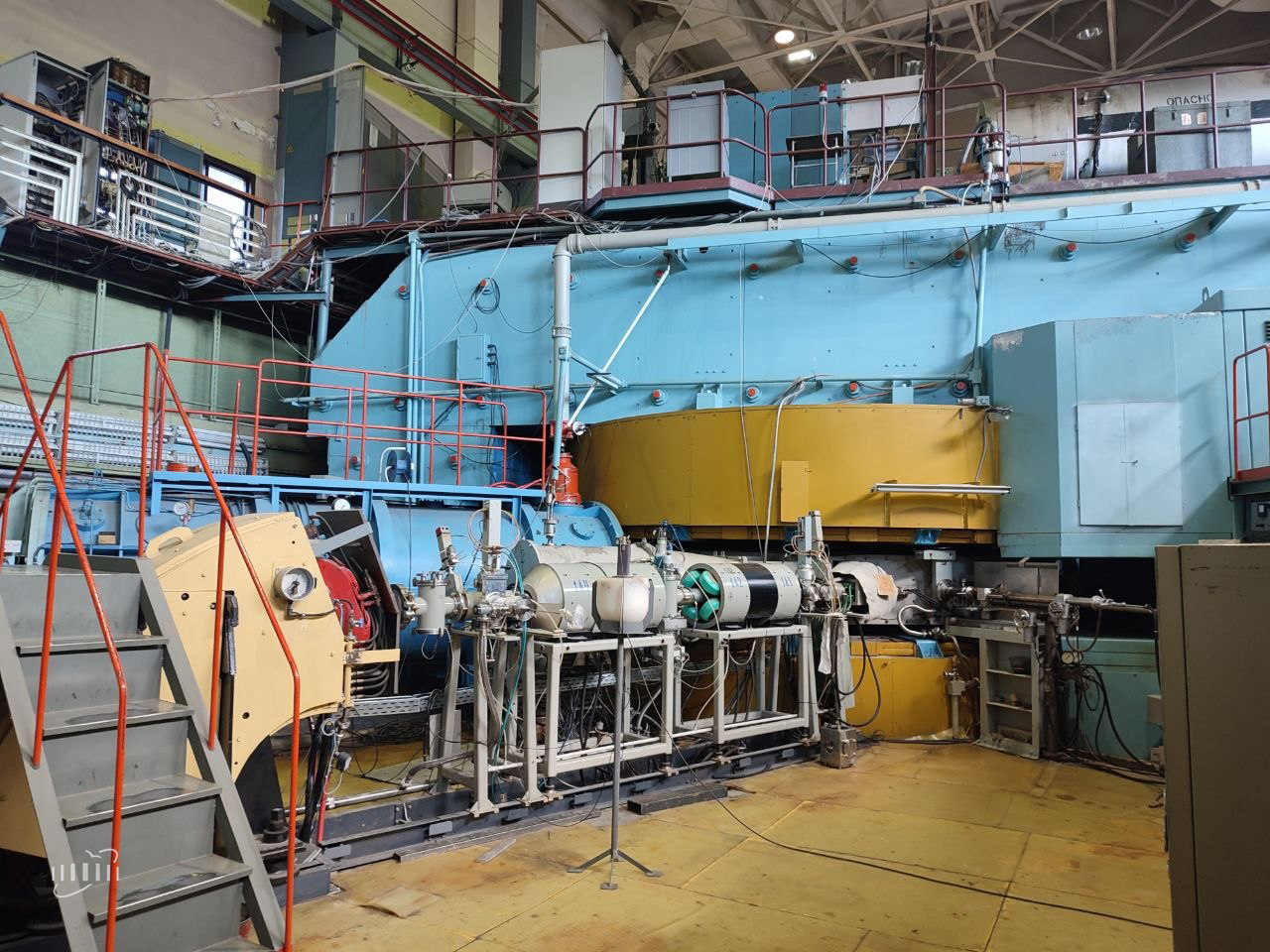 U-400 Cyclotron
The spontaneous fission of heavy and superheavy nuclei is determined by a delicate balance between the Coulomb repulsion of protons and the stabilising quantum shell effects. Measuring the number of prompt neutrons emitted during decay allows physicists to directly study the configuration of a nucleus at the moment of scission, assessing its deformation and excitation energy. Previous experimental studies only focused on lighter, neutron-deficient rutherfordium isotopes, and no data was available regarding the heavy 260Rf isotope.
To obtain rutherfordium-260, the scientists used the complete fusion reaction of a beam of accelerated magnesium-26 nuclei with a uranium target. The modernised SHELS Separator helped isolate the rare isotope from the by-products. Precision adjustment of its electrostatic deflectors allowed effectively filtering the products of competing reactions. Capture and registration of emitted neutrons was performed by the high-sensitivity SFiNx System comprising 116 helium-3 neutron counters.
During the measurements, researchers managed to record 53 events of spontaneous fission of 260Rf. The average number of neutrons per fission act of the isotope was 4.88 ± 0.24, and the half-life of the nucleus was refined and amounted to $16,8 \substack{+5,5 \\ -3,8} \text{}$ milliseconds. Theoretical calculations performed within the stochastic scission-point model demonstrated good agreement with the experimental data.
The success of this experiment confirms the high efficiency of combining the SHELS Separator and the SFiNx Detector. In the future, JINR physicists plan to use this hardware complex for the studies of even rarer and shorter-lived isotopes, including research at the Superheavy Element Factory.
The international team of scientists represented Russia, Kazakhstan, Azerbaijan, and Iran. Detailed results of the work are available in The European Physical Journal A.