The ATLAS Collaboration at the Large Hadron Collider (CERN) announced the discovery of a new excited state – a $B^{*+}_c$ vector meson. Physicists of the Laboratory of Nuclear Problems and the Laboratory of Information Technologies at JINR made a decisive contribution to experimental data analysis.
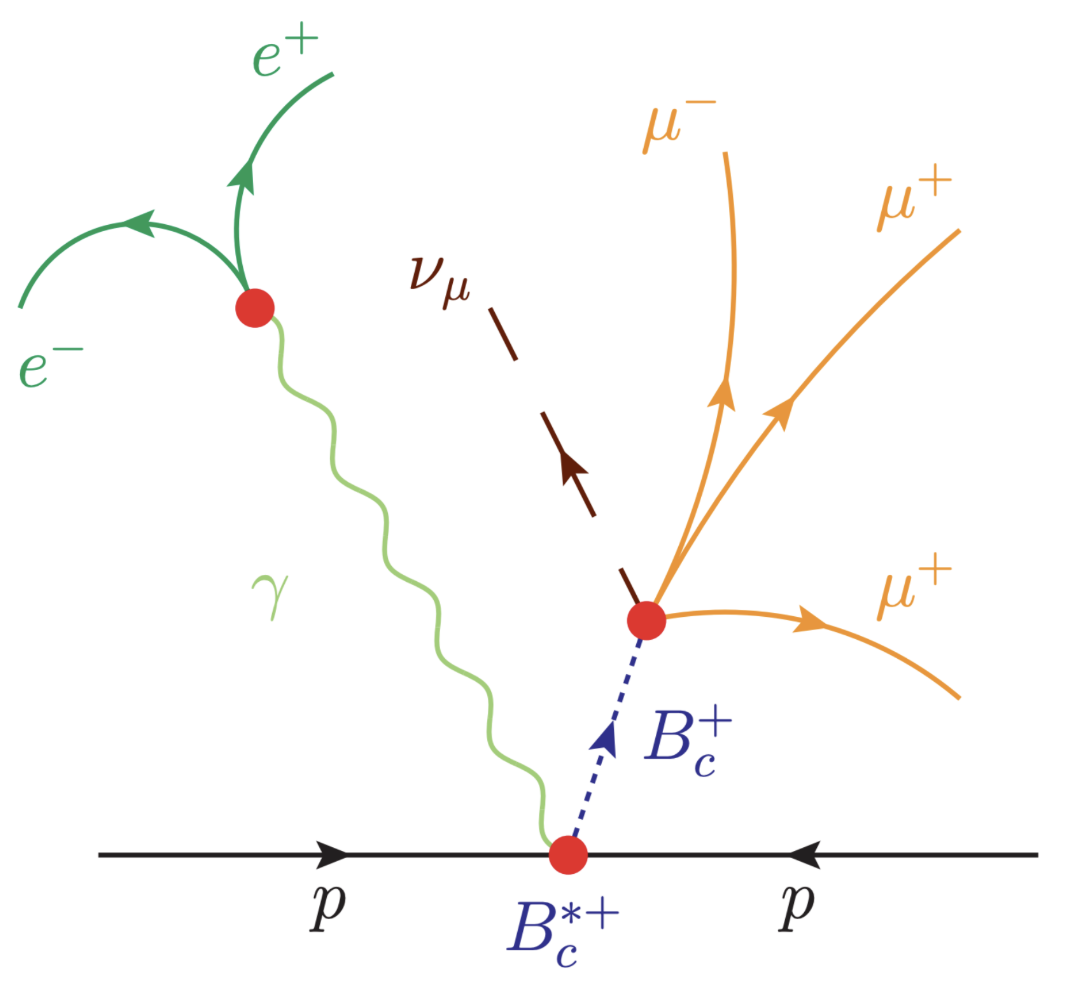 Sketch of final state particles produced by the decay chain used in the ATLAS analysis © ATLAS Collaboration, CERN
At the Large Hadron Collider Physics 2026 conference, researchers from the ATLAS Collaboration announced the first observation of a particle with properties consistent with the $B^{*+}_c$ meson, the lowest excited $B^{*+}_c$ meson.
Most known mesons consist of light quarks. However, the new $B^{*+}_c$ meson contains two heavy quarks – a bˉbˉ quark and a cc quark. Moreover, the spins (intrinsic angular momenta) of these quarks in the open meson are aligned, which also makes the open meson “vector”. In the ground – “scalar” – state of the meson, their spins are oppositely oriented.
Physicists searched for the new particle in ground state decay with photon irradiation. The main difficulty laid in the fact that the mass difference between the ground and excited states of the 𝑩*c+ meson is only about 64.5 MeV. Because of this, the resulting photon’s energy is very low for collider physics.
“Usual LHC detectors just do not notice such a “soft” photon – it gets lost in billions of other collision signals. So the ATLAS Collaboration researchers applied a clever trick. Instead of detecting photons by energy deposition, they reconstructed photons, which, upon interaction with the detector material, transform into an electron-positron pair. By the trajectories of these charged particles in the internal tracker, scientists managed to restore the energy of the “invisible” photon”, a researcher at the DLNP JINR Experimental Department of Colliding Beams Tatiana Lyubushkina explained.
In microworld physics, a discovery is considered reliable if its statistical significance exceeds five standard deviations. The significance of the recorded signal was more than eight standard deviations, meaning that the probability of a statistical error or random data fluctuation is extremely low.
The discovery provides new valuable information for theoretical models describing the mass spectra of heavy hadrons and helps to better understand the strong interaction – a fundamental force binding quarks and holding atomic nuclei from decay. A system of two heavy quarks of different flavours is an ideal “natural laboratory”, on the example of which theoretical calculations of quantum chromodynamics can be verified with unprecedented accuracy.
Experimental data analysis allowing the first observation of the new particle involved a leading researcher at the DLNP JINR Experimental Department of Colliding Beams Leonid Gladilin, a researcher Tatiana Lyubushkina, and MLIT JINR EventIndex Group employees headed by Igor Alexandrov. The research results were published on an electronic preprint archive website: arXiv:2605.16228.