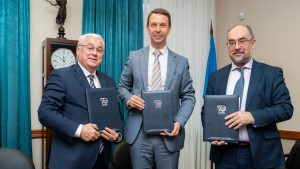
On 25–26 June 2026, the 63rd meeting of the JINR Programme Advisory Committee on Condensed Matter Physics took place at the JINR International Conference Centre. The PAC members discussed the progress of the IBR-2 Reactor and the prospects for designing a new neutron source, the creation of a neutron imaging and small-angle scattering spectrometer, the development of a wide-aperture back-scattering detector for the HRFD Diffractometer, as well as the prolongation of the project on computational physics methods for complex system studies.


PAC CMP Chair Dénes Lajos Nagy opened the event with a talk on the implementation of the previous PAC meeting recommendations. Joint Institute’s Vice-Director Sergey Kulikov presented the resolution of the 139th Scientific Council session (February 2026) and the decisions of the Committee of Plenipotentiaries of the Governments of the JINR Member States (March 2026).
Director of the Laboratory of Neutron Physics at JINR Egor Lychagin spoke on the progress of the IBR-2 Pulsed Reactor, the prospects for its use, and plans to create a new reactor to replace it.
The IBR-2 resumed regular operation – about 80 days per year – at 1.4 MW. The FLNP user programme currently has members from 27 countries. In 2026, 200 new participants from 21 countries were registered, with 75 % of new users representing Russian centres. The nuclear facility operation licence is valid until April 2032. A new reactivity modulator was manufactured for the reactor; work is underway to produce a new nuclear fuel load. Replacing the fuel could allow the reactor to return to its nominal power of 2 MW. In turn, the successful fulfilment of licensing requirements, paired with fuel and reactivity modulator replacement, open up prospects for extending the reactor’s service life until the end of the 2040s.
FLNP and the Dollezhal Research and Development Institute of Power Engineering are developing the project of a new neutron source at JINR. The Neptune Project requires a different type of fuel, as well as a number of engineering solutions that are new to reactor construction, with some having no analogues in the world and still posing many technical queries. Therefore, the FLNP team is additionally working on the concept of another source – IBR-4, a facility based on proven technical solutions, with parameters similar to those of Neptune. Specialists are modelling the new reactor’s parameters and potential instruments.
Head of the FLNP Scientific and Experimental Department of Neutron Research in Condensed Matter Denis Kozlenko provided an update on the neutron imaging (radiography and tomography) configuration for the new combined neutron imaging and small-angle scattering spectrometer on the 10A channel of the IBR-2 Reactor. The speaker announced that the configuration is already functional and discussed the first scientific and methodological results obtained using the spectrometer.
The facility will complement the NRT (radiography and tomography) and YuMO (small-angle neutron scattering). Test measurements of the spatial resolution and spectral distribution of the incident neutron beam, as well as the first experiments on standard and energy-dispersive radiography and tomography, finished. The results showed that the spatial resolution of the neutron imaging configuration will be approximately two times lower than that of the NRT. However, it could prove more effective in energy-dispersive radiography and tomography methods than NRT, which will open up new opportunities for research implementing these methods.
The small-angle scattering configuration of the new spectrometer is yet to be completed due to the delayed delivery of the position-sensitive detector.
The report on the “Methods of computational physics for the study of complex systems” project and a proposal for its prolongation were presented by the Deputy Director for Scientific Work of the Laboratory of Information Technologies Ochbadrakh Chuluunbaatar. The project’s implementation results are reflected in over 130 publications, presented in 110 conference talks, and 40 presentations at MLIT JINR scientific seminars. The project was prolongated for the period of 2027–2031.
The results of the commissioning of the new wide-aperture backscattering detector (BSD-A) for the HRFD diffractometer were presented by the Head of an FLNP JINR sector Vasil Milkov.
The High Resolution Fourier Diffractometer (HRFD) has been in operation since 1994 and undergoes regular upgrades. The creation of the new wide-aperture BSD-A ring detector for the HRFD was completed in 2024. The detector electronics, data acquisition and storage systems are currently being configured, and the software is being updated. The efficiency of collecting scattered neutrons increased fivefold with the BSD-A, and the spatial resolution of the diffractometer was improved twofold, opening up new opportunities for studying the atomic and magnetic structures of crystalline materials and for analysing transient processes within them in real-time. The detector was successfully tested on the IBR-2 reactor beam. Compliance with the reference values of the spectra of La6B11, Na2Al2Ca3F14, and Al2O3 powders was demonstrated.
PAC CMP members heard two scientific talks. An FLNP leading researcher Maria Balasoiu commented on research on the structural properties of carbon fibres obtained from waste materials and their potential applications. An FLNP senior researcher Ulyana Pinaeva gave a presentation on functionalised track membranes for the electrochemical determination of toxic metals.
Information on research events involving FLNP JINR scientists was presented by the laboratory’s scientific secretary Alexander Nezvanov. His talk will help analyse what tools the FLNP programme has at the laboratory’s disposal for attracting new users.
FLNP JINR researchers participated in 52 scientific conferences, meetings, schools, and workshops dedicated to nuclear physics, reactor physics, materials science, ecology, research on cultural heritage, etc. Two FLNP conferences took place at JINR: ISINN-32 and CMR@IBR2-2026. In May, FLNP JINR employees became mentors at the Russia–IAEA School on Research Reactor, and in August, they will participate in the Lise Meitner Programme to promote career advancement for women in the nuclear industry. The International Conference on Condensed Matter Physics, Materials and Life Sciences CCMP2026 will take place in India in November.
The first day of the JINR Programme Advisory Committee meeting on condensed matter physics concluded with a general discussion.
On 26 June, committee members met with the JINR Directorate, and a competition for young scientists’ talks in condensed matter physics took place, in which the following FLNP JINR female employees took first, second, and third places:
- Marina Naumenko (“Small-angle X-ray scattering (SAXS) and complementary methods in the characterisation of liposomal delivery systems for bioactive isothiocyanates”);
- Veronika Smirnova (“Non-destructive neutron tomography analysis of ceramic vessels from the Shubarat-1 archeological site”);
- Marina Donets (“The influence of thermal treatment of Prussian White modified with polyaniline on its properties”).
The winners of the previous PAC CMP meeting talks competition were awarded. The meeting concluded with the preparation of the PAC recommendations and proposals for the agenda of the next meeting, which will take place in Dubna in January next year.