In honour of the 70th JINR anniversary, plant breeders of the Nikitsky Botanical Gardens created two new cultivars of ornamental plants named after the science city at Volga River and the accelerator complex at the Laboratory of High Energy Physics at JINR: Dubna large-flowered chrysanthemum and NICA garden rose.
“In the anniversary year of our Institute, such gifts are especially precious – geniune, creative, and warm. The outstanding researchers of the Nikitsky Botanical Gardens thus remind us all that science can quite literally make the world around us more beautiful. Its valuable fruits will forever remain in the memory of generations and the culture of peoples”, JINR Director, Academician of the Russian Academy of Sciences Grigory Trubnikov commented.
Both the cultivation of new plants and development of new technologies or the launch of a collider mean years of painstaking labour as well as large-scale studies and experiments requiring dedication to science. In 2025, the Nikitsky Botanical Gardens breeders created two new cultivars of ornamental plants:
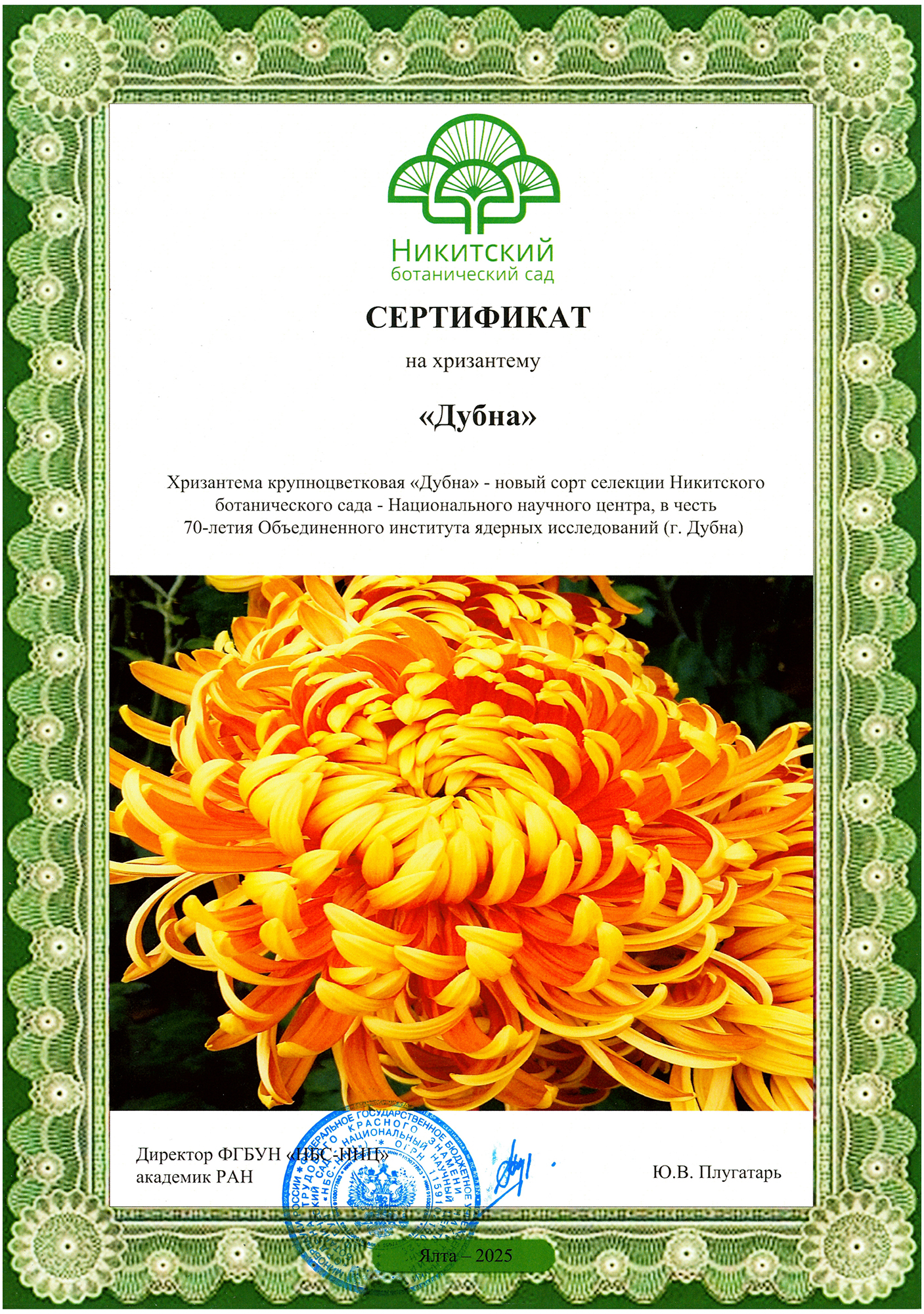 The golden orange Dubna large-flowered chrysanthemum refers to the image of the city with its rich scientific history and long-standing research traditions. Chrysanthemum is a symbol of wisdom, longevity, and vitality, and its warm colour scheme emphasises the continuity of generations and the importance of the path that Dubna and JINR have traveled over 70 years.
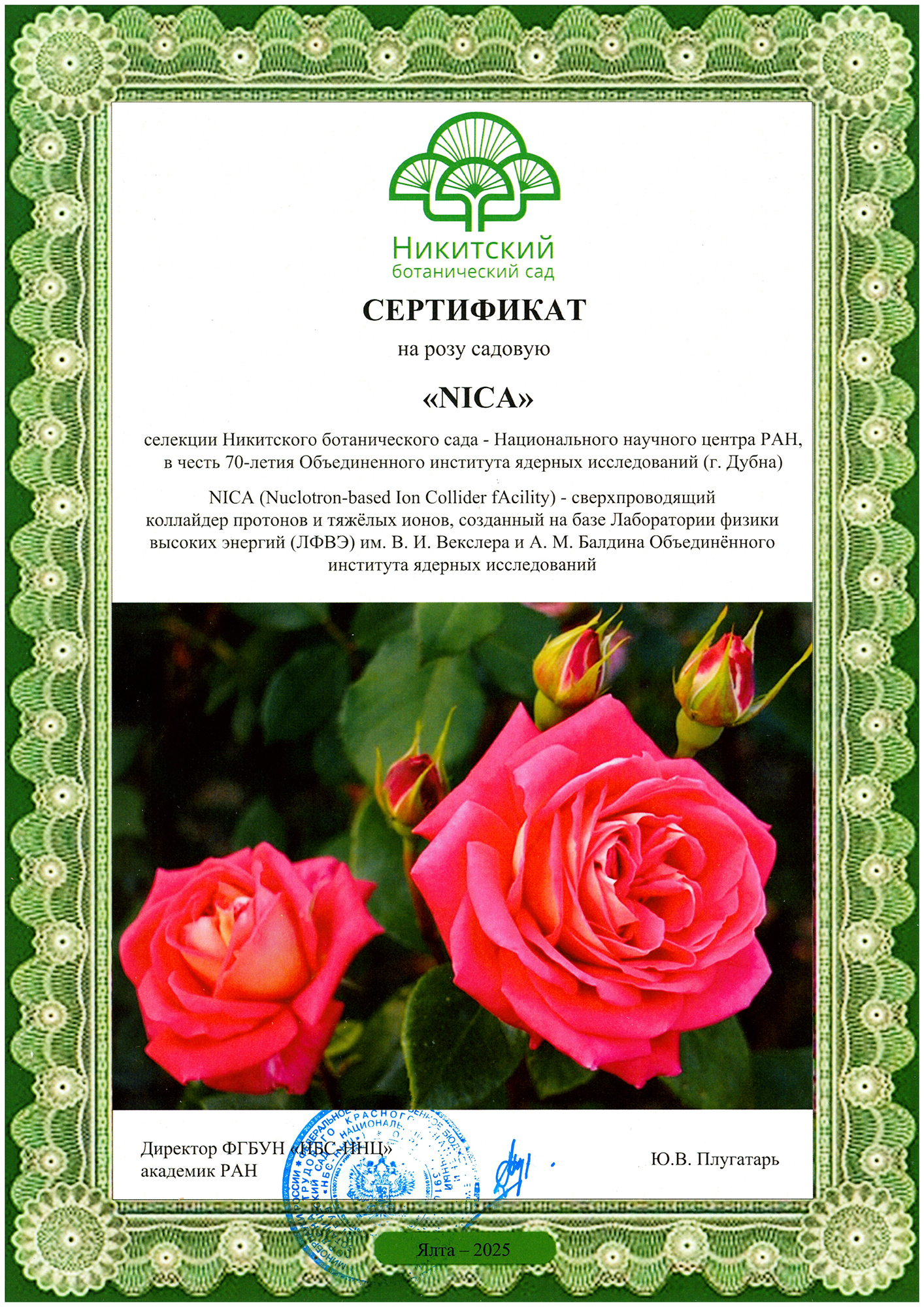 The bright and expressive rich pink crimson colour of NICA garden rose is associated with the images of experiments at the NICA Accelerator Complex: the flashes of high-energy collisions and tracks of charged particles registered by the detectors.
By introducing the names of the megascience project and the science city into the global botanical nomenclature, the breeders created a monument that is impervious to time. The creation of the new NICA and Dubna cultivars proves that large-scale scientific achievements are measured not only in teraelectronvolts, terabytes of data, or the number of publications, but also by the living beauty that research can bring into the world.
Background information
The Nikitsky Botanical Gardens – National Scientific Centre of the Russian Academy of Sciences – are one of Russia‘s oldest research institutions in botany, cultivation, and breeding, founded in 1812. The garden is a major centre for the preservation and study of the species and varietal diversity of southern fruit as well as ornamental and flowering plants.