First beam successfully injected into NICA Collider
News, 19 December 2025
The Joint Institute for Nuclear Research reached an important milestone in the implementation of the NICA (Nuclotron-based Ion Collider fAcility) Megascience Project. On 18 December 2025, a heavy xenon ion beam was injected into the collider ring for the first time. This event marks the accelerator complex entering a key phase of commissioning, which precedes the start of physical experiments.
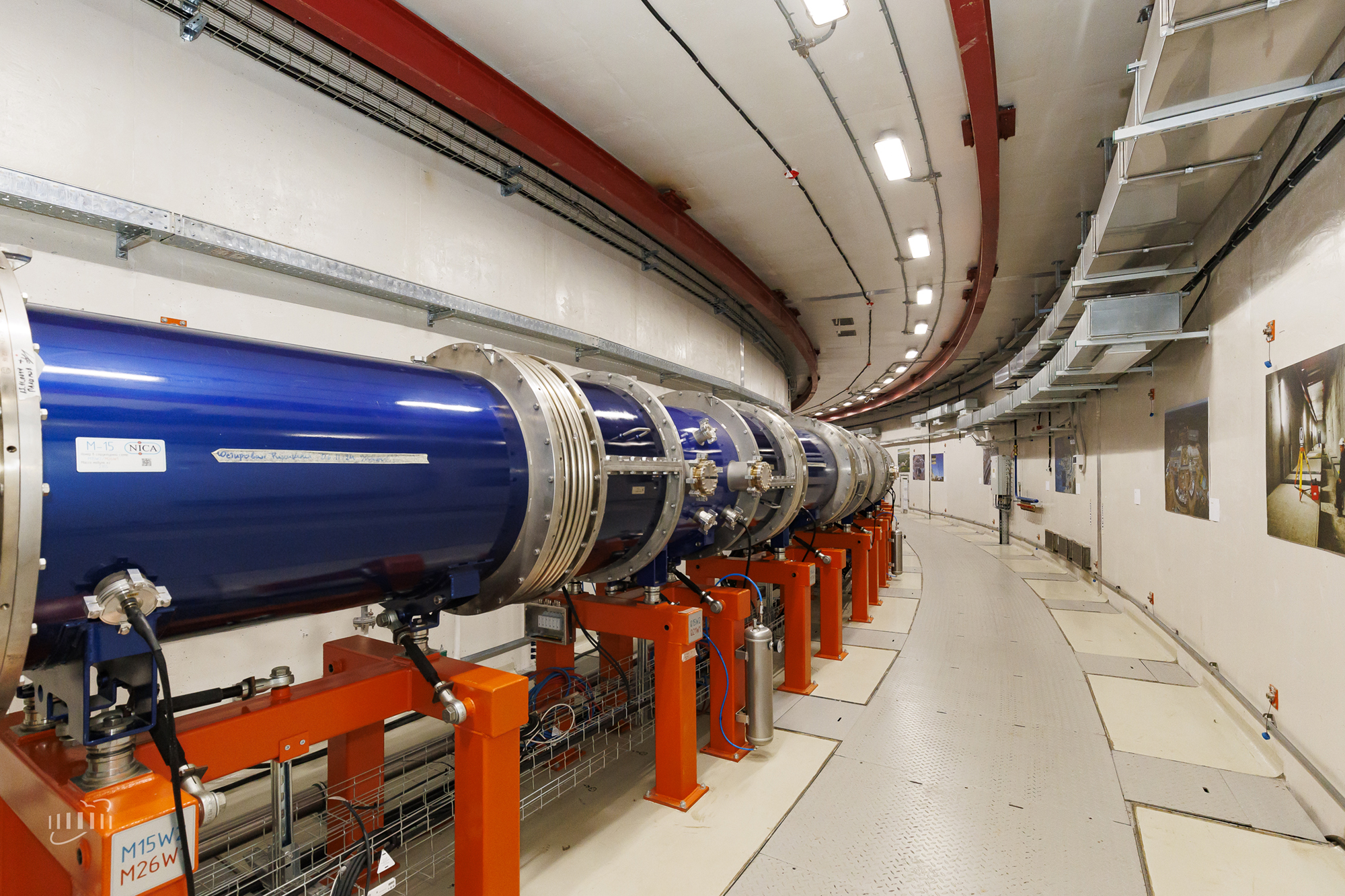
The physical start of the collider is the main task of the current run. Deputy Head for Scientific Work at the VBLHEP JINR Accelerator Department Anatoly Sidorin said that a 124Xe54+ nuclei beam, sequentially accelerated in the Booster and the Nuclotron, was directed at the northern branch of the transport channel and injected into one of the collider’s rings. The beam parameters were recorded by the first pick-up electrode station, a special position sensor.
“An important phase of work was completed at the accelerator complex. It includes the assembly, testing, and adjustment of the joint work of devices for the rapid system for beam extraction from the Nuclotron and optics of transportation channels and systems of beam injection into the collider”, Anatoly Sidorin said. “Currently, specialists are working on directing the beam to the southern branch of the channel for its injection into the second ring. We are looking ahead to get a circulating beam and fine-tune the magnetic optics of the rings”.
As the scientist added, meanwhile, in preparation for a new run of the BM@N Experiment, employees are optimising the system for slow beam extraction from the Nuclotron and adjusting the transport channel in the building 205. The next steps will be to maintain the stable circulation of the beam, accelerate it, and enter the beam-beam collision mode.
The NICA Megascience Project is being created to study the properties of dense baryonic matter. It is expected that scientists will be able to recreate a special state of matter in which the universe was in the first moments after the Big Bang in the laboratory.