On 9 February 2026, a cooperation agreement was signed between the Joint Institute for Nuclear Research and the High Energy Accelerator Research Organization (KEK, Japan) in Dubna. The parties agreed to enhance academic exchange, jointly participate in new international projects, and advance the development of accelerator technologies.


During the visit, the delegation, led by KEK Director General Shoji Asai, got acquainted with the flagship projects of the Institute. Representatives of the Japanese centre visited the site of the NICA Accelerator Complex at the Laboratory of High Energy Physics. At the Laboratory of Nuclear Problems, they learned about JINR’s neutrino programme and the operation of the Baikal-GVD Neutrino Telescope.
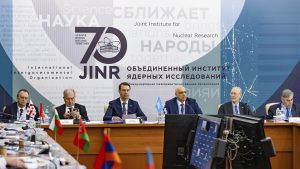
At a meeting with the Joint Institute’s leadership, Shoji Asai presented KEK’s extensive scientific programme, highlighting the unique capabilities of the SuperKEKB and J-PARC Research Facilities. In addition, he elaborated on flagship projects, describing the next-generation Hyper-Kamiokande Neutrino Experiment and the plans to construct its advanced intermediate detector, IWCD.
“JINR is already a key participant in experiments such as COMET and T2K, which aim to search for physics beyond the Standard Model, and we are glad to invite our colleagues from Dubna to collaborate more closely on the Hyper-K Experiment and other projects,” Shoji Asai said to the Joint Institute’s representatives. “Your expertise will be extremely valuable in creating the IWCD Cherenkov Detector, which will enable us to study one of the most crucial topics — CP violation in the neutrino sector. I am confident that combining our efforts is the key to success”.
The JINR representatives confirmed their deep interest in expanding their participation in KEK’s neutrino programme and noted the highly complementary nature of the two organizations’ research programmes. In particular, it was emphasised that experiments at the J-PARC Accelerator Complex are largely complementary to the research conducted at the NICA Complex.
“Our institutes share decades of friendship and scientific collaboration, which have always provided a solid foundation for our joint work,” JINR Director Grigory Trubnikov noted. “The new agreement will allow us to take our partnership to the next level. We look forward with great enthusiasm to the prospects of participating in joint projects”.
The signed document sets out the general framework for the cooperation, highlighting its exclusively peaceful nature. The agreement aims to promote academic mobility and joint studies in experimental and theoretical particle physics, as well as in accelerator physics and technology.
As a result of the meeting, the parties agreed that JINR’s scientific groups will prepare specific proposals in the near future regarding the modalities of their participation in the KEK projects. This will mark the first practical step in bilateral cooperation.