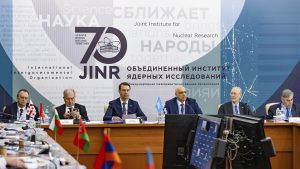
On 26 November 2025, the Veksler and Baldin Laboratory of High Energy Physics hosted a workshop on future experiments with polarised beams at the NICA Accelerator Complex. Among participants were specialists from the Joint Institute for Nuclear Research, the Moscow Institute of Physics and Technology (MIPT), the Institute for Nuclear Research of the Russian Academy of Sciences (INR RAS), the Landau Institute for Theoretical Physics of the Russian Academy of Sciences (ITP RAS), and the Zaryad Science and Technique Laboratory.


This meeting was the second event aimed at discussing the polarisation research programme at NICA. The first one took place on 12 November 2025 and was devoted to the problem of polarimetry of nucleon and deuteron beams for future studies at NICA. The materials can be found on the Indico page. The next events are scheduled for February–March 2026.
Deputy Head of the VBLHEP JINR Accelerator Department Valery Lebedev gave the first scientific talk. He provided an update on the key systems of the NICA Injection Complex and discussed the preparation of the megascience project for the implementation of the research programme, including experiments with heavy ion and polarised high energy particle beams.
Head of the Division of Physics at the Nuclotron-NICA Accelerator Complex Vladimir Ladygin made a presentation on a new project, the Spin Physics Research INfrastructure and Technologies at NICA (SPRINT@NICA). “Our collaboration’s key objective is to create and develop the research infrastructure, along with working on the technologies necessary for conducting spin experiments at the Nuclotron-NICA Complex,” Vladimir Ladygin explained.
The SPRINT@NICA working group includes almost 40 researchers representing JINR, MIPT, INR RAS, the RAS Landau Institute of Theoretical Physics (ITP), and the Research Institute for Nuclear Problems of the Belarusian State University (INP BSU).
Currently, the spin programme at the Nuclotron-NICA Complex includes three main experiments:
- DSS (Nuclotron internal target experiment): requires a beam intensity of ~5·109 for a polyethylene target and ~5·10-10 for nuclear targets, with a 70-75 % polarisation of protons and deuterons;
- ALPOM-2 (extracted beam experiment): uses a vector polarised deuteron beam, requires high intensity (~5·10-11) as well in order to generate secondary neutron and proton beams;
- SPD (collider experiment): imposes broader requirements, including the need for collisions of longitudinally and transversely polarised particles at energies up to √s pp = 27 GeV with a luminosity of around 10+32 cm-2·s-1 and at least 70 % polarisation.
As Vladimir Ladygin emphasised, in order to meet these key requirements, it is necessary to increase the intensity and degree of beam polarisation and develop spin control technologies, particularly in order to achieve a spin transparency mode at the Nuclotron.
Head of the MIPT Accelerator Physics Laboratory Yuri Filatov discussed the characteristics and capabilities of the spin transparency mode (ST mode) for conducting experiments with polarised beams at NICA. This mode, the key feature of which is the use of solenoid Siberian snakes and spin navigators, will allow accelerating beams without polarisation loss, while controlling its direction and conducting high-precision measurements. The scientist proposed methods for experimentally testing the ST mode at the Nuclotron and explained the advantages of an 8-formed fast-cycling injector capable of delivering polarised beams not only to the NICA Collider, but also to other independent experiments. “The technologies under development at JINR will make the NICA Accelerator Complex a unique platform for conducting high-precision experiments with polarised beams,” Yuri Filatov concluded.
A VBLHEP engineer Evgeny Tsyplakov shared more details about the use of special polarisation control devices – Siberian snakes. A research intern at the RAS Institute for Nuclear Research Sergey Kolokolchikov introduced the meeting participants to the features of the Synchrotron’s dual magneto-optical structure for heavy and light polarised particles. An INR RAS leading researcher Yuri Senichev presented the development of a specialised magneto-optical accelerator structure based on the “frozen spin” concept for searching for the electric dipole moment of protons and deuterons.
The workshop’s programme consisted of 11 talks. The organizers noted the active participation of young specialists from MIPT, JINR, and INR: Alexander Aksentiev, Patricia Palamarchuk, Sergey Kolokolchikov, Alexey Melnikov, and Evgeny Tsyplakov. The materials of all presentations are available on the event’s Indico page.