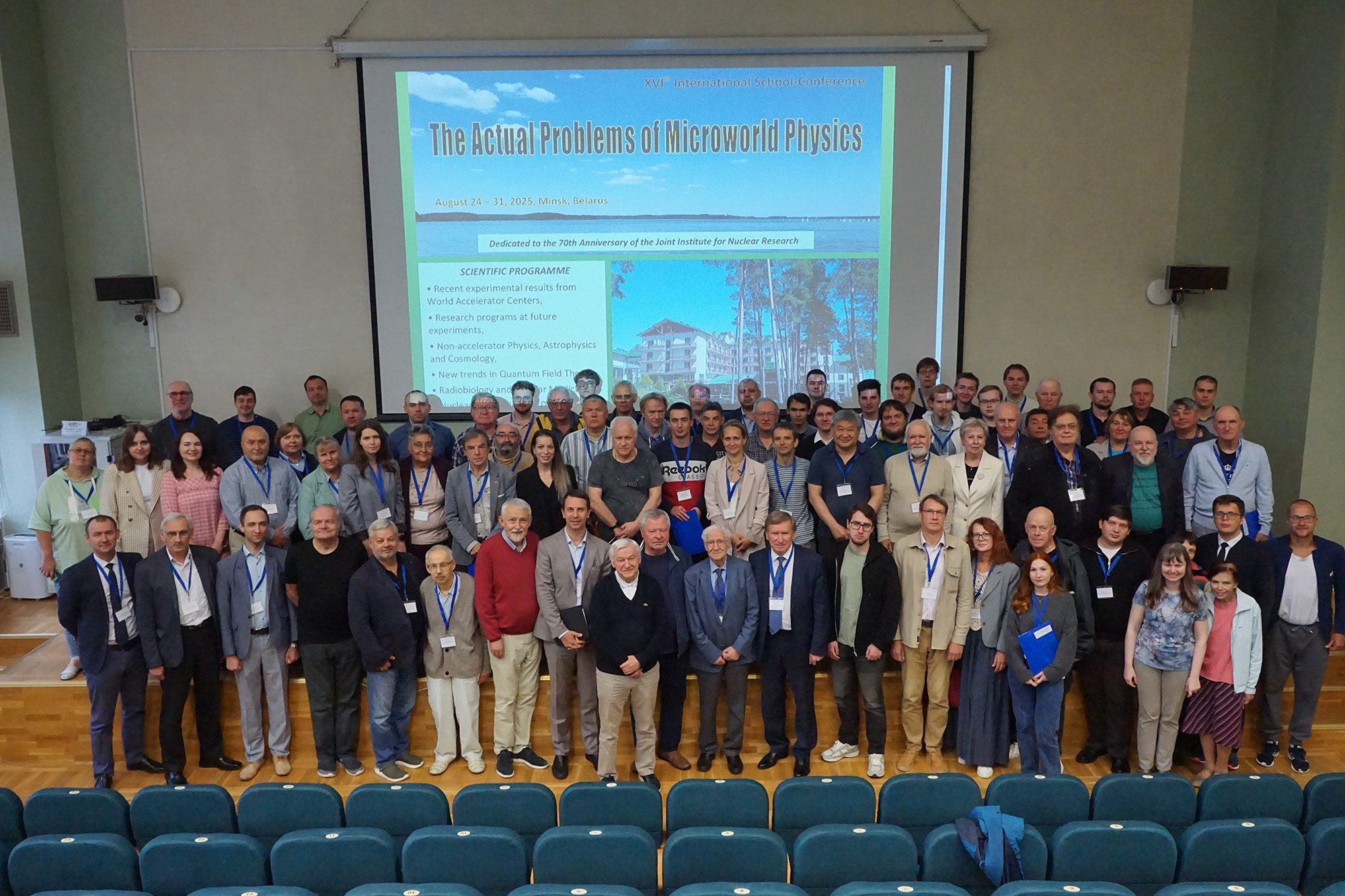
The Actual Problems of Microworld Physics international school and conference taking place in Minsk
News, 27 August 2025
The 16th international school and conference entitled “The Actual Problems of Microworld Physics” is taking place in Minsk from 25 to 31 August 2025. The event is organized by the Joint Institute for Nuclear Research, the Institute for Nuclear Problems of Belarusian State University, and the Stepanov Institute of Physics of the National Academy of Sciences of Belarus (NASB). The school’s goals are the exchange of ideas and scientific results, along with the involvement of students and postgraduates in work on key areas of research. The 16th international school and conference was dedicated to the 70th anniversary of the founding of the Joint Institute for Nuclear Research.
At the opening ceremony, Plenipotentiary Representative of the Republic of Belarus, Chair of the State Committee on Science and Technology of the Republic of Belarus Sergey Shlychkov, Advisor to the DLNP JINR Directorate Nikolai Russakovich, First Vice-Rector of the Belarusian State University (BSU) Dmitry Kurlovich, and Director of the BSU Institute for Nuclear Problems Sergey Maksimenko addressed the audience with a welcome speech. Sergey Shlychkov noted that the conference would be interesting for both scientists conducting basic research and manufacturers of specialised equipment for NICA and other scientific projects. VBLHEP JINR Chief Researcher Richard Lednicky expressed confidence that the event continued to help young researchers find their way in science.
On 26 August, Director of the Joint Institute Grigory Trubnikov opened a plenary session of the event with a lecture entitled “Future experiments in high energy physics”. Afterwards, FLNR JINR Deputy Scientific Leader Mikhail Itkis delivered a talk entitled “Superheavy elements: present and future”. The JINR conference was attended by VBLHEP JINR Chief Researcher Richard Lednicky, who commented on the progress and plans of the BM@N Experiment at the NICA Accelerator Complex, Head of a VBLHEP sector Oleg Rogachevsky, who told the audience about the physics programme of the MPD Experiment, and Head of the ARIADNA Collaboration at NICA Oleg Belov, who spoke about the capabilities of the accelerator complex in applied fields. LRB Director Aleksander Bugay, MLIT Scientific Leader Vladimir Korenkov, MLIT Deputy Director for Scientific Work Nikolay Voytishin, and other employees of the Institute’s laboratories were present at the event.
The programme of the school and conference covers a wide range of areas of modern physics: the latest experimental results of the world’s accelerator centres, research projects for future experiments in high energy physics, non-accelerating physics, astrophysics, and cosmology, and new approaches in quantum field theory. There are sections dedicated to radiobiology and nuclear medicine, nuclear electronics and detectors, current trends in materials science, data processing, and facility design.
This event is a leading platform in Belarus for discussing the modern issues of elementary particle physics, theoretical physics, and latest nuclear physics technologies. The first school and conference on the modern problems of microworld physics took place in Belarus in 1971. The main organizer of the first three schools (1971-1977) from the Belarusian side was Academician Fedor Fedorov, a pivotal figure in the development of theoretical physics in Belarus. At that time, the Advisory Committee of the school was headed by Academician Nikolay Bogoliubov, and Professor Nikolay Shumeyko played a key role in reviving the tradition of holding schools (1997-2015).
Starting in 2018, the tradition has been upheld by the new Programme Committee led by Professor Sergey Maksimenko. The number of lecturers has significantly increased due to the active involvement of leading researchers from other countries, and new scientific areas relevant to Belarus were included in the school’s programme. The events are of great importance for the education of scientific youth, the exchange of expertise and creative ideas of Belarusian scientists of different ages with colleagues from other countries, networking, and the achievement of cooperation agreements. Today, the traditions of the event are preserved and the school stays important for the international scientific community.
About one hundred specialists from different countries are taking part in the school and conference. The working languages are English and Russian.